Share this tool:
 |
Description:
AICheatCheck is an AI-content detection tool built around a simple question: does this text look like it was written by a human, or does it show signs of AI generation? The tool is aimed mainly at educators, so the real value is not just the score. It is how well the tool fits into a fair academic review process.
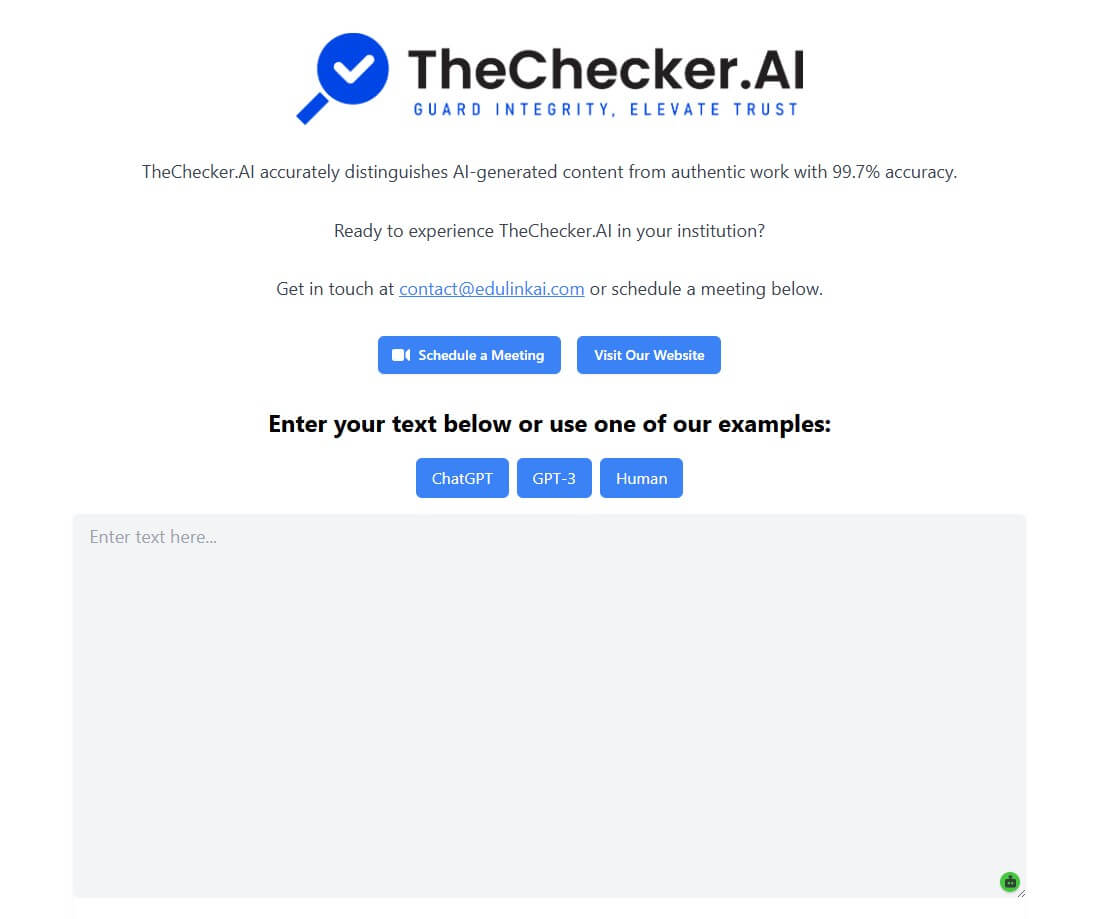
AICheatCheck focuses on one job: separating likely AI-generated writing from likely human writing. The official public page currently presents the product under TheChecker.AI and claims it can distinguish AI-generated content from authentic work with 99.7% accuracy.
The current public-facing access appears under TheChecker.AI branding. The AICheatCheck demo page says TheChecker.AI distinguishes AI-generated content from authentic work with 99.7% accuracy and provides a text box with examples for ChatGPT, GPT-3, and human writing. The broader TheChecker.AI site describes the detector as a tool for AI-generated writing from systems such as Claude, GPT, and Gemini, and says it analyzes writing patterns at sentence level using signals such as perplexity and burstiness.
That makes the tool narrow, but useful. It is not a writing assistant, grammar checker, plagiarism checker, or grading platform. It is a detection layer.
The public technical paper behind AICheatCheck says the team introduced a transformer-based model to predict whether a GPT model, including ChatGPT at the time, wrote a given sentence or text. It reported 99.7% accuracy on a mix of human and AI-written content.
The paper also says the training data combined ChatGPT, GPT-3, and human-written samples. It used about 50,000 human-versus-GPT text examples across domains and education levels, with outputs matched to levels from middle school through Ph.D. writing.
Here is the practical version:
| Area | What It Means |
|---|---|
| Main job | Flags text that appears AI-generated |
| Primary user | Teachers, professors, schools, academic integrity teams |
| Core method | Pattern-based text classification |
| Original model focus | GPT-generated versus human-written text |
| Best role | Screening tool, not final proof |
This is the key distinction: AICheatCheck does not prove who wrote a paper. It estimates whether the text resembles patterns found in AI-generated writing.
The workflow is direct. A user enters text, runs the check, and reviews the result. There are no prompts to engineer and no complex setup shown in the public demo. That makes it accessible for educators who need a fast read on a suspicious passage, short essay, or assignment response.
The simplicity is useful, but it also limits what the tool can do. AICheatCheck does not appear, from public information, to offer a full academic integrity workspace with deep case management, draft comparison, source tracking, or student process review. It is best treated as a first-pass detector.
That first pass can still help. A score may tell an instructor that a submission deserves a closer look. It can also help departments test how AI detection behaves across assignment types before building classroom policy around it.
AICheatCheck’s technical paper reports strong validation results: 99.73% accuracy, 99.90% precision, 99.61% recall, 0.188% false negative rate, and 0.046% false positive rate. The paper also says the model achieved 99.7% accuracy after repeated experiments, with a false positive rate of about 1 in 2200.
Those numbers are useful, but they need context. Controlled validation does not always match real classroom use. Student writing varies by age, subject, language background, disability, writing support, assignment format, and editing history. AI models have also changed since the early GPT-3 and ChatGPT period covered in the original paper.
The paper itself includes a caution. It notes ethical concerns about relying only on detectors because a false classification can affect an individual, and it says more research and additional methods are needed to confirm authenticity. MIT Sloan’s teaching guidance makes the same point more strongly, warning that AI detection tools are not foolproof and can lead instructors to falsely accuse students.
So the fairest use is as a signal, not a verdict.
AICheatCheck is strongest when educators need a quick first pass on a piece of writing. It can help flag submissions that deserve a conversation, a process check, or a closer review of drafts and sources.
It is also useful for policy testing. Schools can run sample assignments through the tool to understand how detection behaves before using it in real cases. That is important because every subject has different writing norms. A lab report, a history essay, and a business reflection do not read the same.
Another good use is student education. Showing students how detectors work, and where they can be wrong, may lead to better conversations about responsible AI use than surprise enforcement after submission.
The main limitation is proof. AICheatCheck can indicate likelihood, but it cannot know intent. It cannot tell whether a student used AI to brainstorm, outline, translate, edit grammar, rewrite a paragraph, or generate the entire answer.
It may also be less reliable on edge cases: short passages, highly formal writing, translated text, formulaic academic language, or heavily edited AI drafts. Public third-party directories also describe AICheatCheck as focused on English text and most accurate on text above 50 words, which is a useful caution when reviewing short answers.
There is also a product maturity question. Current public information is limited, and the official page is more of a demo-facing entry point than a detailed product hub. Users looking for rich reporting, LMS controls, bulk uploads, audit trails, or institution-wide policy tools should verify those capabilities directly before depending on it.
AICheatCheck works best for teachers reviewing essays, instructors checking suspicious assignment sections, departments testing AI-use policies, and academic integrity teams that need a fast screening layer.
It is less suited for making automatic misconduct decisions. The best workflow is to pair it with other evidence: student drafts, version history, citations, oral follow-up, assignment process notes, and a clear course policy.
AICheatCheck is best at giving educators a fast read on whether submitted text appears AI-generated.
Its published model paper reports strong validation results, and the current TheChecker.AI access keeps the workflow simple.
The main caveat is fairness. A detection score can support review, but it should not replace human judgment, student dialogue, or evidence from the writing process.
TAGS: AI Detection
Related Tools:
Identifies wether images are AI-generated
Detects plagiarism and identifies AI-generated text

Verifies authenticity of online content
Detects GPT-generated content

Verifies authenticity of audio files

Compares photos to celebrity look-alike