

Share this tool:
 |
Description:
AI Voice Detector is a focused audio verification tool. Its job is not to create voices, edit recordings, or clean up speech. It helps users check whether a voice clip appears to be human-recorded or AI-generated. That makes it useful for scams, misinformation, journalism, legal review, call-center screening, and any situation where a convincing synthetic voice could create risk.
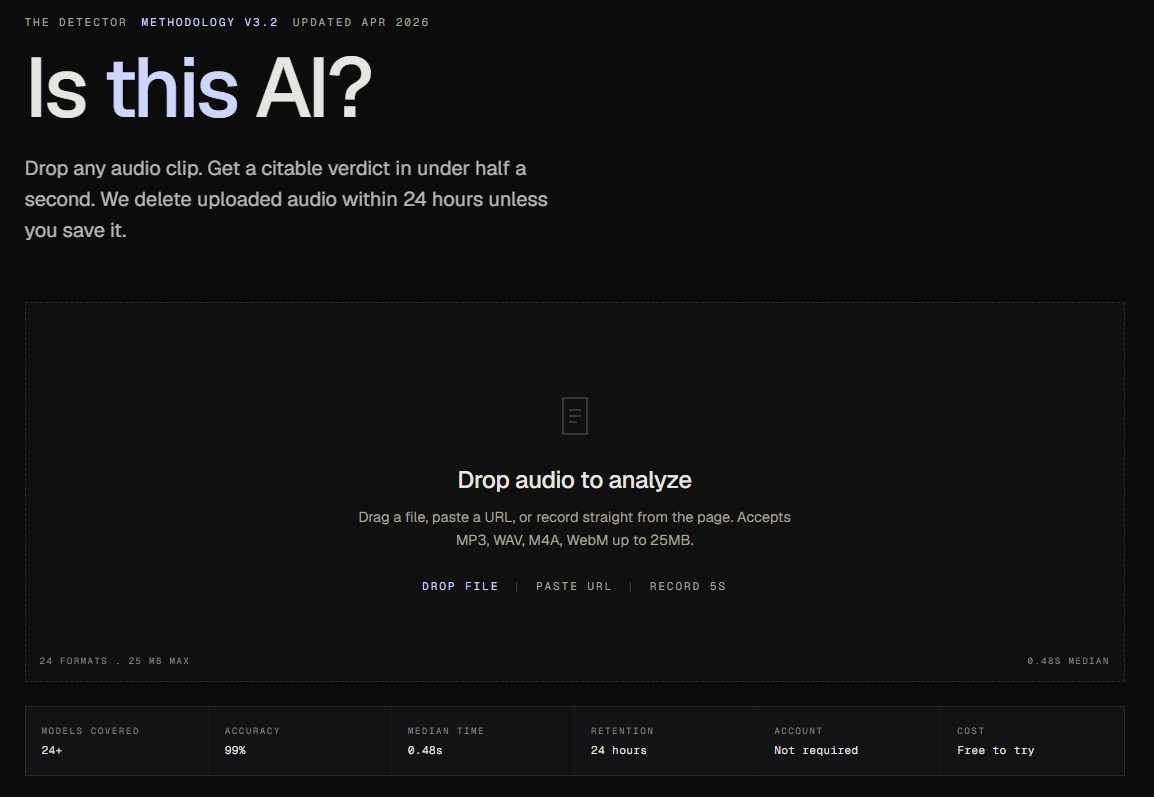
AI Voice Detector analyzes an audio clip and returns a probability-based result. The official detector page describes the output as “a probability, not a label,” which is the right framing for this category. A high score suggests the clip likely came from a synthesis system, while a score near 50% means the tool cannot tell with confidence.
The web checker accepts uploaded audio, pasted URLs, or direct browser recording. Public details list MP3, WAV, M4A, and WebM support, a 25MB file limit, and a reported 0.48-second median verdict time.
The tool also tries to identify the likely voice generator when it recognizes one. Its public pages mention model attribution for systems such as ElevenLabs, Resemble, PlayHT, and OpenAI. When it cannot identify the exact source, the tool says “unknown synthesis” rather than forcing a guess.
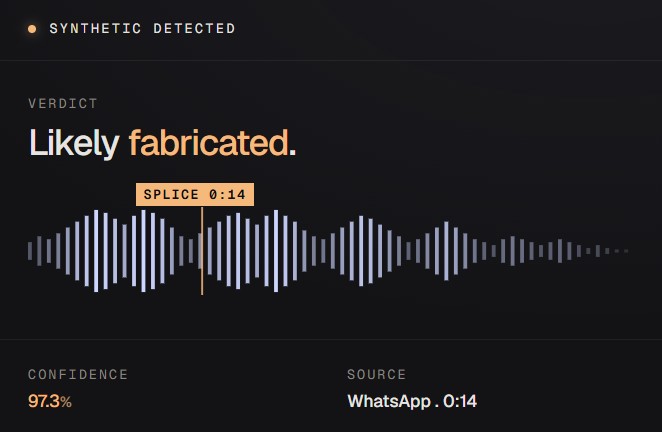
Synthetic voices are getting harder to judge by ear. That is not just a technical problem. It affects fraud, politics, business, media, and personal safety. A fake voice message from a manager could push someone toward a wire transfer. A fake political clip could spread before anyone verifies the source. A cloned family member’s voice could be used in a scam.
Research supports the need for better verification. One study from Sarah Barrington, Emily A. Cooper, and Hany Farid found that people could not consistently identify AI-generated voices, with participants correctly identifying AI voices only about 60% of the time. Another 2026 study on vishing-style audio found participants performed poorly when judging synthetic versus human voices, with mean accuracy below chance in that test setting.
That does not mean detectors are perfect. It means listening alone is a weak defense.
| Feature | What It Means in Practice |
|---|---|
| Web audio checker | Upload, paste a URL, or record from the browser |
| Probability score | Shows likelihood instead of a flat yes-or-no result |
| Confidence signal | Helps users judge how much weight to give the result |
| Model attribution | Names a likely generator when the system recognizes it |
| Citable verdicts | Creates permanent verdict links for review or documentation |
| API access | Lets teams add detection to internal workflows |
| Chrome extension | Checks supported web audio from the browser |
The citable verdict feature is one of the more practical parts of the product. The main site says verdicts can include a permanent URL and an APA-style citation, which is useful for newsrooms, investigators, compliance teams, and anyone who needs a record of what was checked.
The web workflow is straightforward: submit audio, wait for analysis, read the result. That makes the tool approachable for non-technical users. There are no prompts to write and no settings that casual users need to understand before running a check.
The Chrome extension adds a faster browser-based option. Its official page says it works on WhatsApp Web, YouTube, podcasts, and HTML5 audio. The extension opens verdicts in a side panel and only listens when the user right-clicks an audio element for analysis.
For businesses and developers, the API is the more important layer. The API page describes a single REST endpoint where users can send an audio clip or public URL and receive JSON output with a verdict, probability, confidence level, recognized model, methodology version, processing time, fingerprint, and citation URL.
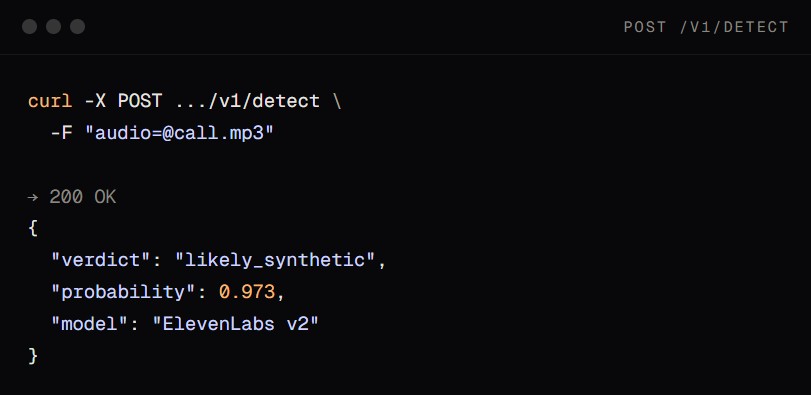
That makes AI Voice Detector more than a one-off web utility. It can fit into call-center workflows, fraud queues, newsroom review systems, or compliance tools that need structured audio checks.
AI Voice Detector is strongest when the clip is clear and the user needs a fast authenticity signal. It is a good fit for checking suspicious voicemails, reviewing audio before publication, screening possible CEO-impersonation calls, and verifying clips circulating online.
It is also useful because it does not pretend every result is certain. The API documentation says probabilities near 50% usually mean the system cannot tell, often because the clip is short or heavily compressed. That kind of uncertainty is important. A detector that admits weak evidence is more useful than one that always gives a confident-looking answer.
Audio privacy matters because voice clips can include names, private conversations, business details, or legal material. AI Voice Detector’s terms say users retain rights to uploaded audio, the service processes audio only to return a verdict, and uploaded audio is deleted within 24 hours unless saved to a dossier. Saved verdicts keep a one-way fingerprint rather than the audio file itself, and uploaded audio is not used for training unless the user opts in.
That is a sensible policy for this type of tool, but users handling sensitive files should still review the terms directly before uploading confidential material.
The main limitation is that detection is probabilistic. AI Voice Detector’s own terms say verdicts are not definitive and that the service does not guarantee any specific outcome.
Audio quality also matters. Compression, background noise, music, overlapping voices, short clips, phone-line distortion, pitch effects, and re-uploaded files can make results less reliable. In mixed cases, the answer can get even harder. A recording may contain a real voice cleaned with AI tools, a human speaker edited with synthetic patches, or an AI voice passed through filters to hide its origin.
That is why the best use is layered verification. A detector result should be combined with source checks, original file review, metadata when available, second-channel confirmation, and human judgment.
AI Voice Detector works best for journalists checking viral audio, investigators reviewing suspicious recordings, fraud teams screening voice-clone attempts, call centers flagging high-risk calls, and individuals checking strange voice messages.
It is less suited for automatic decisions without review. If the result could affect someone’s reputation, employment, legal case, or safety, it should be treated as one piece of evidence, not the whole case.
AI Voice Detector is best at turning suspicious speech into a fast, reviewable authenticity signal.
Its strengths are speed, probability-based scoring, model attribution, citable verdicts, browser access, API support, and practical audio retention rules.
The main caveat is that voice detection is not proof. Use it to guide a smarter review, not to replace context, clean source audio, and human judgment.
TAGS: AI Detection
Related Tools:
Verifies authenticity of audio files

Distinguish human-written and AI-generated texts

Compares photos to celebrity look-alike

Identifies wether images are AI-generated
Detects plagiarism and identifies AI-generated text
Detects GPT-generated content