

Share this tool:
 |
Description:
Originality.ai is a content integrity platform built for people who need to review writing before they trust it. Its main draw is AI detection, but the platform is broader than that. It also checks plagiarism, readability, grammar, factual claims, and document history, which makes it more useful for editorial teams than a basic “AI or human” checker.
Originality.ai helps users inspect text from several angles. You can use it to estimate whether writing is AI-generated, check whether it overlaps with existing web content, review readability, flag grammar issues, and look at claims that may need verification. The homepage positions it as an AI detector and plagiarism checker with shareable reports, paraphrase detection, and checks for more complex plagiarism patterns.
That combination matters. A publisher rarely has only one concern. A draft can be human-written but copied. It can be original but hard to read. It can pass an AI detector but still contain weak sourcing. Originality.ai is strongest when used as a review layer across the whole content process, not as a single-score judgment tool.
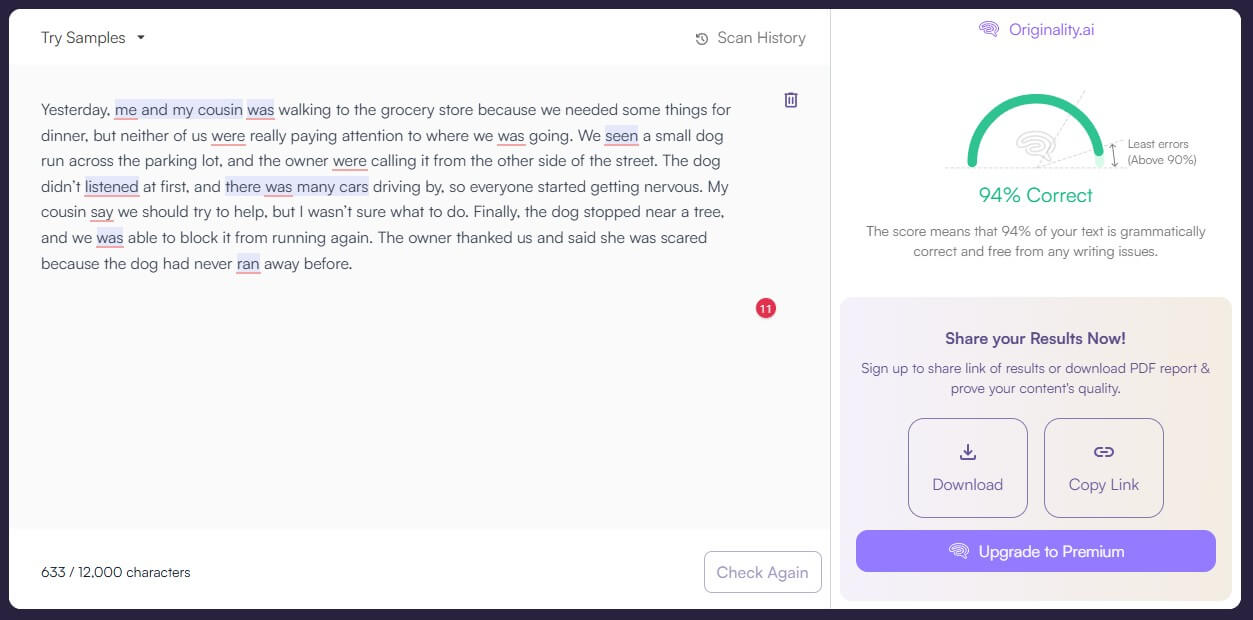
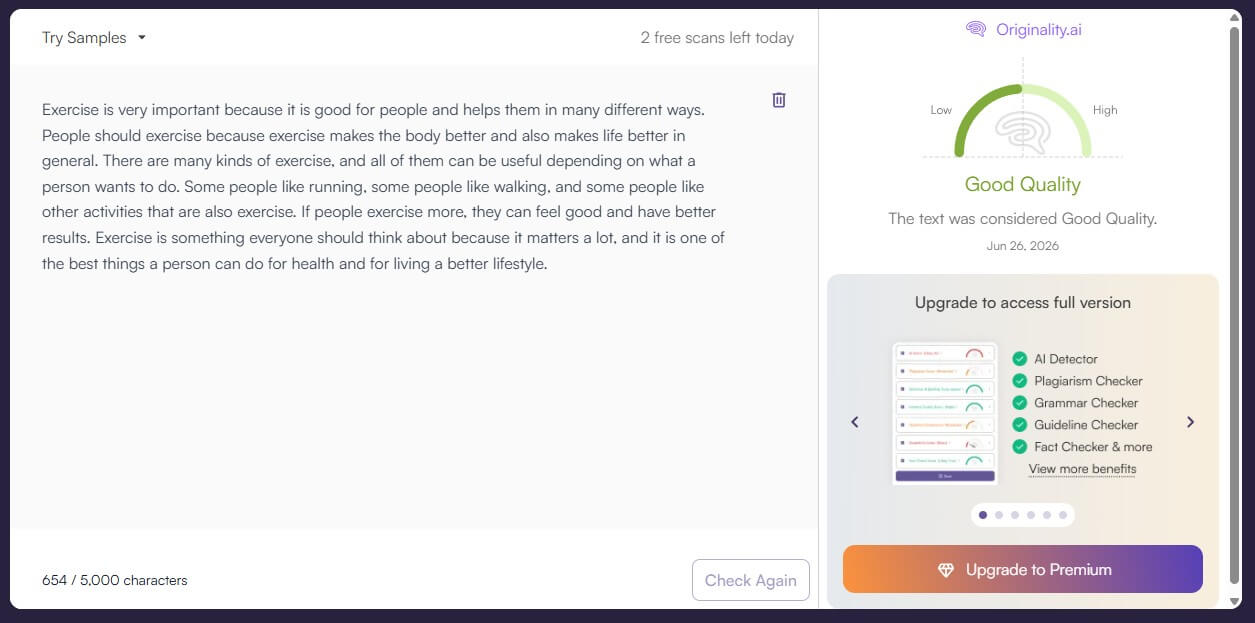
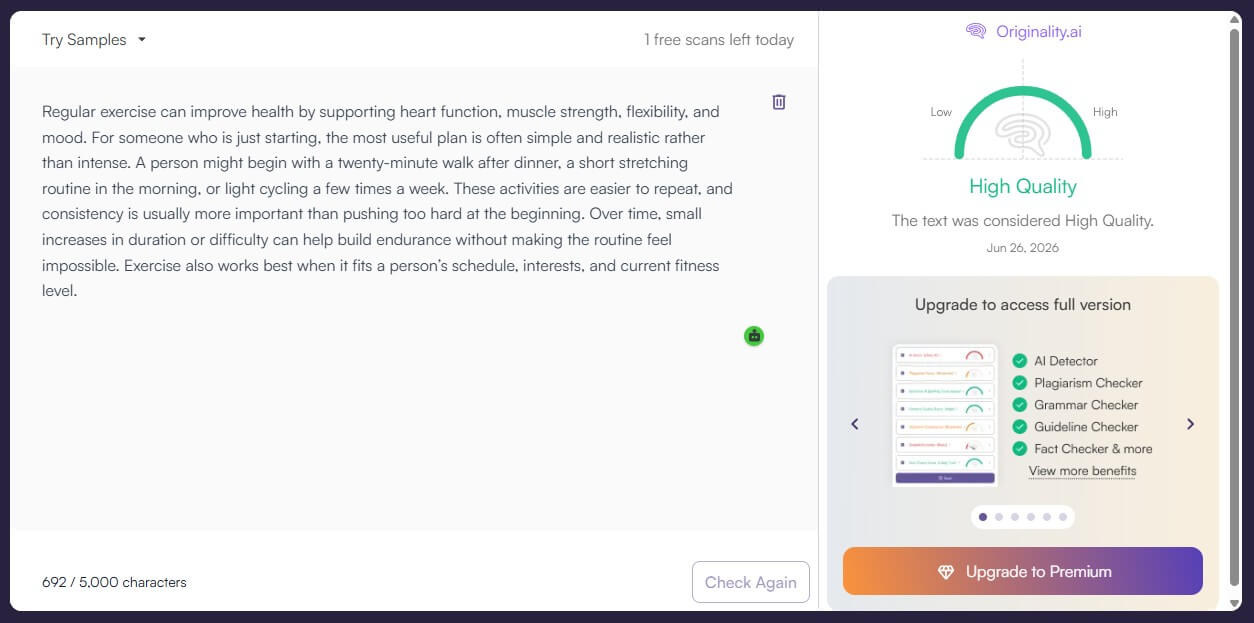
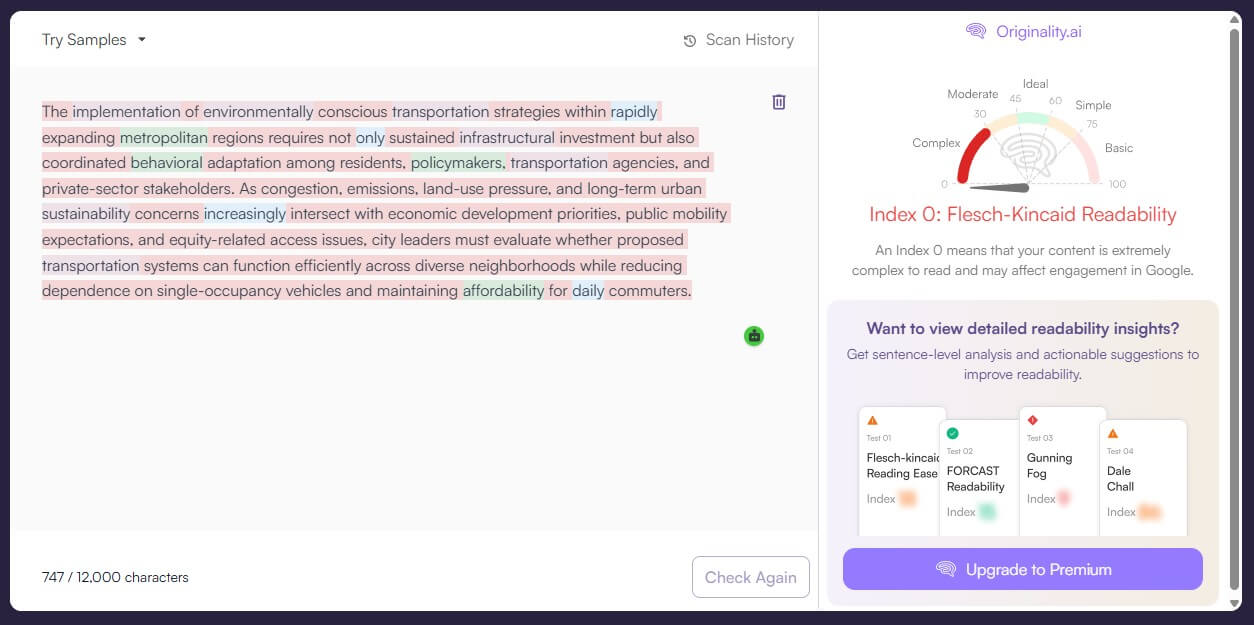
These samples are designed to test Originality.ai across AI detection, plagiarism, grammar, content quality, readability, and factual-claim review.
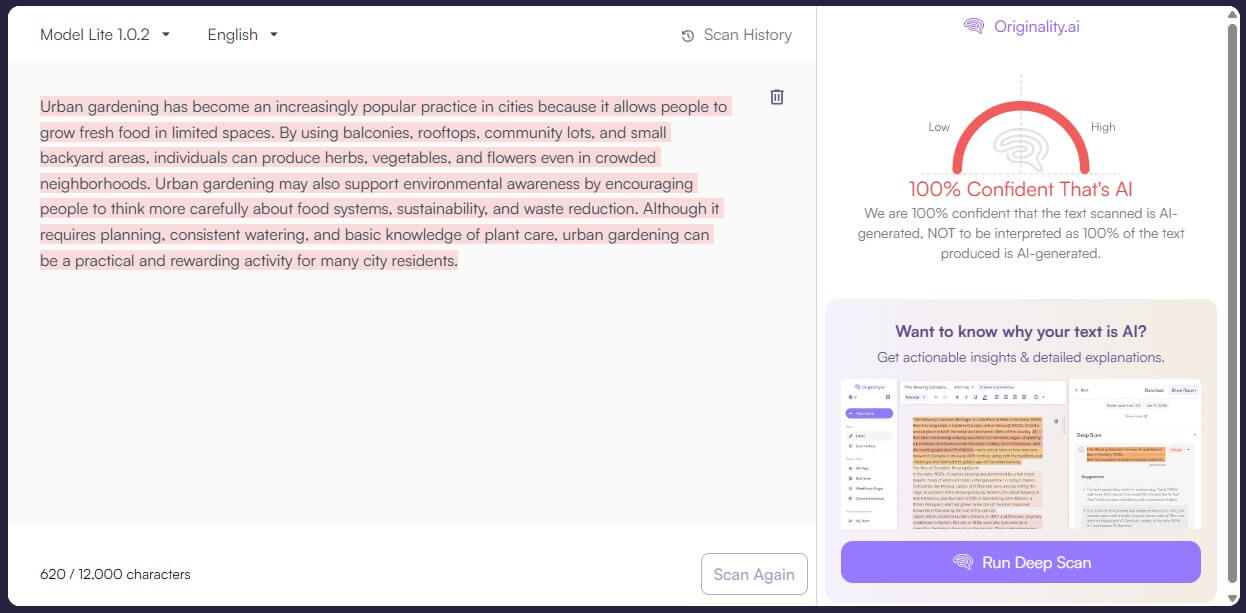
Urban gardening has become an increasingly popular activity in many cities because it gives residents a practical way to grow food in small spaces. People use balconies, rooftops, community plots, window boxes, and shared courtyards to plant herbs, vegetables, and flowers. This practice can help people feel more connected to what they eat, while also encouraging awareness of food waste, seasonal produce, and environmental responsibility. Urban gardens may also improve neighborhoods by creating green spaces where people can meet, learn, and cooperate. Although urban gardening requires planning, patience, regular watering, and basic knowledge of plant care, it can be a valuable habit for people who want fresh food and a stronger connection to their local environment.
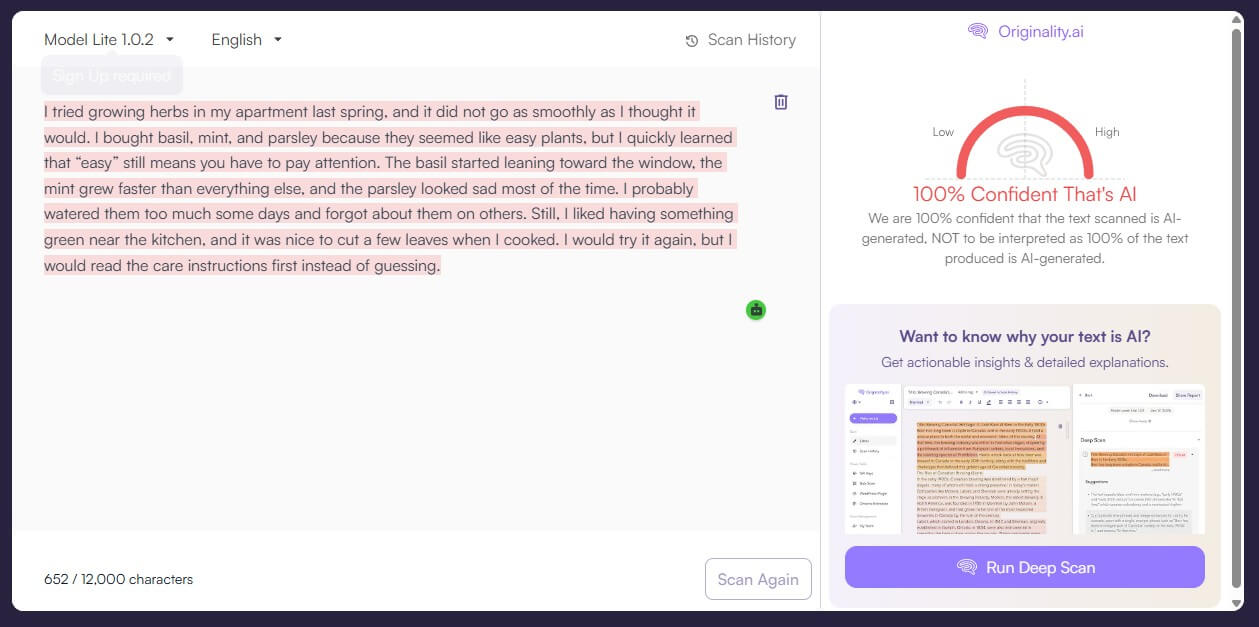
I tried growing herbs in my apartment last spring, and it did not go as smoothly as I thought it would. I bought basil, mint, and parsley because they seemed like easy plants, but I quickly learned that “easy” still means you have to pay attention. The basil started leaning toward the window, the mint grew faster than everything else, and the parsley looked sad most of the time. I probably watered them too much some days and forgot about them on others. Still, I liked having something green near the kitchen, and it was nice to cut a few leaves when I cooked. I would try it again, but I would read the care instructions first instead of guessing.
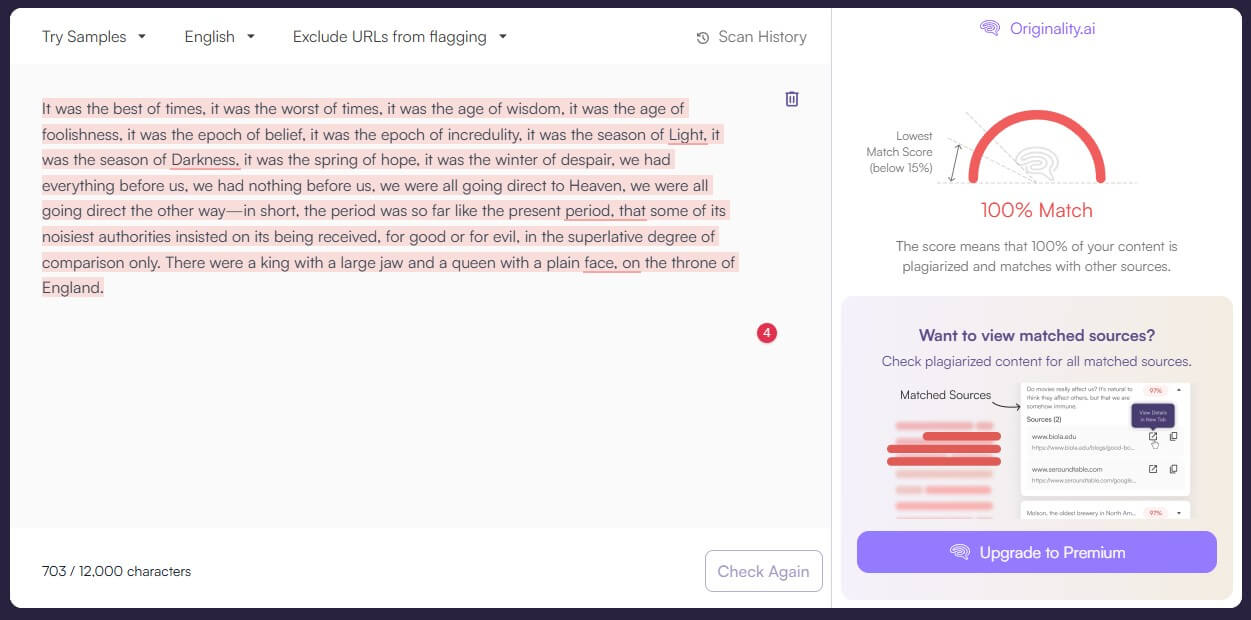
It was the best of times, it was the worst of times, it was the age of wisdom, it was the age of foolishness, it was the epoch of belief, it was the epoch of incredulity, it was the season of Light, it was the season of Darkness, it was the spring of hope, it was the winter of despair, we had everything before us, we had nothing before us, we were all going direct to Heaven, we were all going direct the other way—in short, the period was so far like the present period, that some of its noisiest authorities insisted on its being received, for good or for evil, in the superlative degree of comparison only. There were a king with a large jaw and a queen with a plain face, on the throne of England.
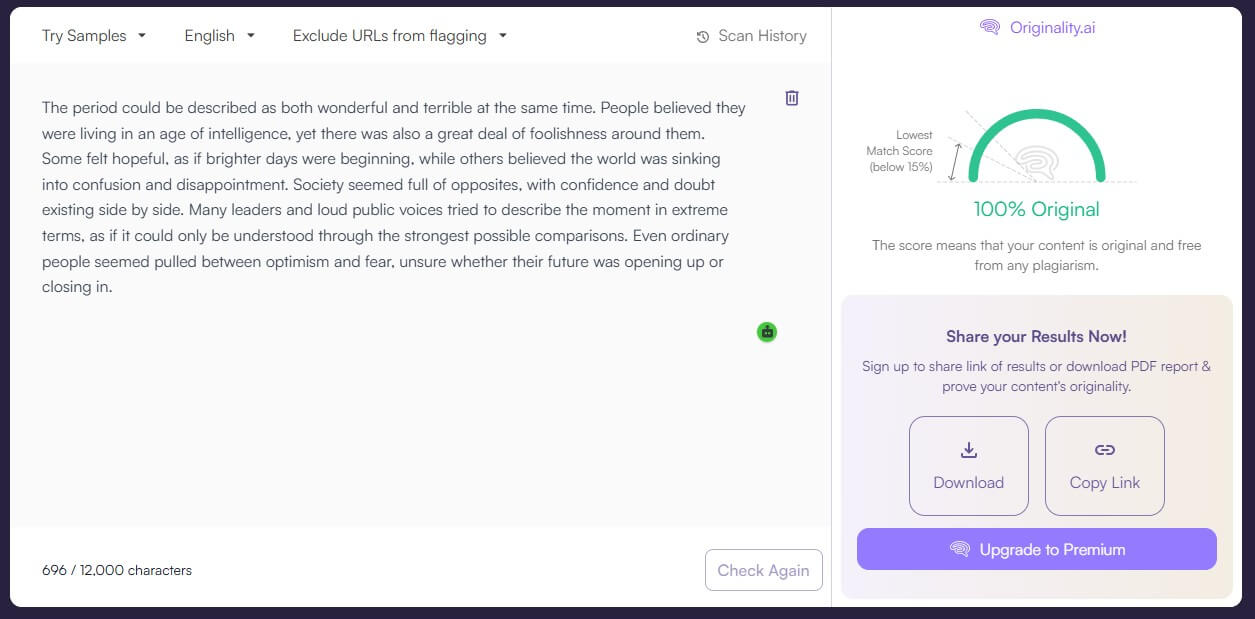
The period could be described as both wonderful and terrible at the same time. People believed they were living in an age of intelligence, yet there was also a great deal of foolishness around them. Some felt hopeful, as if brighter days were beginning, while others believed the world was sinking into confusion and disappointment. Society seemed full of opposites, with confidence and doubt existing side by side. Many leaders and loud public voices tried to describe the moment in extreme terms, as if it could only be understood through the strongest possible comparisons. Even ordinary people seemed pulled between optimism and fear, unsure whether their future was opening up or closing in.
Yesterday, me and my cousin was walking to the grocery store because we needed some things for dinner, but neither of us were really paying attention to where we was going. We seen a small dog run across the parking lot, and the owner were calling it from the other side of the street. The dog didn’t listened at first, and there was many cars driving by, so everyone started getting nervous. My cousin say we should try to help, but I wasn’t sure what to do. Finally, the dog stopped near a tree, and we was able to block it from running again. The owner thanked us and said she was scared because the dog had never ran away before.
Exercise is very important because it is good for people and helps them in many different ways. People should exercise because exercise makes the body better and also makes life better in general. There are many kinds of exercise, and all of them can be useful depending on what a person wants to do. Some people like running, some people like walking, and some people like other activities that are also exercise. If people exercise more, they can feel good and have better results. Exercise is something everyone should think about because it matters a lot, and it is one of the best things a person can do for health and for living a better lifestyle.
Regular exercise can improve health by supporting heart function, muscle strength, flexibility, and mood. For someone who is just starting, the most useful plan is often simple and realistic rather than intense. A person might begin with a twenty-minute walk after dinner, a short stretching routine in the morning, or light cycling a few times a week. These activities are easier to repeat, and consistency is usually more important than pushing too hard at the beginning. Over time, small increases in duration or difficulty can help build endurance without making the routine feel impossible. Exercise also works best when it fits a person’s schedule, interests, and current fitness level.
The implementation of environmentally conscious transportation strategies within rapidly expanding metropolitan regions requires not only sustained infrastructural investment but also coordinated behavioral adaptation among residents, policymakers, transportation agencies, and private-sector stakeholders. As congestion, emissions, land-use pressure, and long-term urban sustainability concerns increasingly intersect with economic development priorities, public mobility expectations, and equity-related access issues, city leaders must evaluate whether proposed transportation systems can function efficiently across diverse neighborhoods while reducing dependence on single-occupancy vehicles and maintaining affordability for daily commuters.
Cities need better transportation options as they grow. More buses, trains, bike lanes, and safe walking paths can help reduce traffic and pollution. These choices also make it easier for people to reach work, school, stores, and medical appointments without depending only on cars. Good transportation planning should serve many kinds of neighborhoods, not just busy downtown areas. It should also be affordable enough for people who use it every day. When public transportation is reliable, people are more likely to use it. Over time, that can make a city cleaner, less crowded, and easier to live in for everyone.
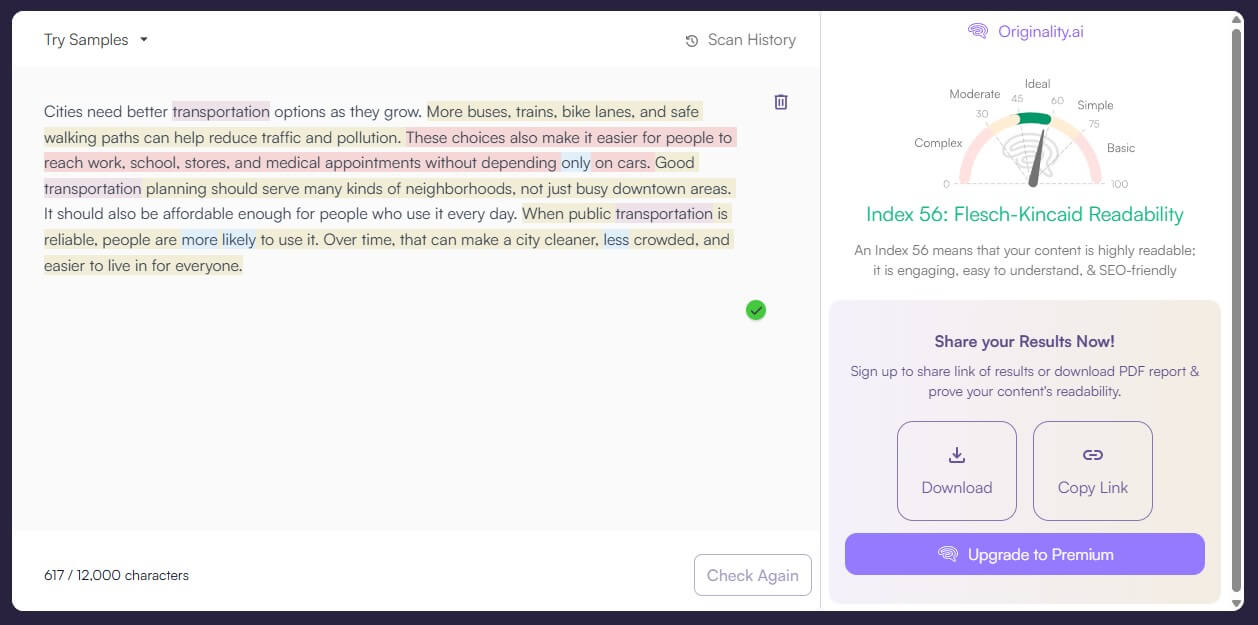
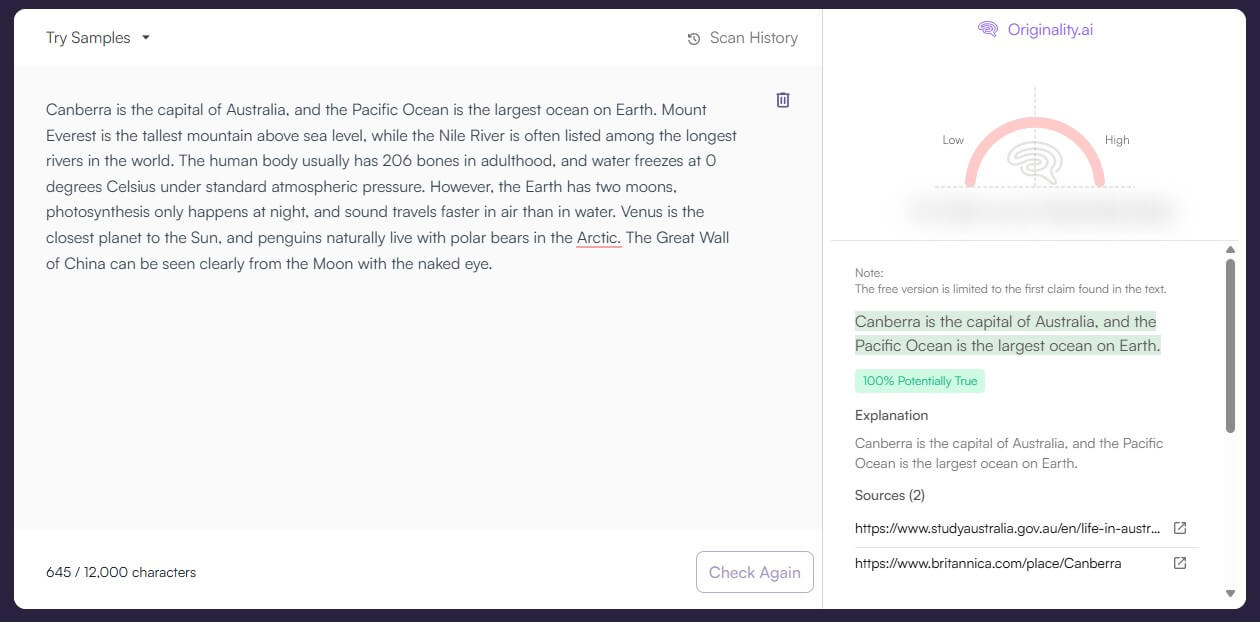
Canberra is the capital of Australia, and the Pacific Ocean is the largest ocean on Earth. Mount Everest is the tallest mountain above sea level, while the Nile River is often listed among the longest rivers in the world. The human body usually has 206 bones in adulthood, and water freezes at 0 degrees Celsius under standard atmospheric pressure. However, the Earth has two moons, photosynthesis only happens at night, and sound travels faster in air than in water. Venus is the closest planet to the Sun, and penguins naturally live with polar bears in the Arctic. The Great Wall of China can be seen clearly from the Moon with the naked eye.
Originality.ai’s model choices are one of its better features. Instead of forcing every user into one detection standard, it offers different models for different tolerance levels. Its public materials describe Lite as a lower-false-positive option that allows light AI editing, Turbo as a stricter option for zero-tolerance AI policies, Academic as a model for education use, and Multilingual as a detector for 30 languages.
That flexibility is practical. A marketing team may allow grammar cleanup but not full AI-written drafts. A school may care about whether the student produced the work. An agency may need to enforce a client contract that bans AI-generated copy. The right model depends on the policy.
The company reports strong accuracy figures across these models, including 99% accuracy for Lite, 99%+ for Turbo, 99%+ for Academic, and 97.81% for Multi Language in its public accuracy materials. It also publishes false-positive rates, which is useful because false positives are often the hardest issue in AI detection.
| Feature | Practical Value |
|---|---|
| AI detection | Estimates whether text appears AI-generated |
| Plagiarism checking | Flags copied, paraphrased, patchwork, and mosaic plagiarism |
| Readability review | Helps editors match writing to the target audience |
| Grammar checking | Catches basic writing issues inside the same workflow |
| Fact checking | Adds a review step for claims that may need sources |
| Chrome extension | Brings checks into Google Docs and webpages |
| Writer Replay | Shows how a Google Doc was written over time |
The plagiarism checker deserves attention because it goes beyond direct copy-paste checks. Originality.ai says its plagiarism tool can detect global, paraphrase, patchwork, unintentional, and mosaic plagiarism, which is useful for publishers and educators who deal with rewritten or stitched-together content.
Originality.ai works best when it is part of a repeatable review process. A writer can draft in Google Docs, an editor can scan the document, and the team can share a report if a client, instructor, or manager needs proof of review.
The Chrome extension is especially useful because it reduces the gap between writing and checking. Originality.ai says the extension works in Chrome and Google Docs, includes AI detection and plagiarism checking, supports multilingual detection, and creates shareable reports.
Writer Replay is the feature that feels most useful in real disputes. It can show a character-by-character replay of how a Google Doc was created, giving teachers, clients, editors, or reviewers more context than a detector score alone. Originality.ai’s help documentation says this is meant to provide transparency beyond a simple score, especially because false positives can happen in any AI detection system.
Originality.ai is strongest for teams that publish or evaluate a lot of writing. It fits content agencies, SEO teams, publishers, educators, editors, and businesses that work with freelancers.
The best use case is not catching people after the fact. It is setting a clear content standard before work moves forward. For example, an agency can define whether AI-assisted editing is allowed, choose the appropriate detection model, scan submissions, and keep reports on file. A school can pair AI detection with draft history instead of relying on a single flag. A publisher can combine AI checking with plagiarism and readability review before publication.
Originality.ai also has an advantage over lightweight detectors because it includes workflow tools. The value is not only the scan. It is the report, document context, model choice, and ability to review several quality signals together.
The biggest limitation is that AI detection is still probabilistic. Originality.ai’s own guidance says an AI score is a confidence score, not a literal percentage of the text written by AI. For example, a 90% AI score means the tool is 90% confident that AI was used in some part of the content, not that 90% of the words were written by AI.
That distinction is important in high-stakes settings. A detector result should not be the whole case. Short passages, formal academic writing, translated text, heavily edited drafts, grammar-tool edits, and mixed human-AI workflows can all make interpretation harder.
Originality.ai is also mainly a text review platform. It does not solve image, audio, video, authorship, or source-trust problems by itself. And while its plagiarism checker is useful, users should choose the right scan type and review the available source coverage for their use case, since current public materials describe hybrid plagiarism checks that can include web-based sources plus academic or journal databases depending on the workflow.
Originality.ai works best for publishers reviewing articles, agencies checking freelancer submissions, educators reviewing student work with draft evidence, SEO teams auditing site content, and writers who want a shareable report before handing work over.
It is less suited for automatic punishment, one-sentence checks, or decisions where no one reviews the draft history, assignment rules, client policy, or source context.
Originality.ai is best at turning content review into a structured workflow.
Its strengths are model choice, plagiarism detection, readability checks, Chrome and Google Docs support, Writer Replay, and shareable reports.
The main caveat is interpretation. Originality.ai can give a strong signal, but the fairest decisions still require context, policy, drafts, and human review.
TAGS: Research AI Detection
Related Tools:

Simplifies data analysis by providing automated insights

Enhances productivity for researchers
Transforms complex topics into simple explanations
Identifies AI-generated content on web pages

Writing tool that generates, customizes, and refines content
Detects plagiarism and identifies AI-generated text