
Share this tool:
 |
Description:
Typo AI is not a writing assistant, code helper, or general chatbot. It is an enterprise data quality tool built around a practical problem: bad data often enters systems quietly, then becomes expensive to find and fix later. Typo’s main idea is to stop those errors earlier, while the user or system that created the data can still correct them.
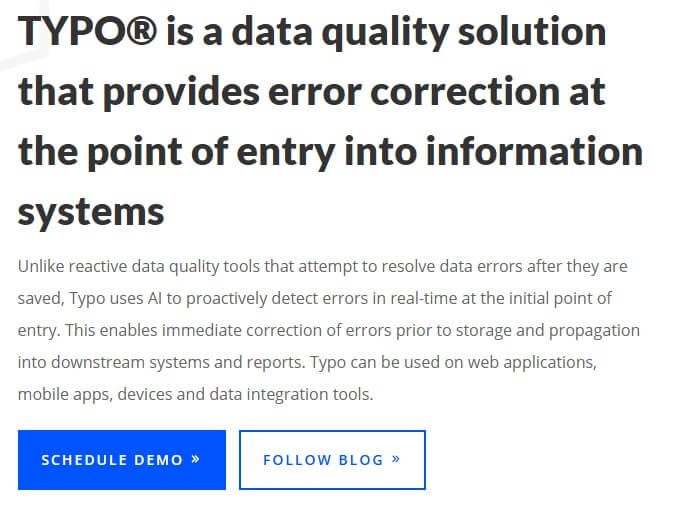
Typo AI is a proactive data quality platform. Traditional data quality tools often work after the fact: data is collected, stored, moved into a warehouse or reporting system, then checked later for problems. Typo takes a different approach. Its official site says it detects errors in real time at the initial point of entry, so the issue can be corrected before it spreads downstream.
That makes Typo more like a data quality guardrail than a reporting tool. It watches data as it moves into systems through web apps, mobile apps, devices, APIs, application users, and data integration tools. When it identifies a possible problem, it can notify the user and give them a chance to correct the entry before the data becomes part of the company’s records.
This is a narrow product, but the problem is real. Data errors affect analytics, customer records, compliance, operations, support, reporting, and decision-making. Typo is aimed at teams that want to reduce cleanup work by preventing dirty data from entering the pipeline in the first place.
Typo AI is strongest in environments where data quality matters at scale. That includes enterprise systems, customer databases, reporting pipelines, operational dashboards, data integration flows, and applications where users enter important information manually.
The most important use case is not “find every typo.” It is “protect the business from bad data before it becomes expensive.” A wrong customer ID, duplicate record, inconsistent date format, strange outlier, or invalid field value can create downstream issues in analytics, automation, billing, customer support, and business intelligence.
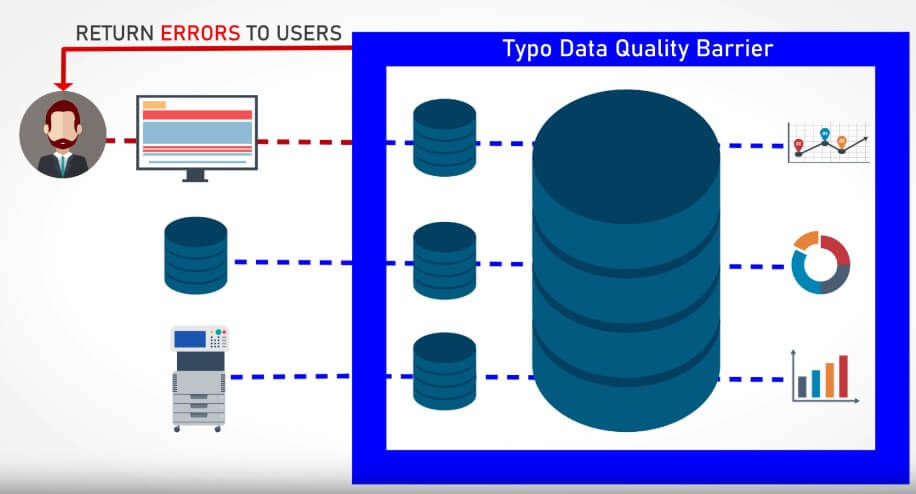
Typo’s value is clearest when multiple teams depend on the same data. A single mistake might start in a form, but it can later show up in a CRM, dashboard, data warehouse, customer support tool, or executive report. Typo’s point-of-entry model tries to stop that chain reaction early.
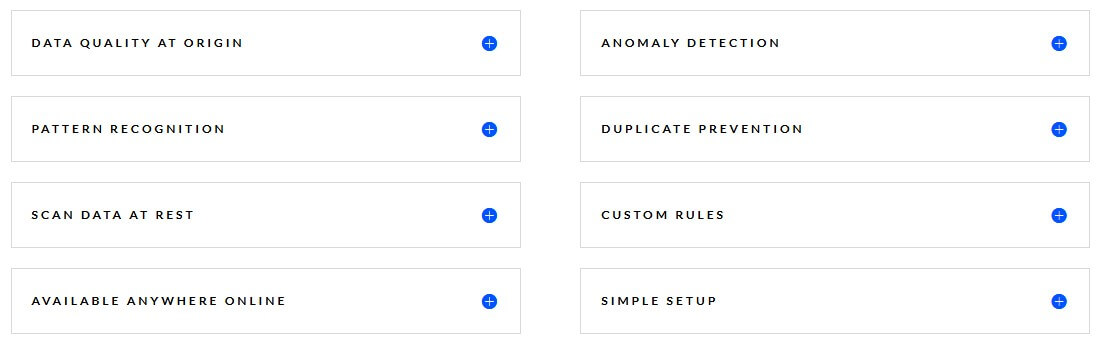
Typo identifies errors as data is first entered, then prompts correction before the error spreads into enterprise systems.
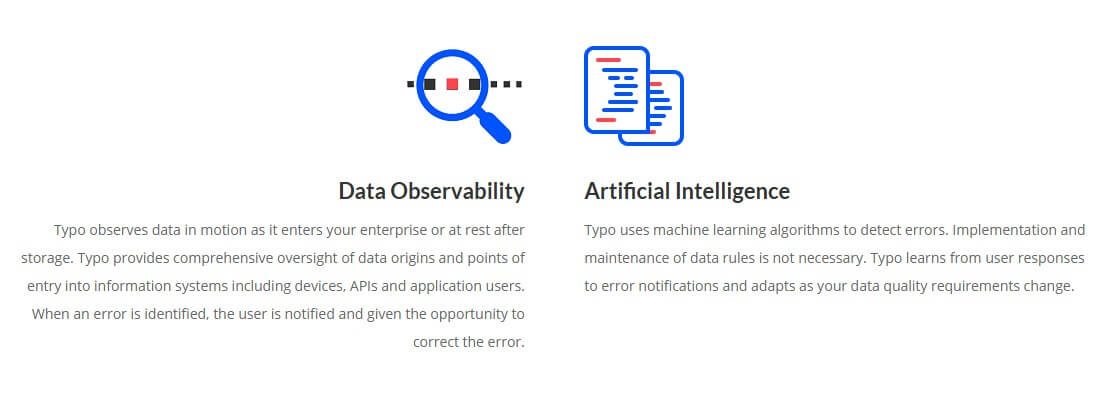
The platform observes data in motion or at rest, giving teams visibility into origins and points of entry across systems, devices, APIs, and application users.
Typo uses machine learning to detect errors and adapts based on user responses, reducing the need to create and maintain large rule libraries.
The tool can categorize values, detect data types from syntax, and recommend consistency when input does not match previous patterns.
Typo can scan stored data sources and produce shareable profiles or reports of detected errors, including relationships between data entities.
The platform uses proximity matching to help keep records free of duplicates.
Typo’s workflow starts where the data enters the system. Instead of waiting for a data analyst to discover problems later, Typo places quality checks closer to the original input. The official site says it can correct data transmitted over HTTP or HTTPS from websites or browser-accessed applications, including some third-party-hosted systems. It also says Typo can be deployed to monitor a web application with one line of HTML.
That setup model matters. Enterprise data quality projects can become heavy because they often require rules, audits, cleansing workflows, and ongoing maintenance. Typo’s pitch is that machine learning can reduce that burden by learning from data and user correction behavior rather than depending only on manually written validation rules.
Still, “simple setup” does not mean “no planning.” A company needs to decide where data quality matters most, which entry points should be protected first, and how correction prompts should fit into the user experience. If Typo interrupts the wrong workflow too often, users may ignore it. If it is deployed at the right points, it can prevent cleanup work later.
Typo’s official page lists several target users: executives and chief data officers, analysts and data scientists, IT and data engineers, data stewards, software developers and managers, and customer success managers. Each group has a different reason to care. Executives want trustworthy reports. Analysts want less cleanup. Engineers want fewer support cases and remediation work. Customer success teams want fewer customer-facing issues caused by bad records.
The best fit is a team that already knows poor data quality is costing time, trust, or money. If the organization has only a small database and rare data issues, Typo may feel too specialized. If the business depends on large volumes of entered, transferred, or integrated data, the value becomes easier to see.
The key difference is timing. Traditional tools often detect issues after data is saved or moved into another system. Typo focuses on catching errors at inception, while the person or system that introduced the issue can still respond.
That changes the work pattern. Instead of building cleanup projects around old mistakes, teams can correct more issues in the moment. Typo also says custom rules are optional, not required, because its AI and machine learning models can identify errors that teams may not have predicted in advance.
This does not make rules useless. Custom rules still matter when a company has strict business logic. But Typo’s strongest idea is that data quality should not depend only on rules for known problems. It should also watch for unfamiliar patterns and unusual entries.
Typo AI is best for companies with high-volume data entry, customer information workflows, operational systems, CRM-like records, web forms, analytics pipelines, and business intelligence environments where data trust matters.
It is useful when inconsistent formats create reporting issues, when duplicate records cause confusion, when bad customer data creates support problems, or when analysts spend too much time cleaning records before they can do useful work.
It is also a good fit for software teams that want reusable validation across multiple applications, rather than rebuilding the same checks in every product or internal tool.
Typo AI is not a general data platform. It does not replace warehouses, BI tools, master data management, or governance programs. It sits closer to the entry point and quality layer.
Its effectiveness also depends on deployment design. If it monitors the wrong fields, creates too many alerts, or lacks enough context, users may treat it as noise. Machine learning can reduce manual rules, but it still needs thoughtful rollout and review.
The product may also be less compelling for teams that only need basic form validation. Typo is more relevant when data errors create broad business cost, not when the problem can be solved with a few required fields and dropdown menus.
Typo AI is best for organizations that want to prevent bad data rather than clean it up later. Its strongest value is proactive error detection at the point of entry, supported by machine learning, pattern recognition, duplicate prevention, data observability, and data-at-rest scanning.
It is most useful for executives, data teams, engineers, and operations groups that rely on trustworthy records. The main caveat is scope: Typo works best when data quality is already a serious business issue, not when a team only needs basic validation.
TAGS: Productivity
Related Tools:

Summarizes meetings to help teams capture key information
Turns Google Sheets into intelligent workflows

Summarizes and take notes from videos

Enhances efficiency in Excel and Google Sheets

Enhances ChatGPT user interaction and functionalities
Enhances digital note-taking and sketching