Share this tool:
 |
Description:
TL;DV is an AI meeting assistant built for teams that spend too much time in calls and too little time using what was said. It records meetings, creates transcripts, generates AI summaries, highlights action items, and sends meeting insights into the tools teams already use. Its best fit is not just “take notes for me.” It is more useful when meetings need to become searchable, shareable, and connected to follow-up work.
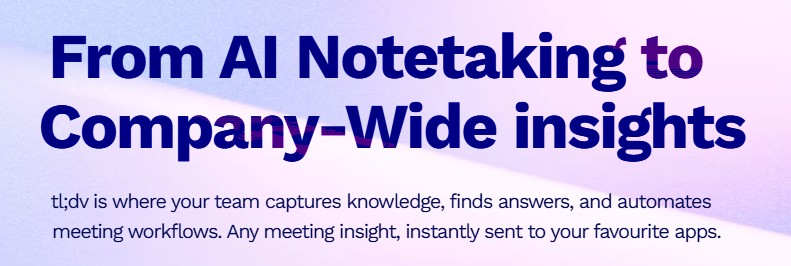
TL;DV is a meeting recorder, AI notetaker, transcription tool, and meeting intelligence platform in one product. It works with Google Meet, Zoom, and Microsoft Teams, which matters because many teams do not use one meeting platform consistently. TL;DV says it can record, transcribe, and summarize meetings across all three platforms, including slide capture.
The product has grown beyond basic meeting notes. TL;DV now talks about AI meeting agents that automate recording, transcription, summarization, and integrations into CRMs and productivity tools. That is an important shift. The platform is not only helping people remember what happened in one call. It is trying to turn recurring meetings, sales calls, customer conversations, and internal discussions into structured outputs that flow into the rest of the business.
In plain terms, TL;DV is for people who want fewer manual notes, better meeting memory, and less copy-pasting after calls.
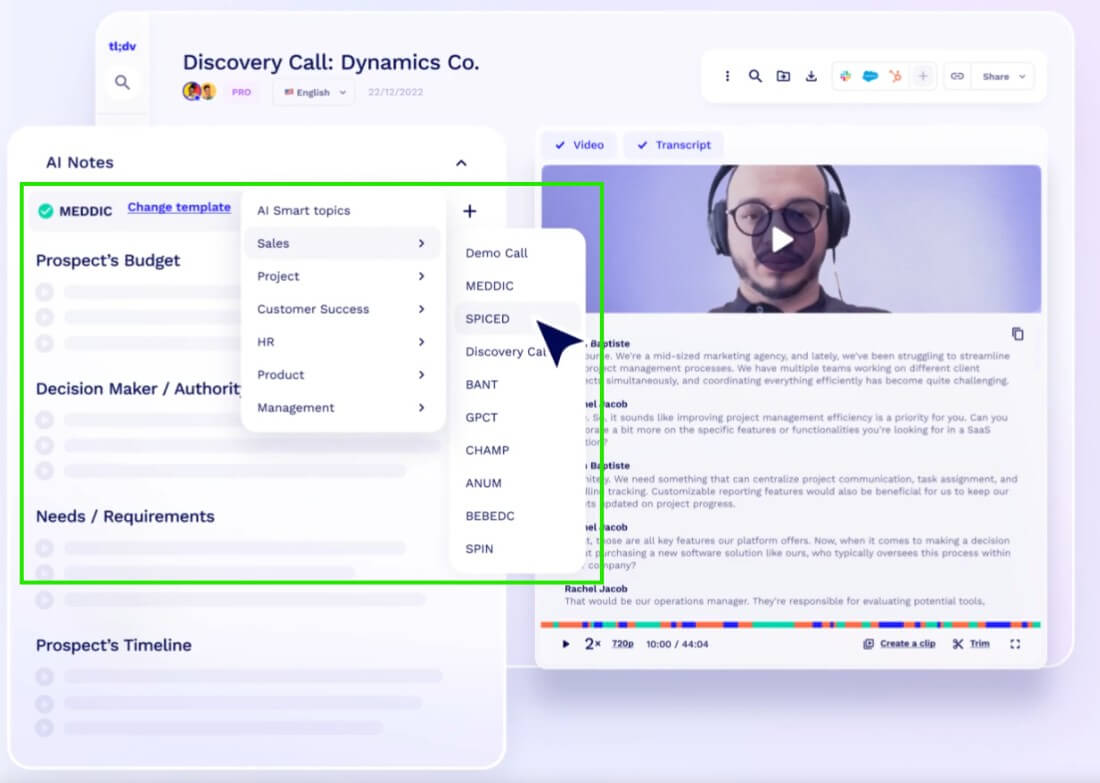
TL;DV is strongest when meetings create work after they end. A one-off catch-up can be summarized by almost any AI notetaker. TL;DV becomes more useful when teams need transcripts, video clips, action items, CRM updates, recurring summaries, or searchable call history.
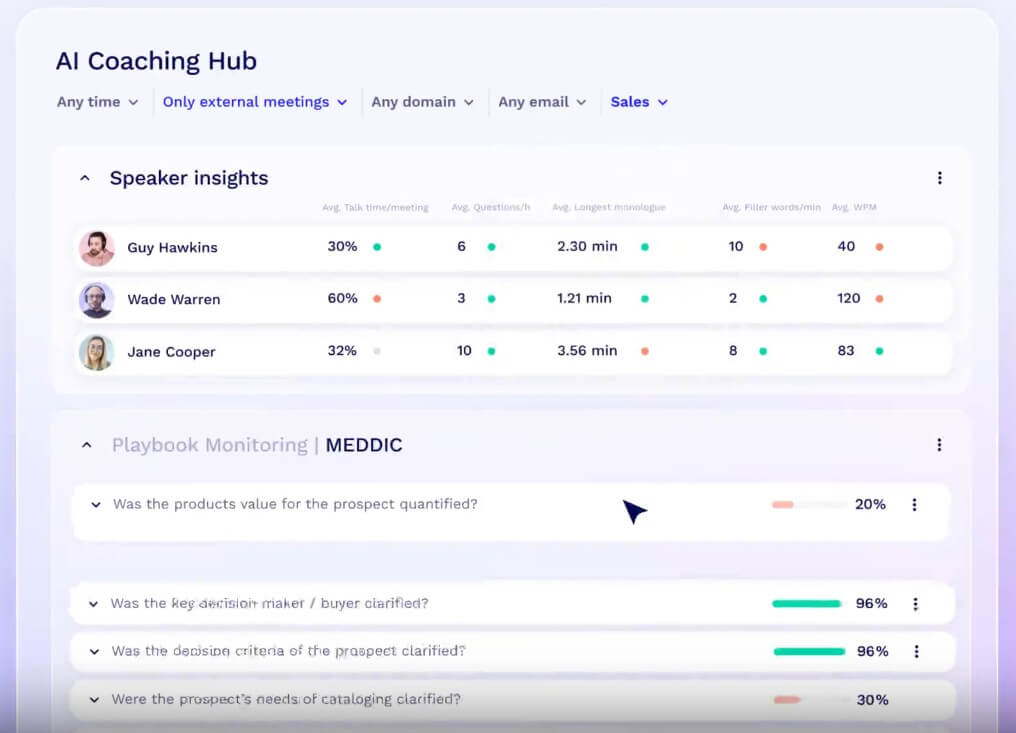
Sales and customer-facing teams are a clear fit. TL;DV’s sales page says it can automatically fill CRM fields, draft follow-up emails, and help prepare users for upcoming meetings. That is a practical workflow because sales reps often lose time after calls updating systems and writing recap emails.
The platform also makes sense for product, research, and customer success teams. When customer calls contain feature requests, objections, pain points, adoption issues, or renewal risks, a full transcript and AI summary are much easier to reuse than memory or scattered notes.
| Feature | Practical value |
|---|---|
| Meeting Recording and Transcription | Records meetings and turns spoken discussion into searchable text across Zoom, Google Meet, and Microsoft Teams. |
| AI Meeting Summaries | Extracts key points, highlights, action items, and useful meeting takeaways instead of leaving users with only a transcript. |
| AI Meeting Agents | Uses modular workflows for recording, transcription, filtering, summarization, and tool integrations. |
| Multi-Meeting Summaries | Can consolidate insights across multiple meetings, useful for tracking recurring themes and customer feedback. |
| CRM and Workflow Integrations | Connects meeting outcomes to tools such as HubSpot, Salesforce, Slack, Notion, and other productivity or CRM systems. |
| Clips and Sharing | Helps users pull out important meeting moments so teammates do not need to watch a full recording. |
The useful part is not only that TL;DV captures meetings. It helps teams turn meetings into structured follow-up assets that can move into the rest of the workflow.
The basic TL;DV workflow is easy to understand. A meeting happens on Google Meet, Zoom, or Microsoft Teams. TL;DV records it, creates a transcript, generates notes, and stores the meeting so it can be searched or shared later. Users can then send summaries to Slack, sync notes to a CRM, share clips, or use the output for follow-up work.
This is where TL;DV feels more practical than a simple recorder. The meeting artifact is not just a video file. It becomes a set of reusable pieces: transcript, summary, timestamps, highlights, action items, clips, and structured notes.
The ease of use depends on how clean the team’s meeting habits are. TL;DV can capture and summarize, but it works better when meetings have clear topics, named owners, and decisions stated out loud. If a call is rambling, full of cross-talk, or packed with half-finished thoughts, the AI output may still need cleanup.
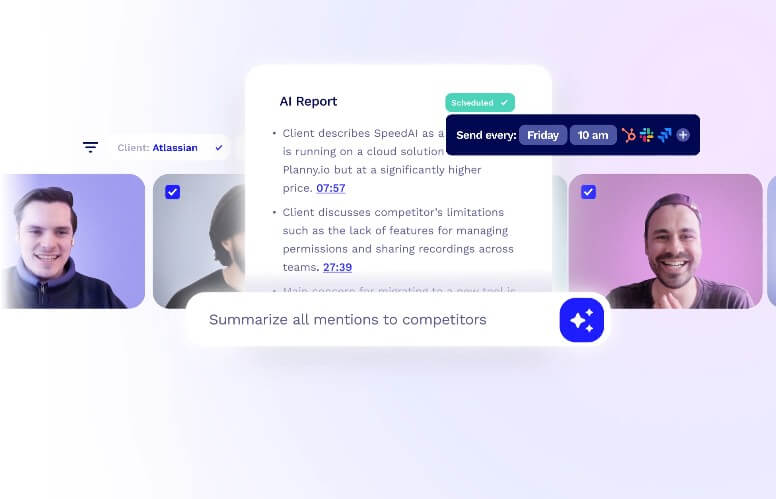
The AI agents are the most interesting part of TL;DV’s current positioning. The official AI agents page describes workflows built from components such as recording, transcription, filtering, summarization, and integrations. These can be used for tasks like CRM updates, extracting customer feedback, or summarizing multiple meetings.
This matters because meeting notes are only valuable if someone uses them. A good transcript that sits untouched in a dashboard is still extra admin. TL;DV’s agent direction is stronger because it pushes meeting information into places where teams already work: CRMs, Slack, Notion, project tools, and follow-up workflows.
The useful question is not “Can TL;DV summarize this call?” It is “Can TL;DV reduce the work after this call?” For sales, that may mean CRM updates and follow-up drafts. For customer success, it may mean renewal risks or customer requests. For product teams, it may mean patterns across user interviews.
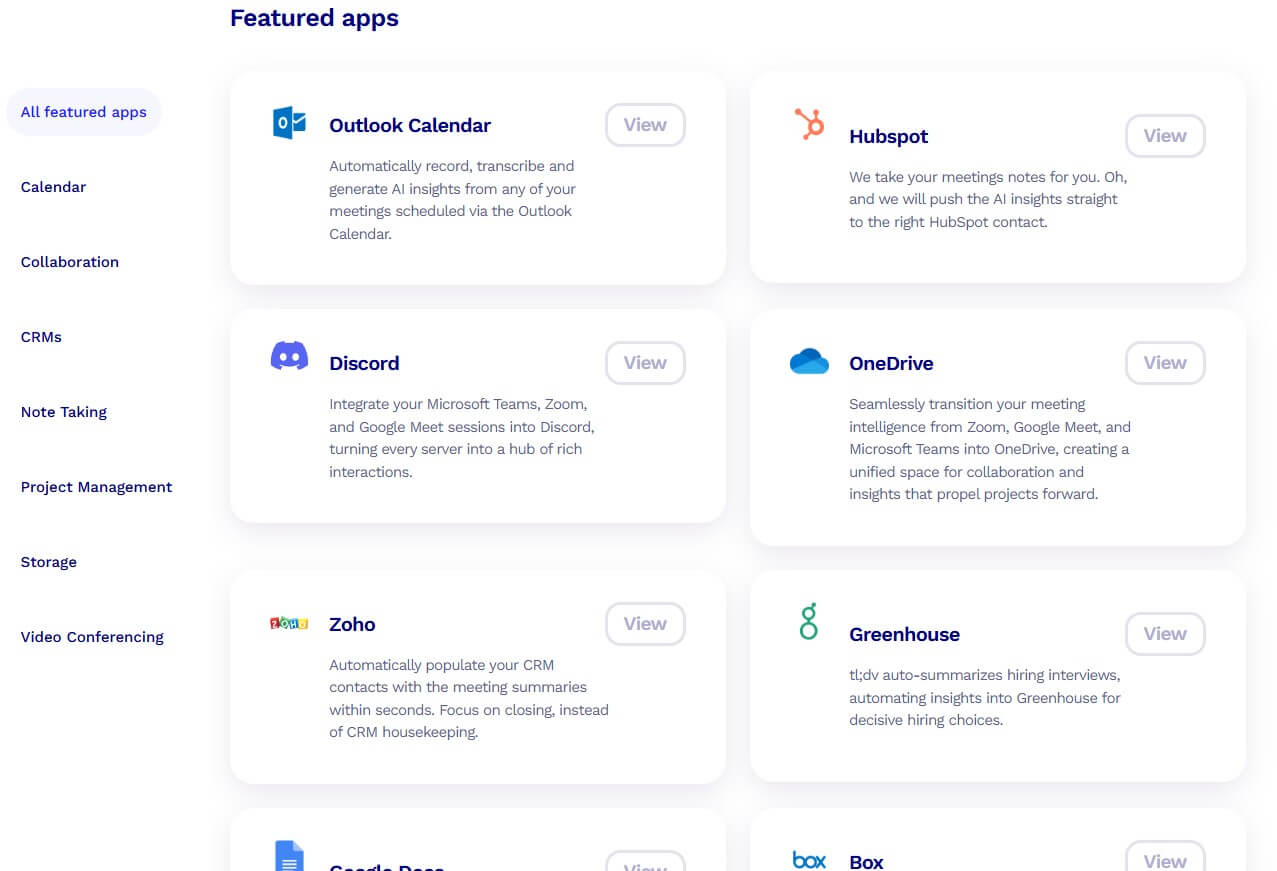
TL;DV’s integration layer is a major part of the product. Its integrations page lists workflows that send meeting summaries and action items into Slack, Google Docs, Dropbox, HubSpot, Greenhouse, Box, Miro, Salesloft, and other tools. It also points to broader automation through Zapier.
This is important because meetings often fail at the handoff stage. A customer says something useful, but it never reaches the product team. A sales call reveals an objection, but it stays in the rep’s head. A hiring interview produces feedback, but it gets buried in a thread. TL;DV’s value rises when teams use integrations to make those insights visible outside the meeting recording.
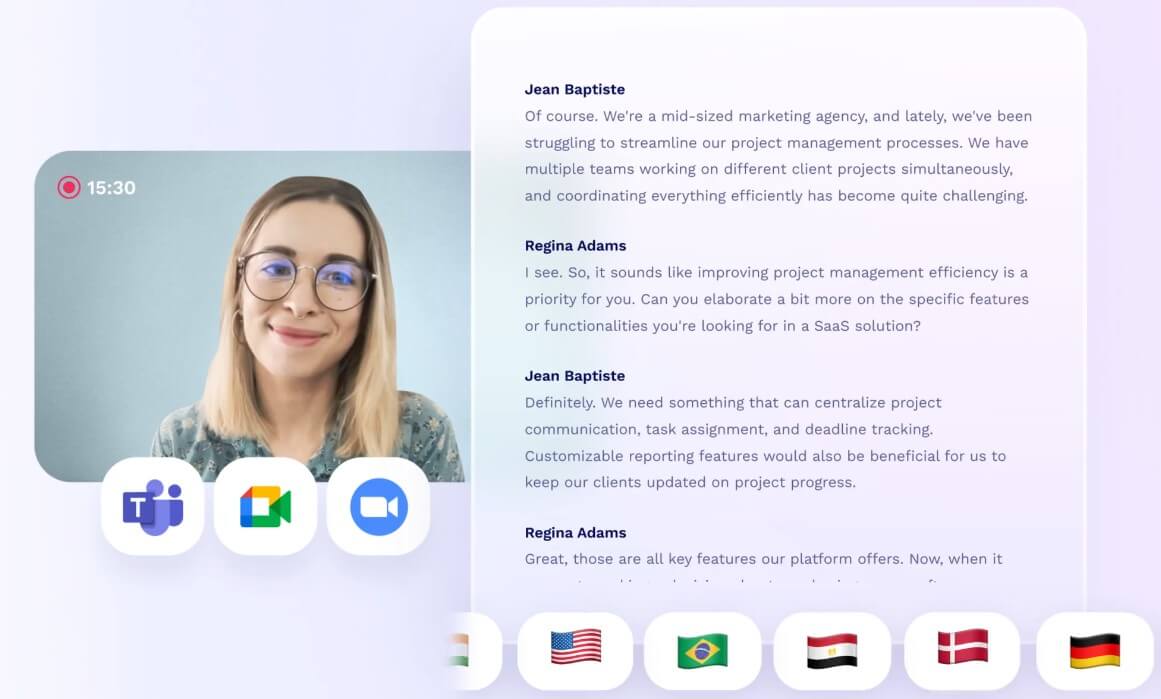
Translation and sharing features make TL;DV more useful for distributed teams. When meetings involve global teammates, customers, or partners, the transcript and summary layer becomes more valuable if the content can be reviewed in another language or shared with people who were not on the call.
This is especially useful for remote teams, multilingual customer conversations, and async collaboration. Instead of asking someone to watch a full call, TL;DV can help turn the meeting into shorter, translated, and easier-to-share meeting context.
TL;DV is a strong fit for sales teams that run many discovery, demo, negotiation, and follow-up calls. The CRM and follow-up support are especially relevant here.
Customer success teams can use it to track account health, customer objections, adoption blockers, and renewal conversations. Product teams can use it as a lightweight research repository for user interviews and feedback calls.
It also works well for remote and async teams. When people cannot attend every meeting, TL;DV gives them a faster way to catch up through summaries, timestamps, and clips rather than full recordings.
TL;DV still depends on meeting quality. If people talk over each other, speak vaguely, or avoid making decisions explicit, the summary may be less useful. AI can organize conversation, but it cannot turn a weak meeting into a strong one.
There is also a privacy and consent layer to handle. TL;DV records meetings, so teams need clear internal rules about when recording is allowed, how participants are notified, and who can access recordings. TL;DV says it is GDPR-compliant and has SOC 2 compliance information, but each company still needs to review its own legal and security requirements.
Another trade-off is focus. TL;DV is strongest around meetings and meeting-derived workflows. It is not a full project management system, CRM, or documentation platform. It works best when paired with those tools, not when expected to replace them.
- Use TL;DV for meetings where the output matters: sales calls, customer interviews, hiring interviews, product reviews, leadership updates, and recurring team meetings.
- Create clear meeting titles and agendas. This makes transcripts and summaries easier to search later.
- Connect integrations early. The platform becomes more useful when summaries and action items move into Slack, CRM, docs, or project tools automatically.
- Review summaries before sending them to customers or executives. AI notes are helpful, but sensitive follow-ups still need human judgment.
TL;DV is a strong AI meeting assistant for teams that want meetings to become useful records, not forgotten conversations. Its best strengths are recording, transcription, summaries, clips, multi-meeting insights, CRM workflows, and integrations across common work tools. It is best for sales, customer success, product, research, recruiting, and remote teams with high meeting volume. The main caveat is that TL;DV improves meeting follow-through, but it does not replace good meeting discipline or clear privacy rules.
TAGS: Productivity
Related Tools:

Transforms ideas into clear, actionable project plans

Improves team communication and project management
Simplifies and accelerates API integrations

Provides customizable email templates
Records, transcribes, and summarizes video meetings

Enhances productivity for researchers