
Share this tool:
 |
Description:
APIDNA is an enterprise AI agent platform for organizations that need agents to do more than answer questions. Its current positioning is built around vertically trained agentic systems that can operate inside real business workflows, connect with existing infrastructure, follow governance rules, and leave behind an auditable trail of what happened.
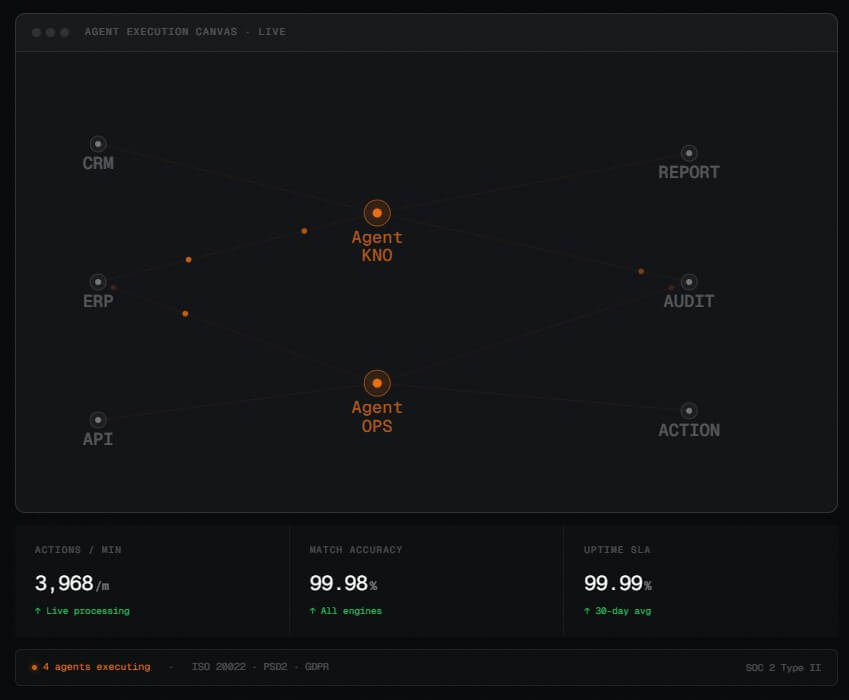
APIDNA is not a general chatbot, no-code prompt tool, or simple API connector. The current site positions it as a company that builds and operates AI agents trained for specific domains, workflows, and systems. The platform’s core pitch is that agents should not just respond to prompts. They should execute work inside enterprise environments with reliability, controls, and monitoring.
That distinction matters. A basic AI assistant might summarize a document or generate a response. APIDNA is aimed at workflows where the agent must move between APIs, databases, enterprise systems, documents, and human review paths. The site describes agents acting across APIs, tools, databases, and legacy infrastructure, with monitoring, governance frameworks, human-in-the-loop design, and full audit trails.
The company’s older public material focused heavily on autonomous agents for API integration. Those articles describe agents reading API documentation, mapping data, testing responses, generating code, and handling integration tasks. The newer website expands that idea into a broader enterprise agent platform where API orchestration is one part of a larger execution layer.
APIDNA is strongest where workflows are complex, repetitive, system-heavy, and hard to automate with standard tools. Think reconciliation across multiple transaction sources, compliance reporting, document-heavy operations, logistics coordination, legacy system workflows, or back-office processes that still depend on spreadsheets, email, file transfers, and manual checking.
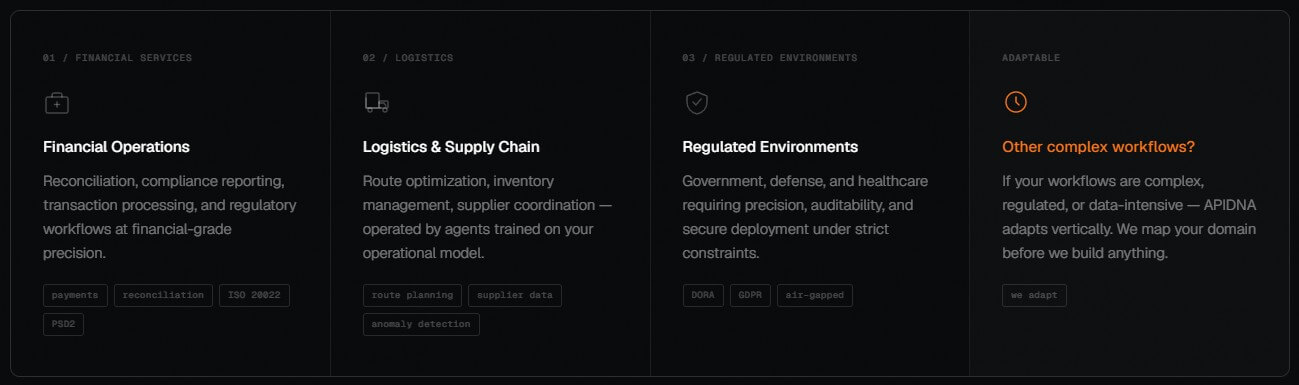
The platform’s own examples include reconciliation, compliance and audit workflows, document-heavy operations, and multi-system process automation. Its site also highlights financial services, logistics, regulated environments, government, defense, and healthcare as examples of areas where accuracy, compliance, and auditability matter.
This is not a tool for a solo developer who only wants to test one endpoint. It is better understood as a custom enterprise automation layer for teams with serious workflow complexity.
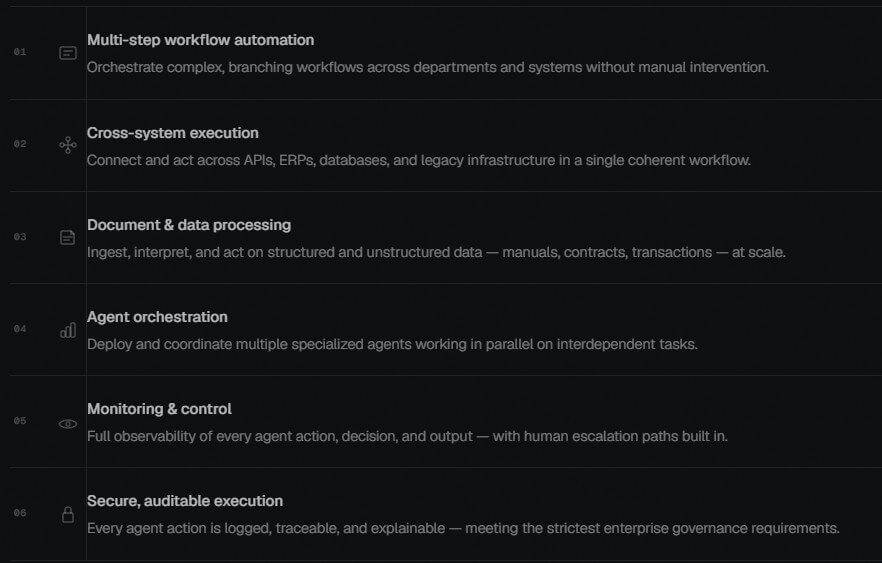
| Capability | What it does | Why it matters |
|---|---|---|
| Vertical Intelligence | Trains agents on a specific domain, data, rules, and workflow context | Helps avoid generic AI behavior in specialized operations |
| Cross-System Execution | Acts across APIs, databases, ERPs, legacy systems, and real-time feeds | Useful when work spans several systems |
| Document and Data Processing | Ingests and acts on structured and unstructured data | Fits contracts, invoices, manuals, policies, and transaction records |
| Multi-Agent Orchestration | Coordinates specialized agents working across related tasks | Supports workflows too broad for one agent |
| Monitoring and Control | Logs actions, decisions, outputs, and escalations | Makes agent behavior easier to review |
| Secure, Auditable Execution | Adds permissions, traceability, human escalation, and deployment controls | Essential for regulated or high-risk workflows |
The most important part is the execution layer. APIDNA’s site argues that enterprise agents need more than model capability. They need orchestration, state management, governance, failure handling, auditability, and controlled integration with business systems.
APIDNA’s workflow is not a self-serve app where a user signs up and builds everything from templates. The site describes a more consultative process: define the workflow, shape the agent, connect systems, then run and monitor the agent. In the first stage, APIDNA maps the target workflow, including steps, systems, rules, exceptions, and success criteria. Then agents are trained vertically on the organization’s domain and operational context.

That makes sense for the market it is targeting. Enterprise workflows usually cannot be reduced to a single form. A reconciliation process may involve bank feeds, ERP records, payment processors, exception rules, compliance requirements, and human approval steps. A document operation may involve PDFs, XML, CSV, email, SharePoint, proprietary schemas, and business-specific classification rules. APIDNA lists these kinds of document and system sources in its integration layer.
The trade-off is that APIDNA is less plug-and-play than lightweight automation tools. It looks more like a platform-plus-engagement model. That is a better fit when the workflow is valuable enough to justify careful mapping and deployment.
API integration is still part of APIDNA’s DNA. Earlier APIDNA articles describe autonomous agents that can read Postman collections or OpenAPI specifications, identify endpoints, extract parameters, understand response structures, handle authentication details, and run initial tests.
The current site broadens that into system integration across REST, GraphQL, SOAP, proprietary APIs, databases, ERP systems, streaming data feeds, document sources, and legacy bridges such as SFTP and custom adapters. It also says APIDNA is model-agnostic, supporting proprietary models, open-source models, private deployments, hybrid configurations, and on-premise inference.
That flexibility is important. Many enterprise workflows do not live inside one modern SaaS stack. They often involve old databases, strict data residency rules, custom APIs, and systems that were never designed to work together.
APIDNA’s testing angle is practical. Its public API integration testing article describes autonomous agents simulating client requests, verifying server responses in real time, comparing mappings, checking data consistency, and reducing manual testing work.
For enterprise use, the governance layer matters just as much as automation. APIDNA says every agent action can be logged with traceability, agents operate within explicit permission boundaries, deployments can run in private cloud or on-premise environments, and human escalation paths can be defined for exceptions.
That is the right emphasis. The hard part of enterprise AI is not getting an agent to perform well in a demo. The hard part is knowing what it did, why it did it, where the data came from, when a human should step in, and whether the system can survive real operational edge cases.
APIDNA is best for enterprise workflows where manual handoffs are expensive and errors matter. Good fits include payment reconciliation, compliance reporting, document intake, regulatory monitoring, logistics workflows, supplier coordination, insurance or healthcare document operations, financial back-office work, and API-heavy integration projects.
It is also a good fit for organizations that have already tried generic AI pilots and found that the model was not the main problem. APIDNA’s own content makes this argument directly: production agents need system integration, state management, escalation paths, audit trails, and edge-case handling.
APIDNA’s biggest limitation is accessibility. This is not the easiest tool for small teams, hobby projects, or simple API testing. The platform is aimed at complex workflows, which means setup will involve process mapping, system access, governance decisions, and ongoing monitoring.
The second trade-off is that custom, vertically trained agents require clear business rules. If a company’s workflow is poorly defined, inconsistent, or politically messy, an agent may expose those issues rather than solve them.
There is also a trust requirement. Any agent acting across enterprise systems needs careful permissions, review paths, security boundaries, and rollback planning. APIDNA’s governance language is encouraging, but buyers should still ask for concrete implementation details tied to their own infrastructure.
APIDNA is a serious enterprise AI agent platform for organizations that need automation across APIs, databases, documents, legacy systems, and regulated workflows. Its strongest value is the focus on vertical training, execution across systems, governance, auditability, and human escalation. It is best for enterprises with complex, high-value operations where generic AI tools are not enough. The main caveat is that APIDNA is not a quick self-serve productivity app. It is most useful when a business is ready to map real workflows and deploy agents with proper oversight.
TAGS: Productivity
Related Tools:

Simplifies creation of educational content

Provides quick summary of Google search results
Automates chat interactions with customizable chatbots

AI search engine for research

Built for tracing, evaluating, monitoring, and improving AI agents

Streamlines the grading process for educators