
Share this tool:
 |
Description:
Consensus is an AI research tool built for people who need evidence from academic papers, not general web answers. It searches a large database of peer-reviewed research, ranks relevant papers, summarizes findings with citations, and gives users tools for deeper literature review work such as Research Agent, Consensus Meter, Ask Paper, filters, collections, and paper comparison workflows.
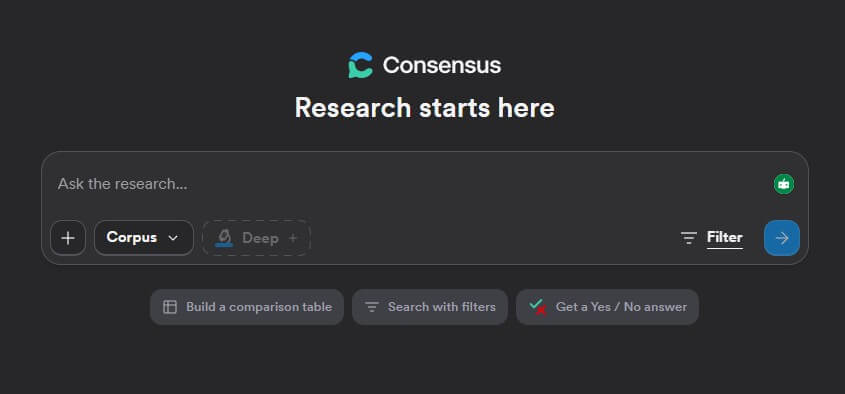
Fast evidence check
Prompt:
“Does creatine supplementation improve cognitive performance in healthy adults? Focus on human studies, systematic reviews, randomized controlled trials, and recent high-quality evidence.”
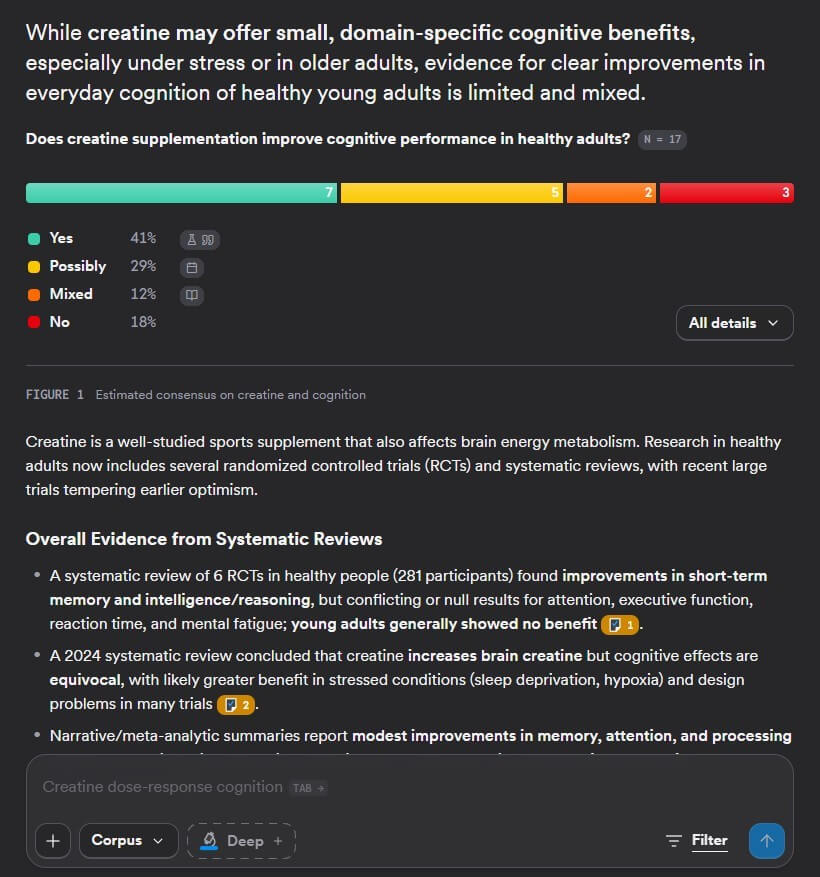
Why this is a good first test: This is the kind of question Consensus handles well because it can search academic papers rather than produce a general answer. It also gives the tool a clear population, intervention, and outcome, which usually improves relevance.
Quick read on where the literature leans
Prompt:
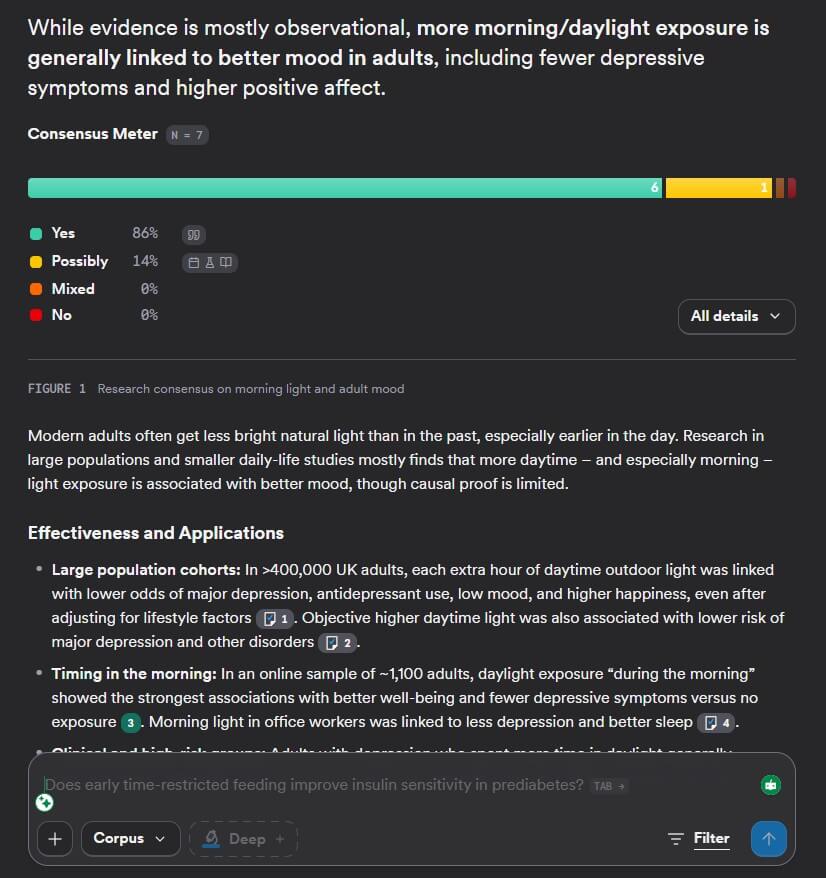
“Does morning sunlight exposure improve mood in adults?”
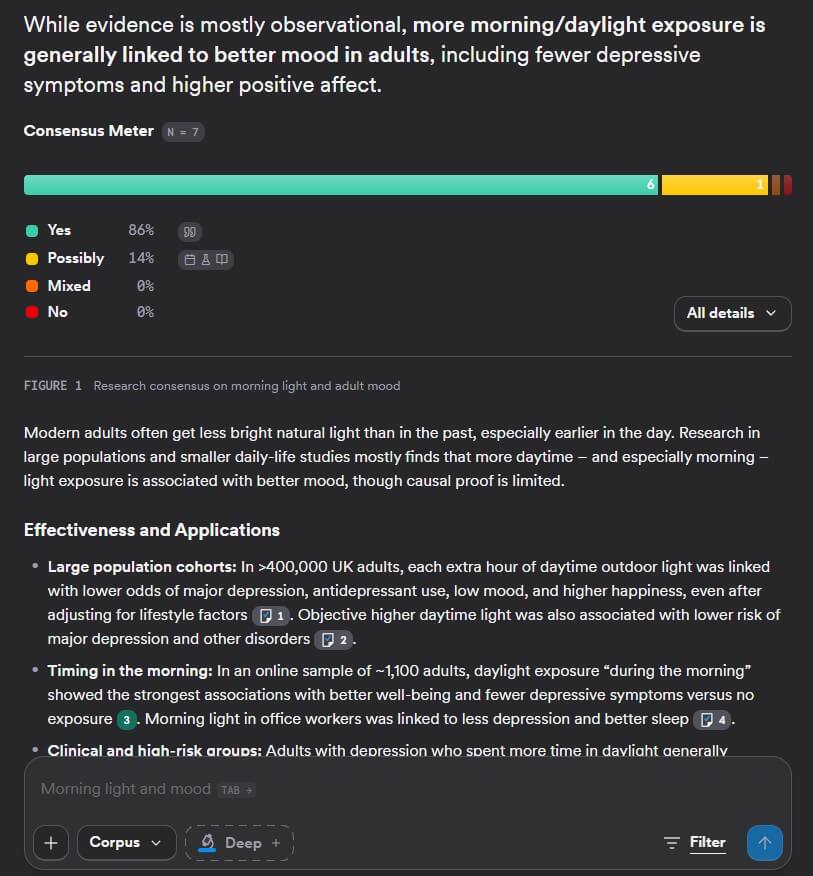
Why this is useful: Yes-or-no questions can trigger the Consensus Meter, which visualizes whether the top relevant papers lean toward “Yes,” “No,” “Possibly,” or “Mixed.” It is useful for a fast directional read, but it should not be treated as the final answer. The Meter is based on the most relevant returned papers, not the entire research universe.
Turn search results into a structured synthesis
Prompt:
“Summarize the strongest evidence on intermittent fasting and insulin sensitivity. Create a table with study type, population, intervention duration, main outcome, and strength of evidence.”
Why this matters: Consensus becomes more useful when you ask for structure. Instead of only scanning search results, you can get a more readable synthesis with citations, then use the table to decide which papers deserve closer reading.
Multi-step literature review
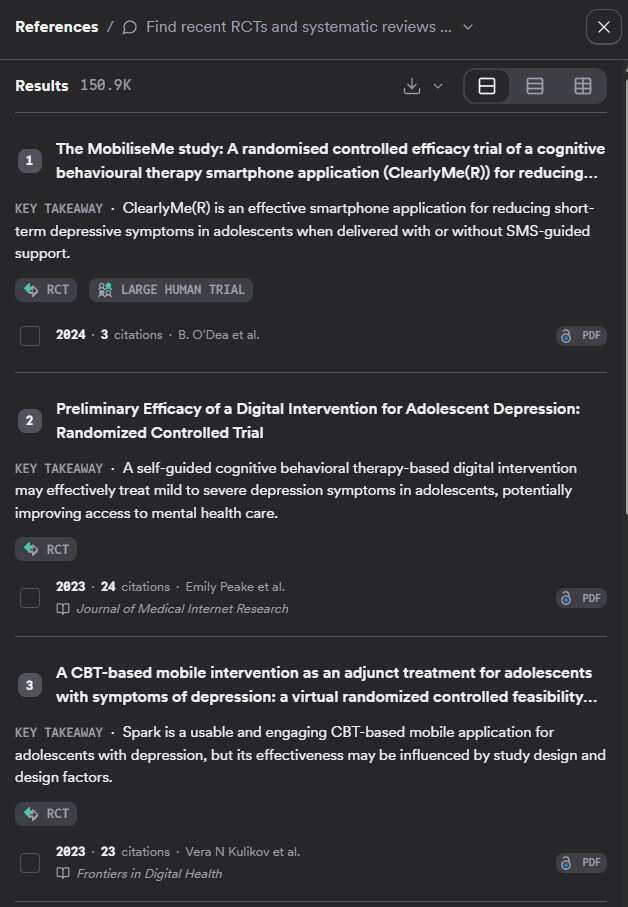
Prompt:
“Find recent RCTs and systematic reviews on digital CBT for adolescent depression. Compare the evidence by sample size, intervention format, follow-up length, and effect on depressive symptoms.”
Why this is a strong test: Research Agent is built for multi-step research questions. It can plan searches, chain tools, apply filters, compare papers, and return citation-backed answers grounded in peer-reviewed research.
Narrow results without building complex search syntax
Prompt:
“Find studies from the last five years on GLP-1 agonists and cardiovascular outcomes. Prioritize human studies, large sample sizes, Q1 journals, and systematic reviews or randomized controlled trials.”
Why this belongs early: Consensus supports natural-language filtering around study type, recency, sample size, journal quality, and population. That makes it easier for non-specialists to get closer to high-quality evidence without learning database syntax first.
Interrogate one paper instead of skimming it manually
Before using this prompt: Upload or select a paper in Consensus.
Prompt:
“What was the study design, who were the participants, what were the main outcome measures, and what limitations did the authors mention?”
Why this is useful: Ask Paper lets you chat with the full text of a paper, which is valuable when the abstract is too thin or when you need methods, limitations, or outcome details quickly.
Compare a small group of studies
Before using this prompt: Select or upload multiple papers.
Prompt:
“Compare these papers. Focus on differences in population, methodology, intervention design, outcome measures, and whether the findings agree or conflict.”
Why this matters: This is one of the more practical research workflows because it helps move from “I found papers” to “I understand how these papers relate to each other.” Consensus describes this as a way to get cited summaries across selected papers and compare findings in one place.
Build around your saved research
Before using this prompt: Save relevant papers into a collection.
Prompt:
“Analyze this collection and identify the strongest recurring claims, weakly supported claims, contradictions, and possible gaps for a literature review.”
Why this is useful: Consensus is moving beyond one-off search. My Library lets users save and organize papers into collections, then work with that research later. That matters for students, researchers, and writers who need a repeatable workflow instead of a single answer.
Higher-precision medical research
Prompt:
“For adults with hypertension, what does high-quality medical literature say about sodium reduction and blood pressure outcomes? Focus on clinical evidence and guidelines.”
Why this is a good test: Medical questions need stricter source control. Consensus introduced Medical Mode to narrow medical searches toward higher-quality medical sources and clinical guidelines, which makes it more useful for evidence discovery in health-related topics. It still should not replace medical advice or clinical judgment.
Map a research field from one paper
Prompt:
“Starting from this DOI, identify the most important papers it cites, the most influential later papers that cite it, and how the research area has developed over time.”
Why this stands out: This is where Consensus feels more like a research workspace than a search box. Citation tracing can help users find foundational papers, follow-up work, and connected studies without manually jumping between databases.
| Workflow | Best For | What To Watch |
|---|---|---|
| Standard Search | Fast evidence discovery | Ask focused research questions, not broad trivia |
| Consensus Meter | Yes/no evidence direction | Use it as a starting point, not a final conclusion |
| Pro Analysis | Summaries, tables, comparisons | Check cited papers before using claims |
| Research Agent | Multi-step literature review | Stronger prompts produce better research paths |
| Ask Paper | Deep reading of one paper | Full-text availability may vary |
| My Library | Organizing research over time | Works best when collections are curated |
| Citation Graph | Finding related and foundational work | Still requires judgment about relevance |
Consensus is strongest when the question belongs in academic literature. It works well for health, psychology, education, economics, climate, biology, medicine, social science, and other research-heavy domains where peer-reviewed papers exist.
Its best use is not “write my paper for me.” Its best use is closer to: “help me find the evidence, understand what the studies say, compare them, and decide what to read next.”
That makes it especially useful for:
- Students building research papers or literature reviews.
- Researchers doing early-stage evidence discovery.
- Clinicians and health writers looking for relevant studies.
- Policy analysts comparing evidence across fields.
- Science communicators who need citations before making claims.
- Professionals who need a faster way to understand what research says.
The most practical value is speed. A traditional search tool may give you a long list of papers. Consensus gives you papers, summaries, source-linked claims, filters, and follow-up paths in the same workflow.
- Use the PICO structure for health and intervention questions: population, intervention, comparison, outcome.
- Ask yes-or-no questions when you want the Consensus Meter.
- Use “focus on systematic reviews, meta-analyses, and RCTs” when evidence quality matters.
- Ask for tables when comparing multiple studies.
- Use Ask Paper for methods and limitations, not just conclusions.
- Save strong papers into collections as you work, so you can analyze your own research set later.
- Treat every AI summary as a map, not the destination. Follow the citations.
| Tool | Stronger For | Weaker For |
|---|---|---|
| Consensus | Citation-backed synthesis, research questions, study comparison | General web questions and non-academic topics |
| Google Scholar | Broad discovery and manual academic search | Fast synthesis and question-based summaries |
| PubMed | Biomedical database searching | Cross-domain AI synthesis and guided literature review |
| ChatGPT | General explanation, drafting, brainstorming | Reliable paper retrieval unless connected to sources |
| Elicit | Literature review workflows and paper extraction | Consensus feels more direct for yes/no evidence checks |
The main difference is positioning. Consensus is not a replacement for every academic database, and it is not a full writing assistant. It is strongest as the research discovery and synthesis layer before deeper reading.
Consensus still has real limits. The most important one is that it does not cover every scientific paper in the world. Consensus says its database is large, but it also acknowledges that access is not universal.
The Consensus Meter also needs caution. It analyzes a selected set of relevant papers, and the model can misclassify findings or miss nuance in the original question. For example, a study on one population may not fully answer a question about another population, even if the surface wording looks similar.
Another limitation is that academic evidence is often messy. If the field is young, underpowered, full of preprints, or split across methods, Consensus can help you see the mess faster, but it cannot turn weak literature into strong evidence.
It also works poorly for topics that are not well represented in peer-reviewed research. For current events, product recommendations, personal advice, legal issues, or general web facts, a broader web search tool or general AI assistant will usually fit better.
Consensus is best for users who need fast, citation-backed access to scientific literature. Its strongest value is helping you move from a research question to relevant papers, structured summaries, evidence direction, and follow-up reading much faster than traditional search alone.
It is a strong fit for students, researchers, clinicians, analysts, and evidence-focused writers. The main caveat is that it should guide research, not replace critical reading, expert review, or careful judgment of the underlying studies.
TAGS: Research Productivity Search Engines
Related Tools:

Automatically tracks tasks and facilitates goal setting

Simplifies the use of diverse applications

Enables seamless file access and synchronization
Detects plagiarism and identifies AI-generated text

Transforms lecture notes into interactive flashcards
Summarizes online content