

Share this tool:
 |
Description:
Gecko Security is an AI-assisted application security platform for engineering and security teams that want more than keyword-based code scanning. Its core promise is that it understands how a codebase works, maps logic across services, finds vulnerabilities that matter, verifies exploitability, and gives developers practical fixes. That makes it especially relevant for teams worried about broken access control, IDOR, privilege escalation, authorization gaps, and multi-step attack chains.
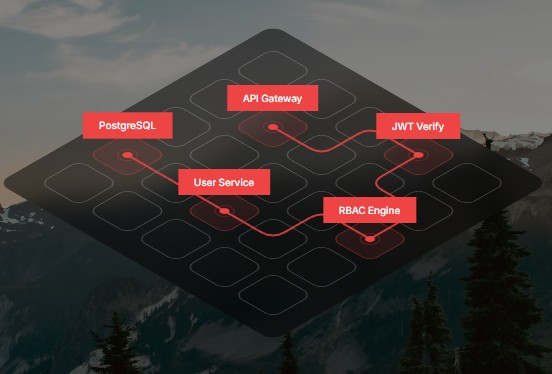
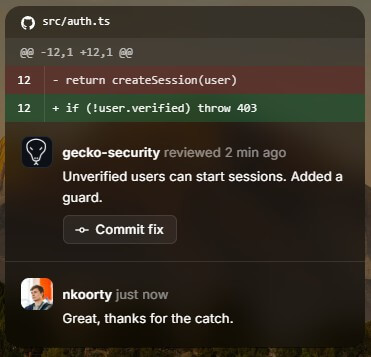
Gecko is best understood as an AI security engineer for codebases. It is not a general security dashboard, a runtime detection tool, or a compliance checklist product. It focuses on application security testing at the code and logic level.
The platform analyzes code, infrastructure, and application behavior to find exploitable vulnerabilities, then prioritizes and helps fix them. Its homepage describes three main stages: find, prioritize, and fix. It also highlights attack-path mapping, logic flaws, cross-service risks, and vulnerabilities that simple pattern-matching tools may miss.
This distinction matters. Many static analysis tools are good at finding known patterns, such as insecure functions, injection risks, or dependency issues. Gecko is aiming at a harder class of problems: flaws that depend on application intent. For example, does this endpoint check ownership before returning a record? Can a lower-privileged user trigger a path intended for admins? Does a service-to-service call skip an authorization boundary?
Gecko’s strongest fit is codebases with meaningful business logic. Simple scanners can catch obvious issues, but modern apps often fail in places where the vulnerability is not a suspicious function. It is a missing permission check, a flawed workflow, or a trust boundary that only becomes risky across several services.
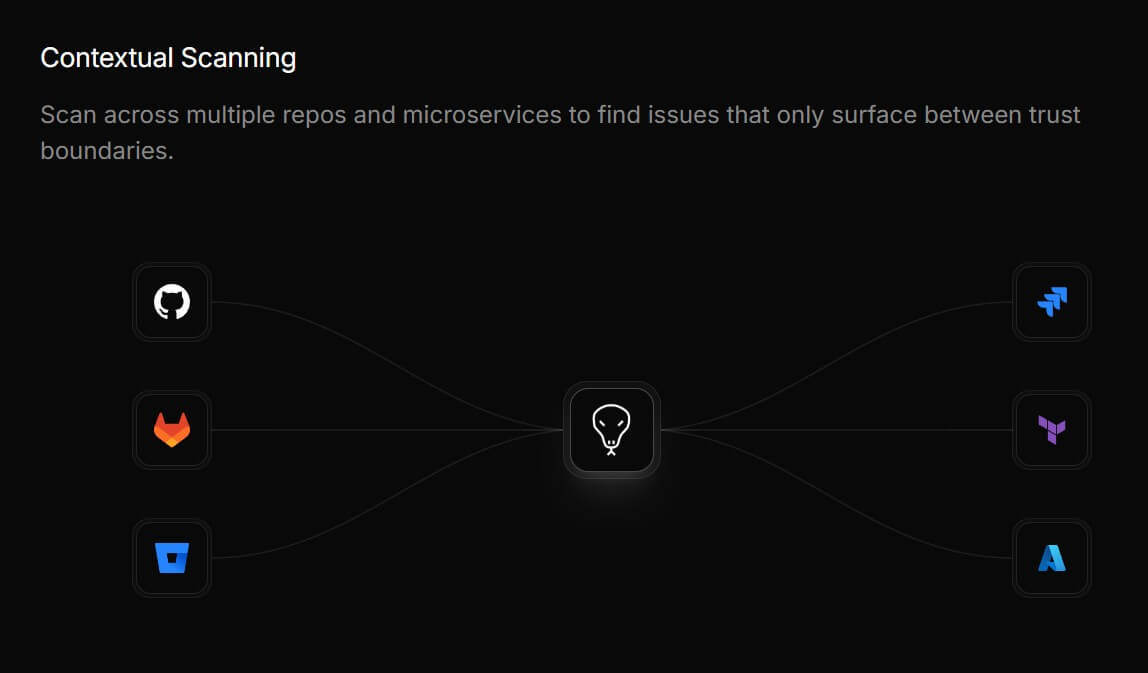
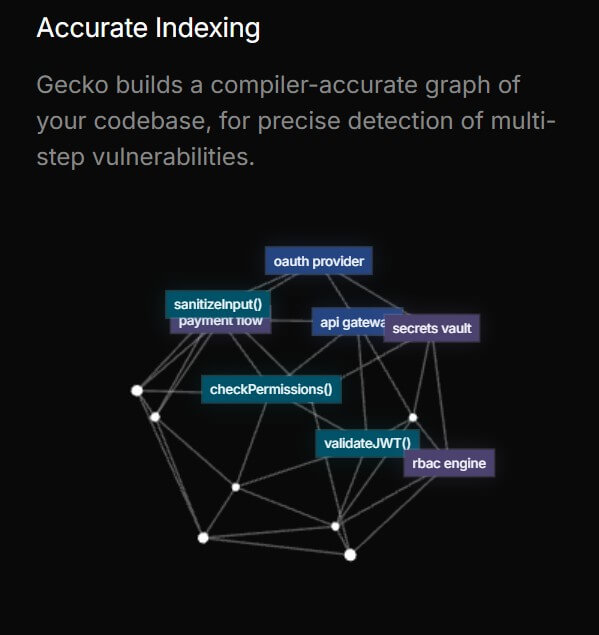
Gecko says it builds a compiler-accurate graph of the codebase to detect multi-step vulnerabilities more precisely. It also supports contextual scanning across multiple repos and microservices, which matters because some security bugs only become visible when data moves through connected systems.
This makes Gecko more compelling for SaaS companies, fintech products, marketplaces, healthcare platforms, internal enterprise apps, and any product where permissions and data access are central to security.
| Feature | Practical value |
|---|---|
| Codebase-aware analysis | Looks beyond isolated files and patterns to understand code logic and application structure. |
| Compiler-accurate indexing | Builds a graph of the codebase for detecting multi-step issues and cross-service vulnerabilities. |
| Natural language rules | Lets teams describe security policies in plain English and apply them across code, dependencies, and environments. |
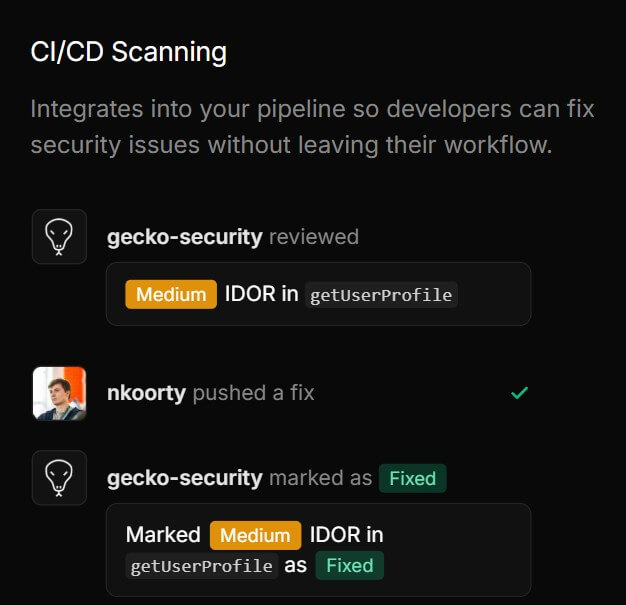
| CI/CD scanning | Fits into developer pipelines so issues can be reviewed and fixed without leaving the normal workflow. |
| Exploit validation | Gecko’s YC profile says it simulates attacks and verifies vulnerabilities by exploiting them. |
| Remediation support | Helps developers understand risk and apply working fixes instead of only reading alerts. |
The main value is not just “AI finds bugs.” The more useful claim is that Gecko tries to reduce noise by focusing on vulnerabilities that can be exploited.
Business logic vulnerabilities are one of the hardest areas in application security because they are unique to the product. A missing authorization check in a calendar app looks different from one in a payments platform or health records system. Traditional SAST tools often struggle here because the issue is not always a dangerous line of code. It is the gap between what the application should allow and what the code actually permits.
Gecko’s own writing frames this as the gap between pattern-matching scanners and semantic analysis. The company says its semantic approach maps data flows, trust boundaries, and authorization logic across the codebase, then generates proof-of-concept exploits to confirm findings.
That is the right direction for modern AppSec. The biggest security risks are not always the easiest ones to grep for. They often appear in permission models, API assumptions, object access rules, workflow transitions, and microservice boundaries.
Gecko appears designed for teams that want security findings inside the development workflow, not in a separate report that developers ignore. Its homepage describes CI/CD scanning and shows examples of PR-style review and a finding being marked fixed.
That matters because security tools fail when they create too much friction. If a scanner produces a long list of uncertain findings, developers tune it out. Gecko’s pitch is that it prioritizes what matters, validates issues, and helps with fixes, which is closer to how a good security engineer would work with a product team.
The natural language rules feature is also interesting. A security team could define policies such as “this service should not send sensitive data to a third-party API” or “this endpoint must verify user ownership.” In theory, that makes application-specific policy easier to express than writing custom static analysis rules from scratch.
Gecko Security is a strong fit for engineering teams shipping code frequently, especially where authorization and data access are hard to reason about.
- SaaS products with complex role-based access control.
- Microservice architectures where risk crosses repo or service boundaries.
- Security teams trying to reduce false positives from older scanners.
- Developers who need fix guidance, not just vulnerability descriptions.
- Companies using AI-generated code and wanting stronger review of logic-level risks.
It is less useful for teams that only need dependency scanning, basic secret detection, or a one-time compliance report. Gecko’s strongest value shows up when the application itself has enough complexity to justify semantic security analysis.
The first limitation is that AI-assisted security still needs human review. Gecko’s own terms note that AI outputs may be incorrect, inaccurate, or unoriginal and should be independently reviewed before use.
The second trade-off is access to sensitive code and context. Any tool analyzing codebases, infrastructure, and logic requires careful vendor review, permission scoping, and internal security approval. Gecko’s terms also mention third-party LLM services and customer responsibilities around data rights and sensitive information, which security-conscious teams should examine before deployment.
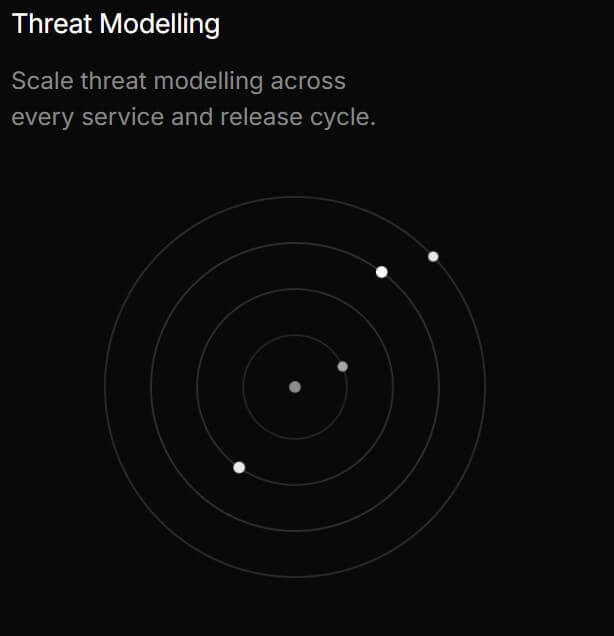
The third limitation is that no scanner replaces a full security program. Gecko may help find deeper flaws, but teams still need secure design reviews, dependency management, secrets hygiene, threat modeling, testing, monitoring, and incident response.
Gecko Security is best for engineering and AppSec teams that need deeper vulnerability detection than traditional SAST tools usually provide. Its strongest value is the combination of semantic code understanding, business logic analysis, exploit validation, prioritization, CI/CD workflow support, and remediation guidance. The main caveat is that AI security findings still need oversight. Gecko can act like an extra security engineer in the workflow, but responsible teams should still review outputs, test fixes, and treat security as an ongoing process rather than a single automated scan.
TAGS: Productivity
Related Tools:

Uses AI to analyze, automate, and visualize data
Automates web tasks
Deploys AI agents for a variety of tasks

Automates the creation of detailed, easy-to-follow digital guides

Prioritizes important emails, summarizes less critical emails

Transforms plain text into accurate formulas