
Share this tool:
 |
Description:
- Introduction
- Core Features and Capabilities
- What Vanilla Voice AI Actually Is
- What Vanilla Voice AI Does Best
- Workflow and Ease of Use
- Lead Warming and Sales Handoff
- Objection Handling and Conversation Quality
- Analytics and Optimization
- Integrations and Business Process Fit
- Best Use Cases
- Where Vanilla Voice AI Is Strongest
- Where It Is Weaker
- Privacy, Compliance, and Trust Considerations
- Practical Tips
- Final Takeaway
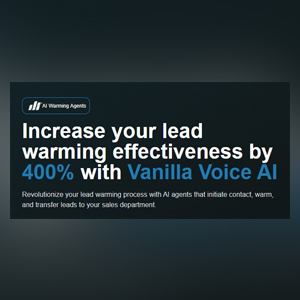
Vanilla Voice AI is an AI calling platform focused on lead warming and sales outreach. Its public positioning is clear: use human-like AI voice calls to contact aged or cold leads, handle early objections, qualify interest, and connect warm prospects to a live sales team.
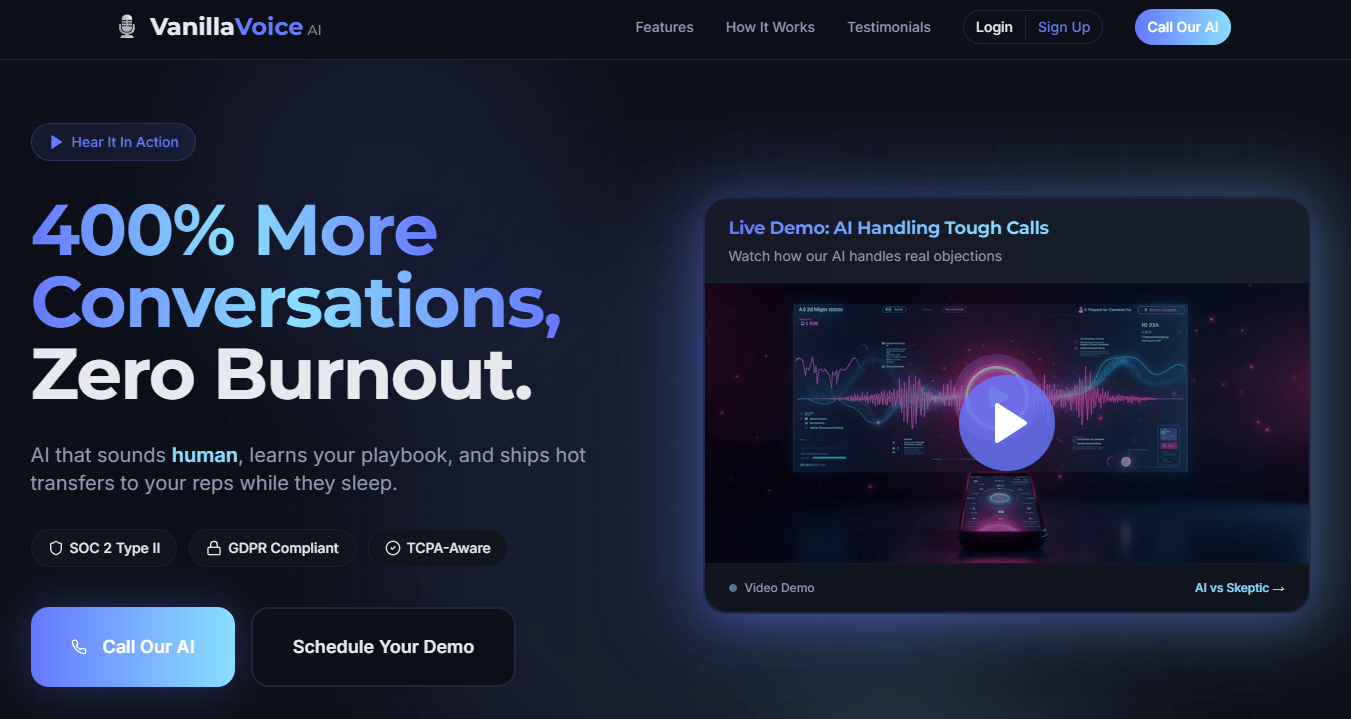
Vanilla Voice AI says its calls are designed to sound natural and help build trust during lead-warming conversations.
The platform’s homepage highlights objection handling as a core conversion feature, which is important for outbound sales calls where “not interested,” “too busy,” and “call me later” are common.
Vanilla Voice AI highlights live transfer so qualified prospects can move from the AI conversation to a human sales rep.
The product page lists real-time analytics as one of its conversion features, giving teams a way to review performance instead of treating calls as a black box.
The site says users can set parameters and let Vanilla Voice AI warm aged leads continuously.
Vanilla Voice AI has an industry-solutions page stating that its AI agents are pre-trained on calls in specific verticals, including what questions to ask and how to position value.
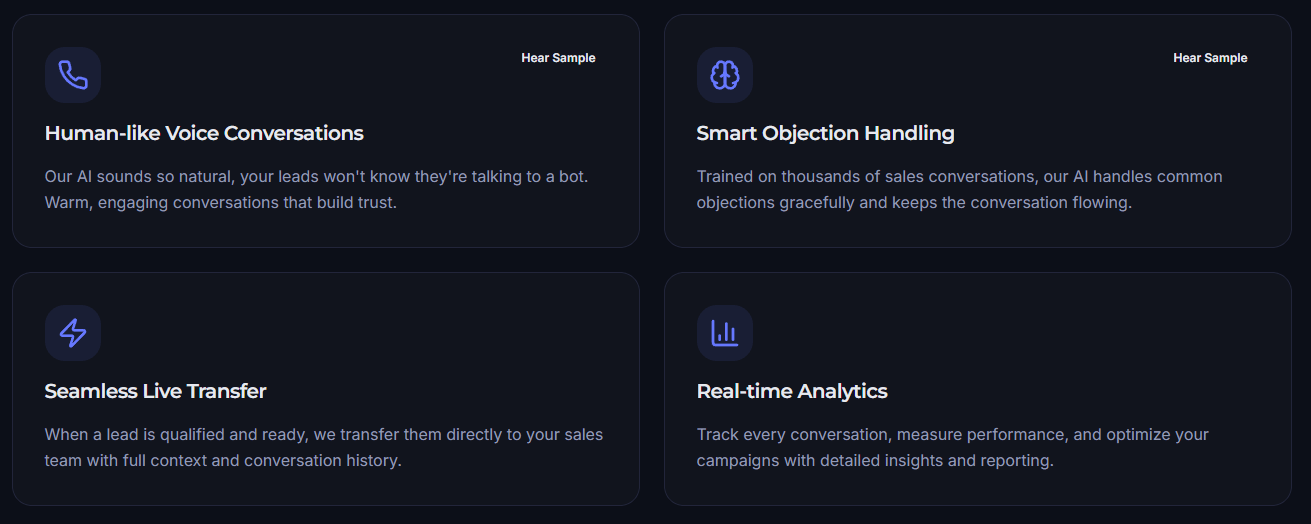
Vanilla Voice AI is best understood as a sales-focused voice-agent platform, not a general-purpose phone bot. It is built for companies that already have leads in a CRM and want to re-engage them at scale through AI-powered phone conversations.
The platform’s own messaging centers on “lead warming” rather than broad customer support. Its site says the product helps warm cold or aged leads, run human-like voice conversations, handle objections, transfer qualified prospects, and show real-time analytics.
That makes it different from a simple autodialer. A normal dialer helps reps make more calls. Vanilla Voice AI is positioned as a layer that can make the initial call itself, respond to common objections, detect interest, and pass better opportunities to humans.
| Layer | What it does | Why it matters |
|---|---|---|
| AI lead warming | Calls older or inactive leads. | Helps revive contacts that would otherwise sit untouched in a CRM. |
| Human-like voice calls | Uses conversational AI voice instead of a basic recorded message. | Makes the first contact feel less robotic than old-style phone automation. |
| Objection handling | Responds to common pushbacks. | Keeps early conversations moving without immediate human involvement. |
| Live transfer | Routes qualified or interested prospects to a sales rep. | Preserves human involvement at the moment it matters most. |
| Analytics | Tracks call outcomes and performance. | Helps teams refine scripts, lists, and follow-up strategy. |
| CRM/workflow fit | Public materials discuss CRM, calendar, and workflow integration topics. | Important because call outcomes need to become actionable sales data. |
Vanilla Voice AI is strongest when a sales team has too many stale, low-priority, or aged leads for humans to call manually. That is the use case its branding keeps returning to: revive leads, warm them up, and route the better conversations back to sales reps.
The most practical strength is scale. AI calling is useful when a business has a large backlog of contacts that are not worth assigning one-by-one to a rep yet, but are still too valuable to ignore. Vanilla Voice AI’s company LinkedIn profile describes the product around reclaiming lost revenue, reviving cold leads, recycling leads through an engagement window, and letting humans focus on closing rather than repetitive top-of-funnel calling.
The second strength is sales-process alignment. The product is not only about making calls. Its public materials mention objection handling, qualified transfers, analytics, CRM-related integration content, and lead-warming outcomes. That combination matters because sales teams do not need more call activity for its own sake. They need conversations that produce appointments, callbacks, qualified leads, or clear disqualification.
The third strength is focus. Some AI phone platforms try to handle support, scheduling, surveys, recruiting, and general call automation all at once. Vanilla Voice AI’s public positioning is narrower: sales outreach and lead warming. That is useful if the buyer’s main problem is pipeline reactivation rather than general call-center automation.
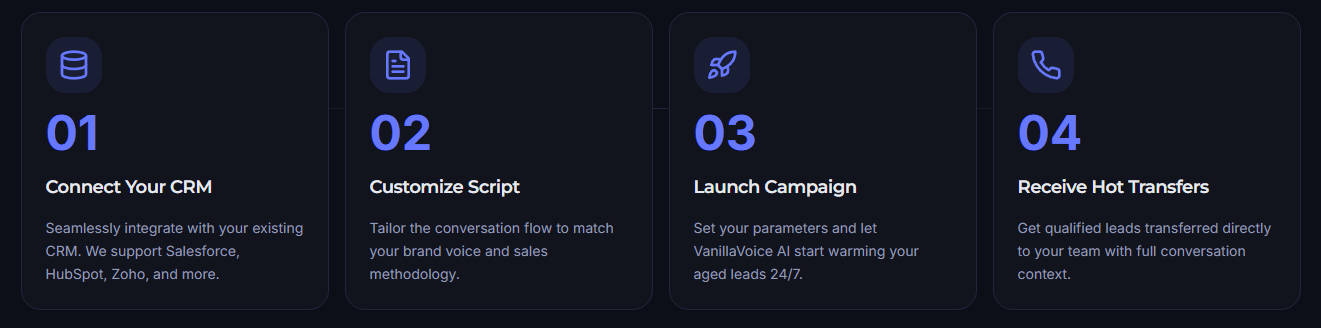
The basic workflow is straightforward in concept.
A business starts with a lead list, usually from a CRM or another sales database. Those leads may be old inbound inquiries, abandoned demos, aged form fills, past prospects, or contacts that went quiet after initial interest. Vanilla Voice AI then becomes the first-touch or reactivation layer.
The AI calls the lead, uses a sales-oriented conversational flow, responds to common objections, gauges interest, and decides whether the contact is worth sending to a human. If the prospect shows enough intent, the call can be transferred or routed to a sales rep. If not, the call outcome can still help the team understand the list quality and refine follow-up.
That is the best version of the workflow. The weaker version is simply using AI to blast through phone numbers. Vanilla Voice AI’s public messaging is more sophisticated than that, but users still need to design the process carefully. Bad targeting, weak scripts, poor lead data, or unclear handoff rules will create bad calls even if the voice technology is strong.
The tool is likely most useful for teams that already understand their sales process. A company with a clear ICP, good CRM hygiene, common objections, known qualification criteria, and a defined handoff path will get more value than a company asking AI to “figure out sales” from scratch.
Lead warming is the central idea. Instead of asking sales reps to spend time on every cold or aged lead, Vanilla Voice AI handles the early outreach and pushes forward the leads that still show intent.
That approach can be useful because not every lead deserves immediate human attention. Some are inactive. Some forgot they filled out a form. Some need a reminder. Some are curious but not ready. Some are bad fits. A voice agent can help sort those groups before a rep spends time on them.
The live transfer feature is especially important. If the AI reaches a prospect at the right moment and the prospect is interested, forcing them into a later callback can kill momentum. A direct handoff to a human sales rep is much more valuable than a call note that someone may follow up on tomorrow. Vanilla Voice AI highlights this live-transfer behavior as part of its core conversion feature set.
The key is handoff quality. A good transfer should include context: who the caller is, why they are interested, what they objected to, what they asked, and what next step they agreed to. Public company social content describes the idea of handing prospects to reps with a concise summary and next-step context, which is exactly the right pattern for this category.
Objection handling is one of the most important parts of any AI sales caller. A caller saying “I’m busy” should not be treated the same as “remove me from your list.” A prospect saying “send me details” may need a different flow from someone saying “we already use a competitor.”
Vanilla Voice AI lists smart objection handling as one of its conversion features. In real use, the quality of this feature will depend on three things: how well the AI understands the caller, how good the scripted or dynamic responses are, and how clearly the business defines escalation or stop rules.
The safest approach is to design objection handling around a few high-frequency scenarios first. For example:
| Objection Type | Best AI Response Pattern |
|---|---|
| “I’m busy” | Offer a quick callback or schedule a better time. |
| “Not interested” | Acknowledge, ask one light qualifying question, then exit respectfully if needed. |
| “Send me information” | Confirm the right email or next step, then log the request. |
| “We already have a provider” | Ask whether they are open to comparing results, but avoid pushing too hard. |
| “Take me off your list” | Stop the outreach and update records immediately. |
The last one matters most. AI outbound calling can easily become brand-damaging if opt-outs, anger signals, or compliance requests are mishandled.
Real-time analytics are not just a reporting extra. They are how a team learns whether the AI calling process is working.
Vanilla Voice AI lists analytics as part of its conversion feature set, and its blog content includes topics around measuring AI voice-agent success and quality assurance. That is the right emphasis because AI calls need monitoring. Teams should look at connection rates, transfer rates, qualified lead rates, objection frequency, opt-out rates, call duration, script performance, and post-transfer outcomes.
The best use of analytics is not vanity reporting. It is diagnosis. If many calls end in the first few seconds, the opener may be wrong. If people keep saying they do not remember the company, the data source or lead age may be the issue. If many prospects agree to a transfer but sales reps do not close, the qualification criteria may be too loose. Vanilla Voice AI should be treated as a system that improves through review. The first campaign should not be the final campaign.
For a sales voice agent, integrations matter almost as much as call quality. The agent needs to know who it is calling, where the lead came from, what the previous context was, and what should happen after the call.
Vanilla Voice AI has public content focused on CRM, calendar, and workflow integration best practices, which suggests the company is positioning the product around existing sales systems rather than isolated calling. That is important because the output of an AI call should become CRM data, calendar activity, rep notification, follow-up task, or a clear disqualification record.
The ideal setup looks like this: the CRM sends eligible aged leads into Vanilla Voice AI, the AI calls them with the right context, the outcome is written back to the CRM, and qualified prospects are transferred or scheduled for follow-up. That turns the voice agent into a pipeline operation instead of a disconnected call tool.
- Aged lead reactivation: This is the clearest fit. Vanilla Voice AI is built around warming cold or aged leads and routing qualified prospects back to sales.
- Inbound lead recycling: If a business has inbound leads that were never reached, no-showed, or stopped responding, AI calling can help determine whether they are still viable.
- Sales teams with large CRM backlogs: Teams sitting on thousands of older contacts can use the AI to identify which ones are worth human follow-up.
- Appointment-setting teams: If the primary goal is to connect a prospect to a rep or schedule a conversation, Vanilla Voice AI’s live-transfer and objection-handling focus fits well.
- High-volume lead-generation agencies: Agencies managing large lead pools may benefit from automated warming before handing leads to closers.
- Vertical-specific sales campaigns: Vanilla Voice AI’s industry-solutions page says its agents are pre-trained on calls in specific verticals, which may help teams that need more tailored outreach than a generic script.
Vanilla Voice AI is strongest when the call has a simple business goal: reconnect, qualify, transfer, or schedule. That is different from asking an AI agent to handle a complex support issue or close a deal on its own.
It is also strongest when there is already demand buried in the CRM. The tool is not a magic lead source. It works best when the company already has contacts who showed some interest but were not fully worked, not properly followed up, or not reached at the right time.
The third strength is its human-in-the-loop sales posture. The best AI sales systems do not try to remove humans from the entire process. They remove repetitive early outreach so reps can spend more time on real conversations. Vanilla Voice AI’s public messaging around qualified prospect transfer and lead warming fits that pattern.
Vanilla Voice AI is weaker when a business expects it to fix a bad sales process. If the CRM is messy, the leads are low quality, the offer is unclear, or the human sales team does not follow up quickly, AI calling will only expose the problem faster.
It is also weaker for sensitive or complex conversations. Legal advice, medical decisions, financial recommendations, angry customer recovery, nuanced enterprise buying committees, and complex negotiations should not be left to an automated voice agent without tight human escalation.
The third limitation is public documentation depth. The official website and public pages clearly describe the sales value proposition, lead-warming angle, objection handling, transfer, and analytics, but there is less publicly visible technical detail on call architecture, model stack, security certifications, workflow builder depth, transcript review, analytics dashboards, and admin controls. Buyers should verify those details directly before rollout.
The fourth trade-off is outbound-call risk. AI calling can scale faster than a human team, but that also means mistakes scale faster. Poor opt-out handling, weak targeting, repetitive calling, or unclear disclosure can create compliance and brand problems quickly.
Vanilla Voice AI has a public privacy policy explaining that it collects, uses, and safeguards information when visitors use the website and services. It also publishes blog content about voice AI compliance, including GDPR, HIPAA, and data-security best practices.
For a calling product, that is only the starting point. Businesses should ask practical questions before using it at scale: how call recordings are stored, whether calls are transcribed, how long data is retained, whether data is used for model improvement, how opt-outs are handled, how do-not-call rules are enforced, and whether callers are informed appropriately.
This matters because outbound sales calls are regulated differently across countries and regions. Call recording, consent, automated dialing, AI disclosure, opt-out handling, and telemarketing rules can all apply. The safest rollout is one where legal, sales operations, and revenue leadership agree on the process before campaigns go live.
- Start with aged inbound leads before cold outbound. Leads who already showed interest are usually safer and more relevant than unknown cold lists.
- Define transfer criteria clearly. A lead should not be sent to a human just because they stayed on the line. Decide what counts as qualified interest.
- Write objection rules carefully. “Not now,” “not interested,” “wrong number,” and “stop calling” should trigger different outcomes.
- Keep humans close to the workflow. Vanilla Voice AI is strongest as a lead-warming layer, not as a full replacement for reps.
- Review call recordings and analytics. Look for repeated objections, awkward phrasing, low-quality lead sources, and poor handoff timing.
- Respect opt-outs immediately. Scaled outbound calling only works long term if suppression and consent rules are handled properly.
- Connect the CRM before scaling. If call outcomes do not flow back into the sales system, the team will lose much of the operational value.
Vanilla Voice AI is best understood as an AI lead-warming platform for sales teams that want to revive cold or aged leads, handle early objections, and transfer qualified prospects to human reps.
Its value is clearest when a business has a large pool of existing leads that are too time-consuming for humans to call manually, but still potentially valuable.
It is best for sales teams, lead-generation agencies, appointment setters, and businesses with CRM backlogs that need structured reactivation. The main caveat is that AI calling magnifies the quality of the process behind it. With clean data, clear scripts, strong transfer rules, and responsible compliance handling, Vanilla Voice AI can act as a useful top-of-funnel accelerator. Without those pieces, it can become just another high-volume calling tool with a more natural voice.
TAGS: Voice/Audio Modulation
Related Tools:
Create and implement dynamic audio systems for games

Enables to create cross-platform 2D and 3D games
Design and build visually stunning games
Voice automation tool that makes human-like phone calls

Converts text to speech
Offers real-time voice changing capabilities