
Share this tool:
 |
Description:
- Introduction
- What Smoove Call Actually Is
- What Smoove Call Does Best
- Core Features and Capabilities
- Workflow and Ease of Use
- Voice Quality, Latency, and Conversation Flow
- Inbound Calls, Outbound Calls, and Scheduling
- Industry Fit
- Integrations and Business Process Automation
- Where Smoove Call Is Strongest
- Where It Is Weaker
- Practical Tips
- Best Use Cases
- Privacy, Compliance, and Trust Considerations
- Final Takeaway
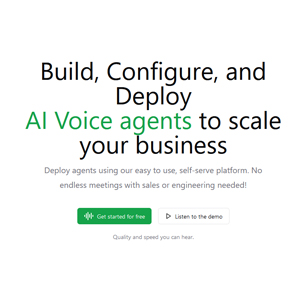
Smoove Call is an AI voice-agent platform for automating business phone conversations. Its public positioning centers on customer service, lead generation, outbound calling, and appointment scheduling, with AI agents designed to answer, qualify, schedule, transfer, and follow up across inbound and outbound call workflows.
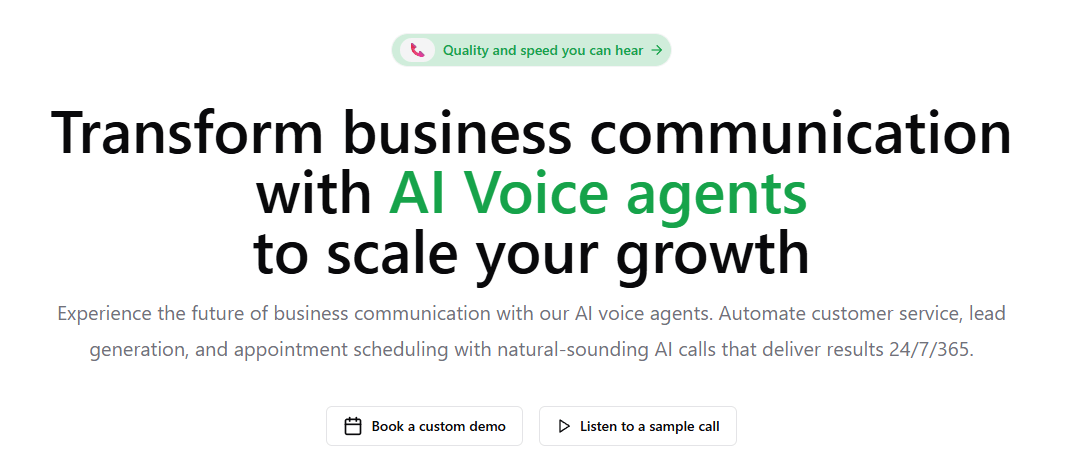
Smoove Call is best understood as a business phone automation platform, not a generic chatbot with a voice layer attached. Its core purpose is to build, configure, and deploy AI voice agents that can handle real phone conversations for companies. The strongest use cases are repetitive but valuable call flows: answering common questions, qualifying leads, booking appointments, routing calls, and handling high-volume outreach.
That matters because phone automation has a different standard from web chat. A voice agent has to respond quickly, handle interruptions, understand caller intent, speak naturally enough to keep the conversation moving, and know when to hand off to a human. Directory listings and public summaries consistently describe Smoove Call around low-latency phone conversations, inbound and outbound capabilities, live function calling, integrations, multilingual availability, and human transfer when needed.
The simplest way to understand Smoove Call is through its main workflow layers:
| Layer | What it does | Why it matters |
|---|---|---|
| Inbound call handling | Answers customer calls, routes inquiries, and manages routine requests. | Helps businesses reduce missed calls and keep service available outside normal hours. |
| Outbound calling | Calls leads, prospects, or customers automatically. | Useful for lead qualification, reminders, outreach, and follow-up campaigns. |
| Appointment management | Books, confirms, or coordinates appointments. | Strong fit for service businesses where scheduling drives revenue. |
| Live function calling | Pulls customer-specific data or triggers business processes. | Lets the agent do more than speak; it can interact with business systems. |
| Integrations | Connects with CRMs, calendars, and other workflow tools. | Helps calls become records, bookings, tasks, or follow-ups. |
| Human handoff | Transfers calls when the AI should not continue alone. | Keeps the automation from becoming a dead end for complex cases. |
Smoove Call is strongest when a business loses time or revenue because humans cannot answer every call, qualify every inquiry, or follow up with every lead quickly. Its homepage copy and third-party listings position it around automating customer service, lead generation, appointment scheduling, and 24/7/365 business communication.
Its first practical strength is call coverage. For many small and mid-sized businesses, the issue is not that the team cannot answer questions. The issue is that they miss calls during busy periods, after hours, during lunch breaks, or while staff are helping other customers. An AI phone agent is useful when the alternative is voicemail, delayed follow-up, or no response at all.
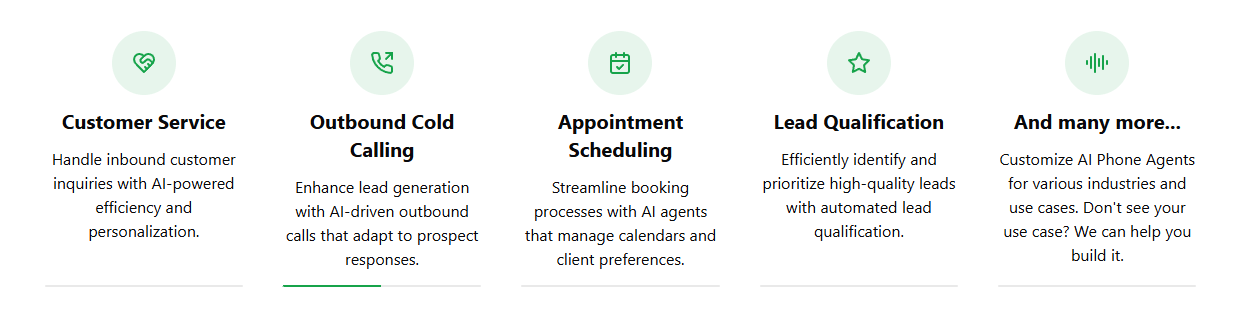
Its second strength is lead handling. Smoove Call is repeatedly described around outbound cold calling, outbound lead qualification, inbound appointment management, and automating customer support. That makes it more sales- and operations-oriented than a simple answering service. The goal is not only to answer the phone; it is to move the caller to the next step.
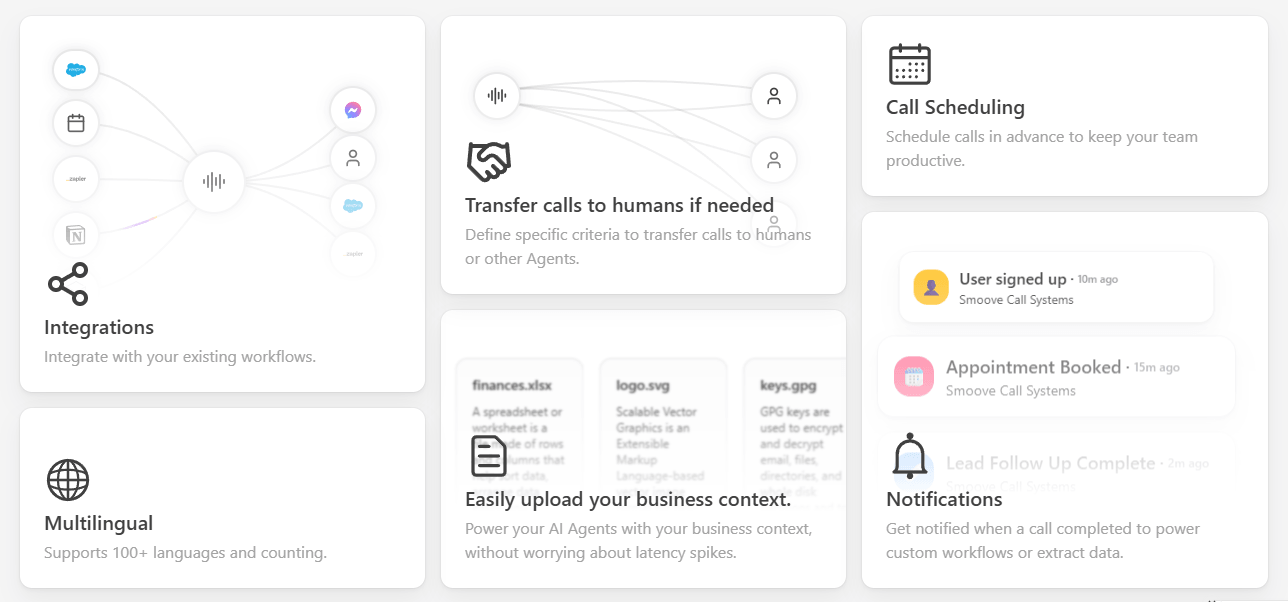
Its third strength is business-process connection. Live function calling is one of the more important capabilities because it lets the agent obtain dynamic customer-specific data or trigger custom workflows. That is the difference between a voice bot that only talks and a voice agent that can actually check availability, create a task, qualify a lead, or start a handoff process.
Build and deploy voice agents for routine business conversations, including support, sales, and scheduling workflows.
Supports both sides of phone automation, which matters for businesses that need answering and proactive outreach.
Handles calls that collect basic prospect information, determine fit, and route qualified leads to the right next step.
Automates booking and scheduling flows for industries like real estate, telehealth, and service businesses.
Retrieves dynamic information or triggers business processes during the call.
Transfers calls to human agents when the conversation requires escalation or judgment.
Smoove Call’s workflow is easiest to understand in four stages.
First, a business defines the call job. That could be “answer inbound property inquiries,” “qualify new leads,” “schedule consultations,” “handle basic patient calls,” or “call prospects and book sales meetings.” Smoove Call’s public industry pages show this positioning across real estate, telehealth, lead generation, appointment scheduling, accounting, market research, and other service-heavy categories.
Second, the business configures the agent. That usually means setting the agent’s purpose, call script or conversational flow, qualifying questions, escalation rules, scheduling logic, integrations, and handoff behavior. Public listings describe Smoove Call as a no-code platform for building, configuring, and deploying voice agents, which is important for teams that do not want to build voice infrastructure from scratch.
Third, the agent connects to business systems. This is where calendar, CRM, customer records, and workflow integrations matter. Smoove Call is described as supporting 100+ integrations and real-time integrations with existing business workflows. For real work, this part matters as much as voice quality. A call that does not update a calendar, CRM, or task system can still create manual follow-up work.
Fourth, the business reviews performance. AI calling should not be treated as “set it and forget it.” Teams need to listen to calls, check qualification quality, inspect drop-off points, refine scripts, improve knowledge, and adjust transfer rules. Smoove Call may automate the phone workflow, but the business still owns the customer experience.
Voice-agent quality is not just about whether the synthetic voice sounds pleasant. For business calls, the more important question is whether the conversation feels responsive and useful.
Latency is one of the key signals. Smoove Call is described in multiple listings as offering latency under 600ms. That matters because phone calls become awkward quickly when there is too much delay. A human caller expects quick turn-taking. If the AI pauses too long, interrupts at the wrong time, or responds before the caller has finished speaking, the experience starts to feel broken.
The second quality factor is intent handling. The agent needs to understand why the caller is calling, ask the right next question, and stay on track. For appointment scheduling, that may mean confirming service type, location, availability, and contact details. For lead generation, it may mean qualifying budget, need, timeline, and decision-maker status. For support, it may mean recognizing whether the call is routine or needs human escalation.
The third quality factor is handoff judgment. Smoove Call is described as automatically transferring calls to humans when needed. This is one of the most important safety valves in any AI calling setup. A good agent should not try to handle everything. It should know when a billing issue, angry customer, sensitive request, urgent medical concern, or complicated edge case needs a person.
Smoove Call’s value changes depending on the call direction.
Inbound workflows are usually about availability and triage. A caller reaches out because they want help, information, a quote, a booking, or a next step. Smoove Call is a good fit when the business gets repeated call types that can be answered or routed predictably. Real estate inquiries, appointment requests, basic service questions, and simple customer support are clear examples.
Outbound workflows are more sensitive because they involve proactively calling people. Public listings describe Smoove Call around outbound cold calling, outbound lead qualification, and outreach at scale. That can be valuable for sales teams, agencies, recruiters, appointment setters, and local service businesses, but it needs careful governance. Bad outbound automation can create spam complaints, brand damage, and compliance risk if it is not controlled properly.
Scheduling is the cleanest use case. It has a clear goal, measurable success, and usually a defined flow. The agent gathers information, checks availability, confirms details, and books or routes the appointment. Smoove Call’s official pages specifically call out appointment scheduling, real estate viewings, telehealth consultations, and lead-generation sales calls.
Smoove Call is broad, but the best use cases are businesses with repeatable phone conversations.
| Industry / Team | Best Workflow | Why It Fits |
|---|---|---|
| Real estate | Property inquiries, viewing scheduling, lead qualification. | Calls are frequent, time-sensitive, and often qualification-heavy. |
| Telehealth and clinics | Consultation scheduling and routine patient communication. | Useful for appointment coordination and basic routing, with strong compliance caution. |
| Lead generation agencies | Outbound qualification and sales-call booking. | Good fit when volume and consistency matter. |
| Accounting firms | Appointment scheduling and routine inquiry handling. | Useful during seasonal spikes and tax-time call volume. |
| Market research firms | Survey calling and interview scheduling. | Repetitive call flows can be structured and measured. |
| Local service businesses | Missed-call recovery, quotes, bookings, reminders. | Helps capture demand when staff are busy or unavailable. |
The key is repeatability. Smoove Call is more compelling when the phone conversation has a predictable structure and a clear success outcome. It is less compelling when calls require deep emotional intelligence, complex negotiation, legal judgment, medical advice, or unusual problem-solving.
The most important thing about an AI phone agent is what happens after the call.
A useful call should become a booked appointment, CRM update, qualified lead, support ticket, callback task, or human escalation. Smoove Call is described as offering 100+ integrations, live function calling, CRM/calendar-style workflow support, and real-time business process connections.
That makes integrations a major buying factor. A voice agent that sounds good but cannot update your systems is only half useful. The best Smoove Call setup should connect to the tools the team already uses, capture call outcomes consistently, and reduce manual re-entry.
Live function calling is especially important for dynamic conversations. For example, an agent may need to check whether a time slot is available, look up a caller record, verify whether a prospect already exists in the CRM, trigger a follow-up text, or route a high-value lead to a sales rep. Smoove Call’s public listings describe live function calling as a way to obtain customer-specific data or kick off custom business processes.
Smoove Call is strongest for businesses that need phone coverage without hiring a larger call team. If the same call types keep repeating, an AI agent can take pressure off staff and reduce missed opportunities.
It is also strong for service businesses where speed matters. A real estate lead, appointment request, consultation inquiry, or quote request often loses value if the business waits too long to respond. Smoove Call’s public use cases focus heavily on scheduling, lead qualification, and always-on phone automation, which fits that need.
The platform also makes sense for teams that want a no-code or lower-code way to deploy AI calling. Third-party listings describe Smoove Call as accessible for building and configuring voice agents without deep technical setup, while still supporting integrations and live function calling for more advanced workflows.
Smoove Call is weaker when the business wants AI to fully replace human judgment. Calls involving upset customers, complex account history, sensitive medical or financial details, legal issues, or nuanced negotiation should have clear human handoff rules.
It is also weaker if the business has poor process design. AI calling does not fix a messy calendar, unclear qualification criteria, outdated CRM data, weak scripts, or undefined escalation paths. The agent can only follow the process it is given.
Outbound calling is another area that needs caution. Smoove Call can support cold calling and outbound qualification, but businesses still need to manage consent, calling rules, opt-outs, local regulations, call recording laws, and brand risk. The more aggressive the outbound campaign, the more important compliance and quality control become.
The final limitation is public documentation depth. Smoove Call’s public pages and listings describe the major features clearly enough, but compared with some developer-first voice-agent platforms, there is less visible technical documentation around model choices, telephony architecture, testing tools, analytics depth, security posture, and compliance certifications. That does not mean those features are absent, but buyers should verify them during a demo rather than assuming.
- Start with one high-value call flow. Appointment scheduling, missed-call recovery, or inbound lead qualification is easier to test than automating every phone interaction at once.
- Write clear escalation rules. The agent should know when to transfer to a human, create a callback task, or stop the automation.
- Connect the calendar and CRM early. The best phone agent workflow is not just conversation; it is conversation plus action.
- Use real call examples during setup. Build the agent around the questions, objections, and edge cases your actual callers use, not an idealized script.
- Review call recordings and outcomes. Listen for awkward pauses, misunderstood intent, incorrect routing, and places where callers repeat themselves.
- Be careful with outbound campaigns. Use compliant lists, respect opt-outs, identify the caller appropriately, and avoid turning automation into spam.
- Test sensitive industries more heavily. Healthcare, finance, legal, insurance, and real estate can benefit from AI calling, but they also need stricter review and compliance guardrails.
- Inbound lead capture: Smoove Call is a good fit when a business gets phone leads but cannot always answer quickly.
- Appointment scheduling: The clearest use case is booking calls, consultations, viewings, demos, or service appointments.
- Real estate inquiries: Smoove Call’s real estate page positions the tool around handling property inquiries, scheduling viewings, and qualifying leads.
- Telehealth scheduling: The telehealth page describes using AI-powered calling to schedule consultations and manage patient care workflows.
- Sales outreach and qualification: Lead-generation agencies and sales teams can use Smoove Call for outbound qualification and sales-call scheduling.
- Customer support triage: It can handle routine support inquiries and route complex calls to humans.
- Market research and surveys: Smoove Call’s market research page positions the tool around conducting surveys, scheduling interviews, and collecting data through AI-powered calling.
Phone automation touches sensitive areas quickly. Calls can include names, phone numbers, appointment details, customer histories, health-adjacent questions, financial questions, sales objections, and recorded conversations.
That means Smoove Call should be evaluated not only on voice quality, but also on governance. Businesses should ask how call recordings are stored, whether calls are transcribed, how customer data is handled, whether data is used for model improvement, what retention controls exist, what integrations can access, and how opt-outs are handled.
Industry-specific use also needs extra scrutiny. Smoove Call has public pages for telehealth and accounting-style workflows, but those industries can involve stricter compliance duties depending on the country, state, and exact use case. The safe approach is to use the AI for scheduling, routing, and routine administrative handling first, while keeping sensitive advice, diagnosis, legal interpretation, or financial judgment with qualified humans.
Smoove Call is best understood as an AI phone-agent platform for businesses that want to automate routine calls without losing the ability to schedule, qualify, integrate, and hand off to humans.
Its strongest value is in repetitive, high-volume, time-sensitive workflows: missed-call handling, appointment scheduling, lead qualification, outbound follow-up, customer support triage, and industry-specific call automation.
It is best for service businesses, sales teams, lead-generation agencies, clinics, real estate teams, market research firms, and local operators that need more phone coverage than their staff can provide. The main caveat is that AI calling only works well when the workflow is clear. The agent needs good scripts, accurate business data, strong integrations, careful escalation rules, and regular review to avoid becoming an automated version of a bad call process.
TAGS: Voice/Audio Modulation
Related Tools:

Enhances online communication by eliminating background noise

AI virtual camera with voice modulation

Transforming audio and video recordings into polished, shareable content

Enables to create cross-platform 2D and 3D games
Voice automation tool that makes human-like phone calls

Transforms written texts to voiceovers