
Share this tool:
 |
Description:
- Introduction
- What MetaVoice Speech Actually Is
- What MetaVoice Speech Does Best
- Core Features and Capabilities
- Why the Call Focus Matters
- Workflow and Ease of Use
- Speech Quality and Control
- Speech-1 vs Older MetaVoice-1B
- Best Use Cases
- Where MetaVoice Speech Fits in the Market
- Practical Tips
- Limitations and Trade-Offs
- Final Takeaway
MetaVoice Speech is a real-time speech model for AI phone agents, built around the parts of voice AI that usually break in live calls: tone, pacing, interruptions, natural pauses, and reliable pronunciation of practical details like names, numbers, emails, and addresses. It is not positioned like a general creator voiceover tool. Its clearest purpose is helping developers build AI agents that sound more natural during lead qualification, appointment handling, customer support, and receptionist-style phone workflows.
MetaVoice Speech is the public product surface for Speech-1, MetaVoice’s conversational speech model for voice AI agents. The company describes Speech-1 as purpose-built for customer phone calls, with the goal of making AI voice experiences sound more familiar and natural, closer to a human agent than to a scripted narrator.
That distinction matters. A lot of text-to-speech products are optimized for polished narration, audiobooks, ads, explainers, or creator audio. MetaVoice Speech is aimed at a narrower but harder problem: live conversations where the voice needs to respond quickly, sound emotionally appropriate, and survive awkward real-world call details.
The easiest way to understand it is this:
- Use it when the voice is part of a live AI agent.
- Use it when call completion matters more than studio-style narration.
- Use it when the AI must say messy real-world details clearly.
- Use it when latency, tone, pacing, and trust are central to the product experience.
That makes MetaVoice Speech more of a voice infrastructure product than a simple “generate an MP3” tool.
MetaVoice Speech is strongest in four areas.
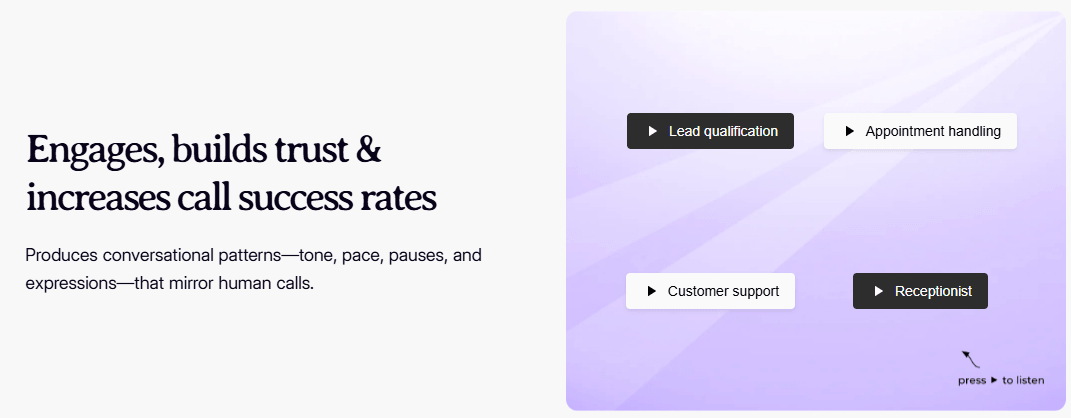
First, it focuses on conversational delivery. MetaVoice says its voice AI produces patterns such as tone, pace, pauses, and expressions that mirror human calls. That is the core value proposition: not just speech that sounds realistic in isolation, but speech that works inside a phone conversation.
Second, it handles context-aware tone and flow. The product page says the model understands word meaning in context and adjusts tone, rhythm, and expression accordingly. That matters because call agents often fail when they sound cheerful at the wrong moment, too stiff during confirmation steps, or too scripted during sensitive exchanges.
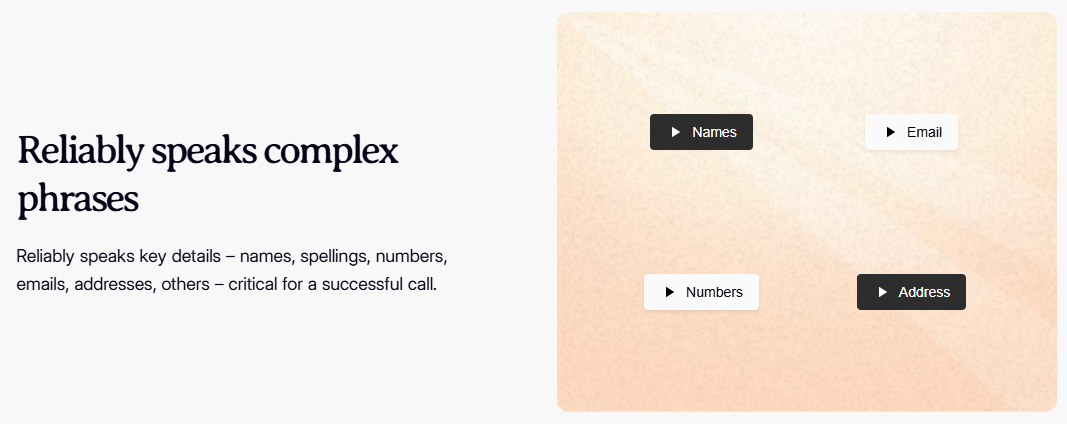
Third, it is built for complex call details. MetaVoice specifically calls out names, spellings, numbers, emails, and addresses as details Speech-1 is designed to speak reliably. That is a practical strength because many voice agents sound good in demo conversations but become frustrating when confirming “poorvanangia08@gmail.com,” reading a postcode, or spelling a customer’s name.
Fourth, it is built for streaming. MetaVoice states that Speech-1 has a p90 time to first audio of under 250 ms, positioning it for real-time use rather than slow batch generation. For voice agents, this is not a minor spec. Delayed audio makes an AI agent feel less responsive, increases interruption problems, and makes the call feel less human.
Produces call-style tone, pacing, pauses, and expressions instead of polished audiobook narration.
Adjusts rhythm and expression based on the meaning of the words being spoken.
Built to speak names, numbers, emails, spellings, addresses, and similar call-critical details more clearly.
Designed for low-latency voice agent workflows, with MetaVoice listing p90 time to first audio under 250 ms.
Publicly positioned around lead qualification, appointment handling, customer support, and receptionist workflows.
MetaVoice’s stated mission is to help developers create better AI voice calling experiences.
The most important thing about MetaVoice Speech is that it is not trying to win every voice AI category. It is trying to solve a specific failure point in voice agents.
MetaVoice’s own blog argues that many current speech models sound realistic but are still too content-production-oriented, with audiobook-like narration and speech patterns that do not match normal customer service calls. The company’s critique is that a voice can sound impressive in a demo and still feel wrong in a live conversation.
That is a useful framing. In call automation, the final mile is not just “does the audio sound human?” It is also:
- Does the AI pause naturally?
- Does it speak confirmation details clearly?
- Does it avoid weird emotional spikes?
- Does it respond quickly enough to feel live?
- Does it sound like a helpful agent rather than a synthetic narrator?
- Does the caller stay on the line?
MetaVoice Speech is built around those questions. That makes it especially relevant for teams building voice agents where user trust, call completion, and conversational comfort are the product.
The public product page is simple: MetaVoice presents Speech-1 as a conversational speech layer for voice AI agents, with audio examples and a direct “Try Speech-1 now” path. The broader positioning is clearly developer-facing rather than consumer-editor-facing.
That means the workflow is likely to feel different from creator tools such as classic text-to-speech studios. A creator TTS workflow usually starts with a script, a voice picker, and an export button. MetaVoice Speech is better understood as a component inside a real-time agent system: the user speaks, the system listens, the agent decides what to say, and Speech-1 delivers the spoken response quickly enough to keep the call flowing.
In practice, the important workflow questions are not “how many voices are in the library?” or “can I make a polished narration track?” They are:
| Workflow question | Why it matters |
|---|---|
| Can it start speaking quickly? | Live phone agents feel broken when responses lag. |
| Can it say messy details clearly? | Names, emails, addresses, and numbers are common in real calls. |
| Does it sound conversational rather than theatrical? | A call agent should not sound like an audiobook narrator. |
| Does tone adapt to context? | A sales call, support call, and confirmation step need different delivery. |
| Can developers fit it into their stack? | The product is aimed at AI voice calling experiences, not just standalone audio generation. |
That call-first workflow is MetaVoice Speech’s biggest strength and also its biggest limitation. It is sharply focused, which is good if you are building AI phone agents. It is less useful if you want a broad audio production suite.
MetaVoice Speech is designed around conversational realism, not just clean audio. The company’s product page emphasizes tone, pace, pauses, expressions, context-aware delivery, and reliable handling of complex phrases. Its launch blog also positions Speech-1 as an answer to common voice-agent problems such as erratic tone, audiobook-like narration, chipmunk-like effects during confirmations, and failures on names and emails.
That gives it a different quality target from many AI voice tools. A perfect creator voiceover might be crisp, dramatic, and emotionally polished. A good AI call voice needs to be calm, adaptive, fast, and understandable under pressure.
The most valuable quality signals are:
- Natural pacing in short replies.
- Controlled emphasis when confirming details.
- Clear pronunciation of practical data.
- Consistent tone across a full call.
- Low-latency response behavior.
- Avoiding overacted or overly polished delivery.
The product’s public materials do not present Speech-1 as a full voice editing suite with detailed manual controls. Instead, the emphasis is on model behavior: the speech itself should infer the right tone and rhythm from context. That is a cleaner experience when it works, but it also means users who want granular studio-style direction may find it less flexible than tools designed for voiceover production.
There is one naming issue worth clearing up. MetaVoice also has an older open-source model, MetaVoice-1B, available through GitHub and Hugging Face. That model is a 1.2B-parameter text-to-speech model trained on 100,000 hours of speech and supports voice cloning workflows, including zero-shot cloning for American and British voices with a 30-second reference audio sample.
That is not the same thing as the current MetaVoice Speech page.
| Product / model | Best understood as | Main fit |
|---|---|---|
| Speech-1 | Current conversational speech model for AI phone agents. | Real-time customer calls and voice-agent delivery. |
| MetaVoice-1B | Open-source foundational TTS model. | Developers experimenting with expressive TTS and cloning. |
This distinction matters because a review of MetaVoice Speech should not treat it like the old Studio-style voice changer or only like the open-source model. The current /speech page is about real-time conversational speech for AI agents, and Speech-1 is the key product name to use.
- Lead qualification agents: MetaVoice Speech is a strong fit when an AI agent needs to ask questions, confirm details, and keep a prospect engaged without sounding robotic. MetaVoice explicitly lists lead qualification as one of its target call workflows.
- Appointment handling: Scheduling calls often involve names, dates, times, locations, phone numbers, and email confirmations. This plays directly into Speech-1’s focus on reliable complex phrase delivery.
- Customer support calls: Support agents need calm tone control, clear confirmations, and fast response timing. MetaVoice’s context-aware tone and streaming positioning make sense for this kind of workflow.
- AI receptionist systems: Receptionist calls are often short, repetitive, and detail-heavy. The AI needs to sound natural quickly, route the caller, and confirm information without creating friction. MetaVoice lists receptionist workflows directly on the Speech page.
- Voice-agent developers: This is probably the clearest audience. MetaVoice says its mission is to help developers create better AI voice calling experiences, and its homepage frames the broader company goal around making voice AI feel like talking to a person.
MetaVoice Speech is best understood as a specialist layer for real-time voice agents. It is not trying to be the broadest AI audio platform. It is not mainly a podcast narrator, dubbing studio, sound effects generator, transcription suite, or music tool. Its strength is much narrower: making AI phone agents sound more natural and effective during live calls.
That narrowness is a good thing for the right buyer. Voice AI has a lot of failure modes that do not show up in normal TTS demos. A model can sound great reading a paragraph and still fail badly when it has to say an email address, respond after a half-interruption, or confirm a name without sounding unnatural. MetaVoice is explicitly focused on those call-specific issues.
The trade-off is that teams looking for a general-purpose creator audio platform may need more than MetaVoice Speech. If your workflow is audiobook narration, multilingual dubbing, voice library browsing, video localization, or post-production editing, a broader audio tool may make more sense. If your workflow is real-time phone agents, MetaVoice Speech is much more directly aligned.
- Test it with real call scripts, not polished demo text. Use messy customer-service lines, appointment confirmations, address readbacks, spelling sequences, and email confirmations. That is where Speech-1’s strengths should show up.
- Benchmark latency inside the full agent stack. MetaVoice lists p90 time to first audio under 250 ms for Speech-1, but the full experience also depends on speech recognition, reasoning, orchestration, network conditions, and telephony setup.
- Evaluate tone over an entire call. A single sentence can sound impressive. A five-minute support or qualification call reveals whether tone stays coherent.
- Use domain-specific test sets. A healthcare receptionist, real-estate appointment setter, and debt collection assistant need very different tone behavior. Test the actual call type you plan to deploy.
- Stress-test names, addresses, and numbers. MetaVoice emphasizes reliable complex phrase delivery, so these should be core evaluation cases rather than afterthoughts.
- Do not judge it like a narration tool. Speech-1 is more interesting when it sounds naturally conversational than when it sounds dramatically polished.
The first limitation is scope. MetaVoice Speech is focused on conversational voice agents, especially phone-call workflows. That makes it less obviously useful for creators who want a broad audio studio, long-form narration workflow, dubbing controls, transcription, sound effects, or heavy post-production editing.
The second limitation is public product detail. The Speech page explains the high-level strengths clearly, including conversational delivery, context-aware tone, complex phrase handling, and streaming latency. But it does not expose a large amount of public detail about voice libraries, customization controls, supported languages, deployment options, dashboard features, or safety tooling on the page itself.
The third limitation is evaluation difficulty. Voice-agent quality depends on the whole system, not just the speech model. A poor ASR layer, weak turn-taking logic, slow LLM response, or brittle call orchestration can make even a good speech model feel bad. MetaVoice’s own broader blog argues that today’s voice AI often suffers from turn-based, pipeline-like architectures and that more natural systems need to handle overlapping speech, backchannels, and interruptions better.
The fourth limitation is that naturalness is still context-sensitive. A voice can sound excellent in one industry and slightly wrong in another. Support, sales, healthcare, education, collections, and coaching all require different emotional boundaries. MetaVoice’s context-aware tone is the right direction, but serious teams should still test it with domain-specific conversations.
The fifth limitation is that Speech-1 should not be confused with older MetaVoice materials. Some search results and third-party writeups still describe MetaVoice Studio, voice changing, or MetaVoice-1B. The current /speech page is centered on Speech-1 for conversational AI agents, so older descriptions may not reflect the current product focus.
MetaVoice Speech is a specialist AI speech product for real-time voice agents, not a general-purpose voiceover studio. Its strongest value is in the details that decide whether an AI phone call feels usable: conversational pacing, context-aware tone, clear confirmation of names and numbers, and low-latency streaming.
It is best for developers and companies building AI receptionists, support agents, appointment handlers, and lead qualification systems.
The main caveat is that its public positioning is narrow by design. If you need a full creator audio platform, look elsewhere. If you need the spoken layer of an AI phone agent to feel more natural and reliable, MetaVoice Speech is one of the more focused tools to evaluate.
TAGS: Voice/Audio Modulation
Related Tools:
Offers real-time voice changing capabilities

Enables users to create 2D games for various platforms

Transforms voices into professional performances for media projects

Allows users to create and publish their own role-playing games

Animates people in videos to speak any language

Allows developers to create and publish 2D and 3D games