

Share this tool:
 |
Description:
- Introduction
- What CrewAI Actually Is
- Where CrewAI Is Strongest
- Strong Features and Capabilities
- Crews, Flows, and Why the Split Matters
- Tools, Knowledge, and Real Workflows
- Enterprise Platform and Production Control
- Workflow and Ease of Use
- How It Compares to Other Agent Frameworks
- Best Use Cases
- Limitations and Trade-Offs
- Final Takeaway
CrewAI is an AI agent orchestration platform for teams that want to build systems made of multiple agents, not just one chatbot wrapped around a prompt. Its core idea is that complex work can be broken into roles, tasks, tools, and workflows. A research agent gathers information, an analyst reviews it, a writer prepares the output, and a manager agent or flow controls how the work moves. That makes CrewAI useful for agentic automation, but it also means the tool is best suited to users who understand processes, not people looking for a casual AI assistant.
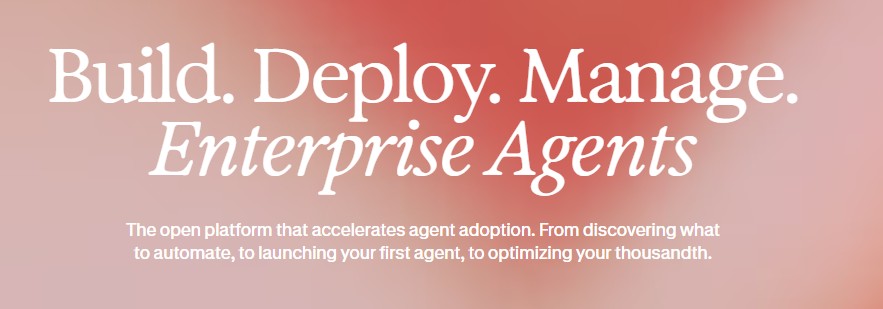
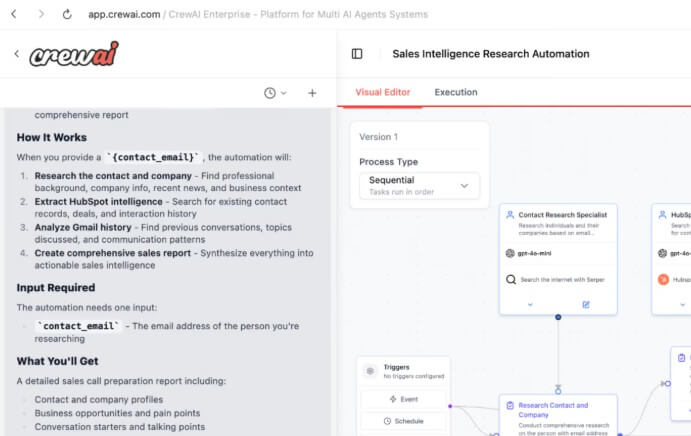
CrewAI has two closely related parts. The first is the open-source framework for building autonomous agents, crews, and flows. The second is CrewAI’s enterprise platform, now positioned around building, deploying, and managing production agents. CrewAI’s docs describe it as a framework for orchestrating autonomous AI agents and building complex workflows by combining Crews with Flows.
The distinction between Crews and Flows is central. A Crew is a group of agents working together on assigned tasks. Each agent can have a role, goal, tools, memory, and model configuration. A Flow is the control structure around the work. It handles state, events, branching, loops, and execution order. CrewAI’s own guidance says production-ready applications should generally start with a Flow, then use Crews inside Flow steps when autonomous collaboration is useful.
That is the best way to understand CrewAI: Crews bring intelligence and collaboration; Flows bring control.
CrewAI is strongest when a task has multiple stages and benefits from specialized roles. A single-agent workflow may be enough for “summarize this document.” CrewAI becomes more useful for work like competitive research, sales intelligence, financial analysis, content operations, customer support triage, software engineering tasks, report generation, or internal process automation.
The reason is structure. Multi-agent systems can become messy fast if every agent just talks freely. CrewAI gives developers a way to define agents, assign tasks, set execution processes, attach tools, manage memory, and control the workflow around the agents. Its docs describe crew attributes such as agents, tasks, process type, manager LLM, function-calling model, memory, cache, request limits, and configuration settings.
That makes it more practical than a loose “agents chatting with each other” demo. The product still gives agents autonomy, but it puts that autonomy inside a defined process.
| Feature | Practical value |
|---|---|
| Crews | Lets teams build groups of specialized agents that collaborate on defined tasks. |
| Flows | Adds state, branching, event handling, and execution control around agent workflows. |
| Tools and MCP support | Allows agents to search, interact with websites, query databases, run code, and connect to external tools. |
| Knowledge | Gives agents access to external information sources so responses can be grounded in domain material. |
| Memory | Supports longer-running agent behavior by letting agents retain useful context across work. |
| Enterprise control plane | Adds observability, governance, RBAC, audit trails, human checkpoints, and production monitoring. |
The most important feature is not one item in the table. It is the way CrewAI separates creative agent work from procedural control. That separation matters if you are moving from prototypes to production.
A common mistake with agent platforms is making everything agentic. That sounds exciting at first, but it can make systems harder to debug. CrewAI’s Flow model is a useful correction. A Flow can decide when something starts, what data is passed forward, when a branch should run, and when a crew should be invoked. The crew then handles the part that benefits from agent collaboration.
For example, a market research workflow might start with a trigger, collect company names, send a research task to a crew, validate the result, route weak outputs for another pass, then generate a final report. The agents do the research and analysis. The Flow keeps the whole process from turning into an open-ended conversation.
That is where CrewAI feels mature. It acknowledges that agents need room to reason, but business workflows need boundaries.
Agents are only useful when they can reach the information and systems needed for the task. CrewAI supports tool use across search, web interaction, vector databases, code execution, MCP servers, and sandboxed environments such as E2B and Daytona.
The Knowledge feature is also important. CrewAI describes Knowledge as a way for agents to access external information sources during tasks, like giving them a reference library. Its docs mention benefits such as domain-specific information, real-world grounding, context across conversations, and more factual support.
This is useful for internal knowledge assistants, compliance workflows, customer support agents, research pipelines, and document-heavy operations. The caveat is that knowledge setup still matters. Bad documents, stale data, unclear chunking, or weak retrieval rules can lead to weak agent output. CrewAI gives teams the system, but they still need to prepare the sources well.
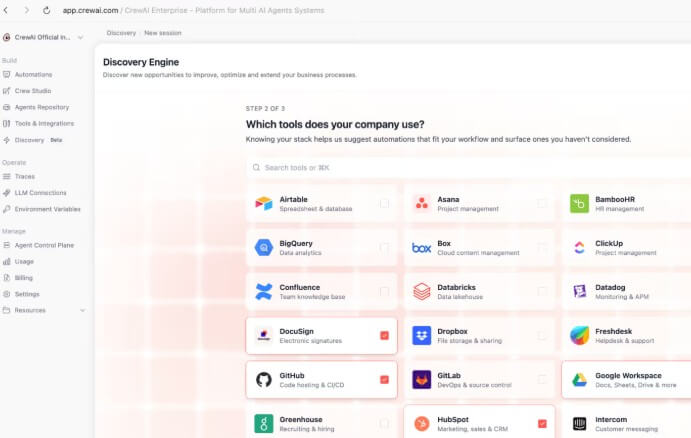
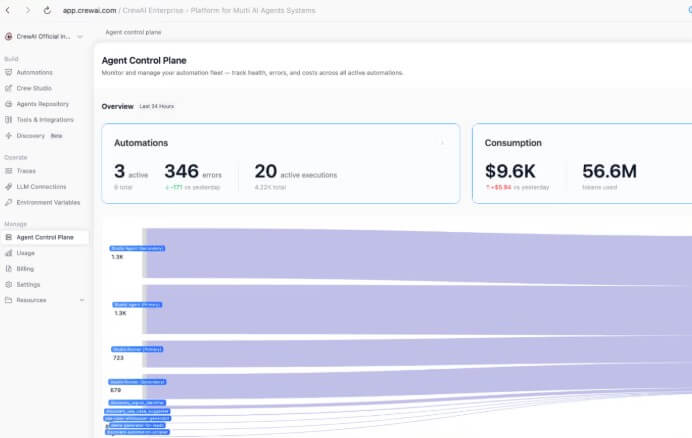
CrewAI’s enterprise side is aimed at the harder stage of agent adoption: managing agents after pilots become real workflows. The Agent Management Platform is described as a way to build crews that interact with enterprise applications and use tools to automate workflows, with or without code. It also emphasizes real-time monitoring, centralized visibility, governance, role-based access, audit trails, human-in-the-loop checkpoints, and compliance controls.
This matters because agent sprawl becomes a real issue. A company may begin with one research agent, then add support agents, sales agents, operations agents, and internal productivity agents. Without a control layer, it becomes hard to know what is running, who changed it, what data it can access, and whether the outcomes are improving.
CrewAI’s newer Discovery positioning also shows where the platform is going. The homepage says CrewAI Discovery helps identify automation opportunities by analyzing tickets, chats, apps, and workflows, then ranking opportunities by effort, value, and readiness.
That is a useful enterprise angle. Many companies do not just need an agent builder. They need help deciding what should become an agent workflow in the first place.
CrewAI is approachable for developers, but it is not a beginner productivity app. The open-source framework expects users to think in agents, tasks, tools, YAML or code, model setup, execution processes, and state. The docs also reference installation, CLI setup, project layout, agent templates, tasks, guardrails, callbacks, and human-in-the-loop triggers.
For technical teams, that structure is a strength. CrewAI gives enough abstraction to move faster than building an agent runtime from scratch, while still leaving control over models, tools, and orchestration. For non-technical users, the enterprise platform’s no-code and managed deployment direction may help, but CrewAI still feels best when someone on the team understands automation design.
CrewAI’s closest competitors are not general chatbots. They are agent orchestration frameworks and production platforms. LangGraph is stronger when teams want lower-level graph control, durable execution, streaming, and human-in-the-loop workflows inside the LangChain ecosystem. Its docs describe it as focused on the underlying orchestration capabilities needed for agent systems.
AutoGen has long been known for multi-agent experimentation and research-style agent collaboration. Microsoft’s current AutoGen documentation describes it as an event-driven framework for scalable multi-agent systems, while its GitHub repository notes that AutoGen is now in maintenance mode and community managed.
CrewAI’s edge is its clearer “crew plus flow” mental model and its push toward enterprise agent management. LangGraph may appeal more to teams that want graph-level control. CrewAI may feel faster for teams that think in roles, tasks, and business workflows.
CrewAI is a strong fit for research automation, competitive intelligence, sales preparation, support triage, document review, report generation, coding assistants, operations workflows, and internal knowledge agents. It works best when the workflow can be broken into roles and steps.
It is less ideal for simple chatbot use, one-off content generation, or casual personal automation. In those cases, the structure may be more than you need.
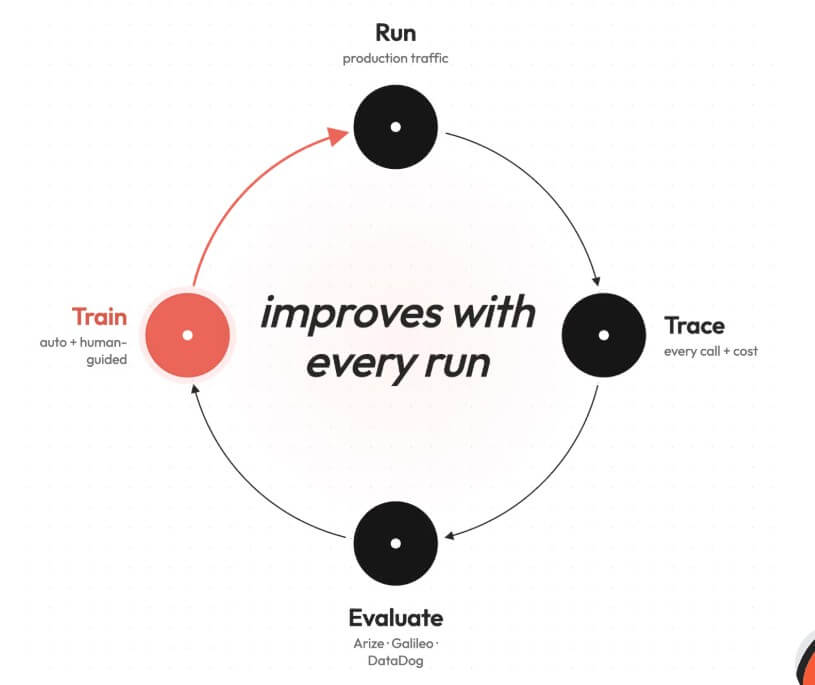
The first limitation is complexity. Multi-agent systems can be powerful, but they are harder to test than single prompts. Teams need evaluation, logging, retry handling, guardrails, and human review for important workflows.
The second trade-off is cost and latency at the architecture level. More agents often means more model calls, more tool calls, and more failure points. A well-designed Flow can control this, but poor design can make the system slower and less reliable.
The third caveat is that CrewAI does not remove the need for process design. It can orchestrate agents, but your team still has to define what success looks like, which steps need autonomy, and where humans must stay in the loop.
CrewAI is best for developers and enterprises building multi-agent workflows that need both autonomy and control. Its strongest value is the combination of Crews for collaborative agent work, Flows for structured orchestration, Knowledge and tools for real-world context, and an enterprise layer for deployment, governance, and monitoring. The main caveat is that CrewAI is not a shortcut around system design. It rewards teams that know their process, define clear boundaries, and treat agents as production software rather than experiments.
TAGS: Productivity
Related Tools:

AI-powered data analysis platform

Creates interactive guides and product demos
Automates and optimizes the job application process

AI-enhaanced calendar for scheduling
Enhances digital note-taking and sketching

Simplifies time tracking and billing