

Share this tool:
 |
Description:
Apify is a cloud platform for web scraping, browser automation, and data extraction. Its main value is practical: it gives teams a way to collect structured data from websites without building every scraper, proxy setup, storage layer, scheduler, and API integration from scratch. It is especially relevant now because AI products need fresh web data, and Apify has positioned Actors as reusable tools that can feed applications, agents, research systems, lead databases, and market-monitoring workflows.
The center of Apify is the Actor. An Actor is a serverless program that takes structured JSON input, runs a task such as scraping, crawling, browser automation, or data processing, and returns structured output. Actors can be run manually, through the API, on a schedule, or as part of larger automation workflows.
That design makes Apify more flexible than a single-purpose scraping API. You can use an existing Actor from the Apify Store, build your own with JavaScript, TypeScript, or Python templates, run it in Apify’s cloud, store the results, and connect the output to other tools. Apify’s homepage describes a large marketplace of ready-made Actors for scraping websites, automating web tasks, and feeding AI with live web data.
The product is not only for scraping pages. It also includes storage, schedules, proxy infrastructure, integrations, monitoring, collaboration, API access, SDKs, CLI tooling, and an MCP layer for AI agents. That broader stack is why Apify feels closer to web data infrastructure than a lightweight scraper.
Apify is strongest when a team needs repeatable data extraction rather than one-off page scraping. A marketer can pull leads from public directories. A product team can monitor competitors. A data team can collect ecommerce listings. A researcher can gather public web data. An AI team can give an agent a tool for fetching current information from websites.
The strongest use case is not “get the HTML of one page.” It is “run a reliable extraction job again and again, store the output, export it, and connect it to another system.” Apify’s platform docs frame the product around Actors, storage, schedules, proxy, integrations, and monitoring, which are the exact pieces needed to make scraping operational instead of experimental.
| Feature | Practical value |
|---|---|
| Actors | Package scraping, crawling, automation, and data-processing jobs into reusable serverless tools. |
| Apify Store | Lets users start from thousands of ready-made scraping and automation tools instead of building from scratch. |
| Datasets | Store structured Actor results and export them in formats such as JSON, CSV, Excel, XML, or RSS. |
| Proxy | Rotates IP addresses and monitors proxy health to reduce blocking risk during scraping tasks. |
| API and clients | Provides REST API access plus JavaScript and Python clients for backend integrations. |
| MCP for AI agents | Lets AI assistants and agent frameworks discover, run, and retrieve data from Apify Actors. |
The useful part is how these features connect. An Actor can scrape a site, use Apify Proxy to avoid common access problems, save structured results into a dataset, run on a schedule, and send results to another app or AI agent.
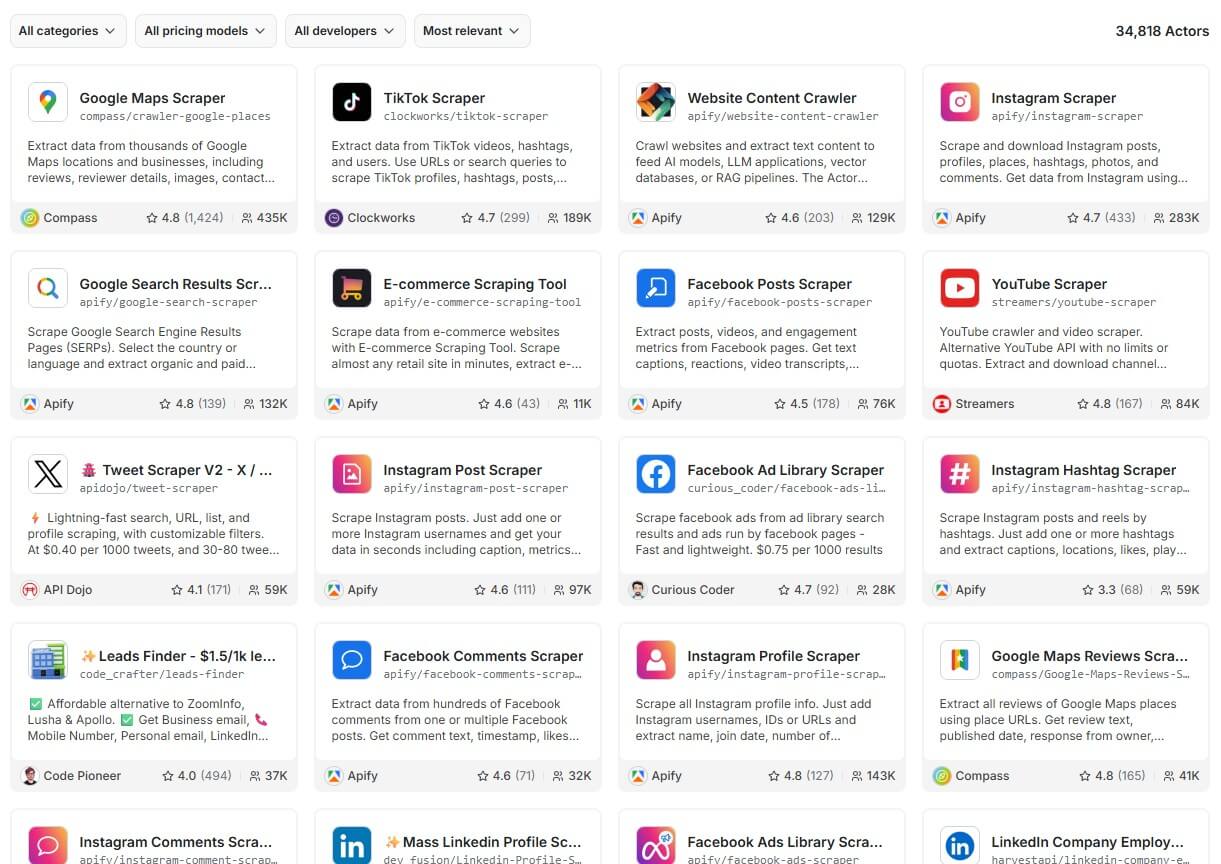
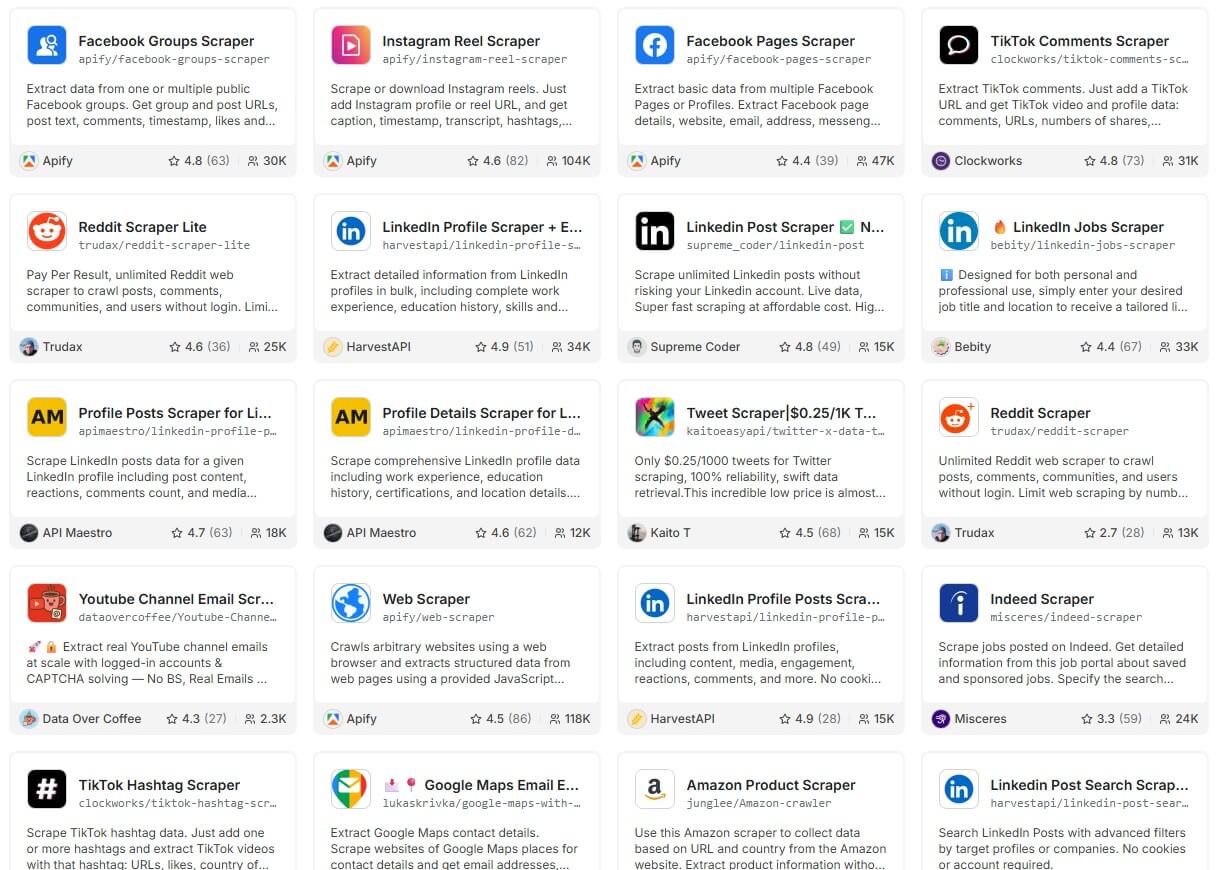
The Apify Store is the fastest way to understand the platform. Instead of writing a scraper first, users can search for an Actor that already handles a site or category. The official homepage currently references more than 34,000 Actors, covering scraping, automation, and AI data workflows.
This matters because scraping is full of repetitive engineering problems: pagination, JavaScript rendering, rate limits, selectors, login handling, broken layouts, and output formatting. A ready-made Actor can save time, especially for popular sources like search engines, maps, ecommerce sites, social platforms, and directories.
The caveat is that ready-made Actors vary by maintainer, target website, update frequency, and input quality. A Store Actor can be a great shortcut, but serious users should still test output quality, inspect fields, monitor failures, and confirm that the Actor fits their compliance and data-use requirements.
Scraping becomes more useful when results are stored cleanly. Apify’s AI-agent docs explain that every Actor run creates a default dataset, and datasets are append-only storage for structured results. Those results can be exported in several common formats, which makes Apify useful for both technical and non-technical workflows.
Schedules are another important layer. A price-monitoring Actor or lead-enrichment Actor is not very useful if someone has to launch it by hand every morning. Apify’s platform docs include schedules for automatically starting Actor and task runs, plus monitoring tools for checking Actor performance, validating data, and receiving alerts.
That is where Apify feels production-oriented. It is not just a button that scrapes a URL. It gives teams the parts needed to run recurring data jobs and notice when they stop working.
Apify Proxy is a key part of the platform because web scraping often fails at the access layer before it fails at the extraction layer. The docs explain that Apify Proxy can rotate IP addresses, monitor IP pool health, and reduce the chance of IP-based blocking.
This does not make scraping effortless or risk-free. Some sites are more aggressive than others, and legal, contractual, and ethical limits still matter. But a managed proxy layer is useful because building and maintaining proxy pools separately can become a project of its own.
For teams scraping at scale, this is one of Apify’s bigger advantages. You can build an Actor, run it in the cloud, and use the platform’s proxy tools without stitching together a separate provider from day one.
Apify has become more interesting as AI agents need live web access. The official AI-agent documentation describes a simple workflow: find an Actor, run it, and get structured data back. It also lists several connection methods, including MCP, API clients, CLI, and REST API.
The MCP server is especially relevant for AI workflows. It lets tools like Cursor, Claude Desktop, VS Code, and other MCP-compatible clients connect agents to Apify Actors. In plain terms, an agent can use Apify as a web-data tool layer instead of relying only on browsing or static knowledge.
This is useful for RAG systems, research agents, lead-generation agents, ecommerce monitoring, social listening, and competitive intelligence. The model can reason, but Apify helps it fetch current structured data from the web.
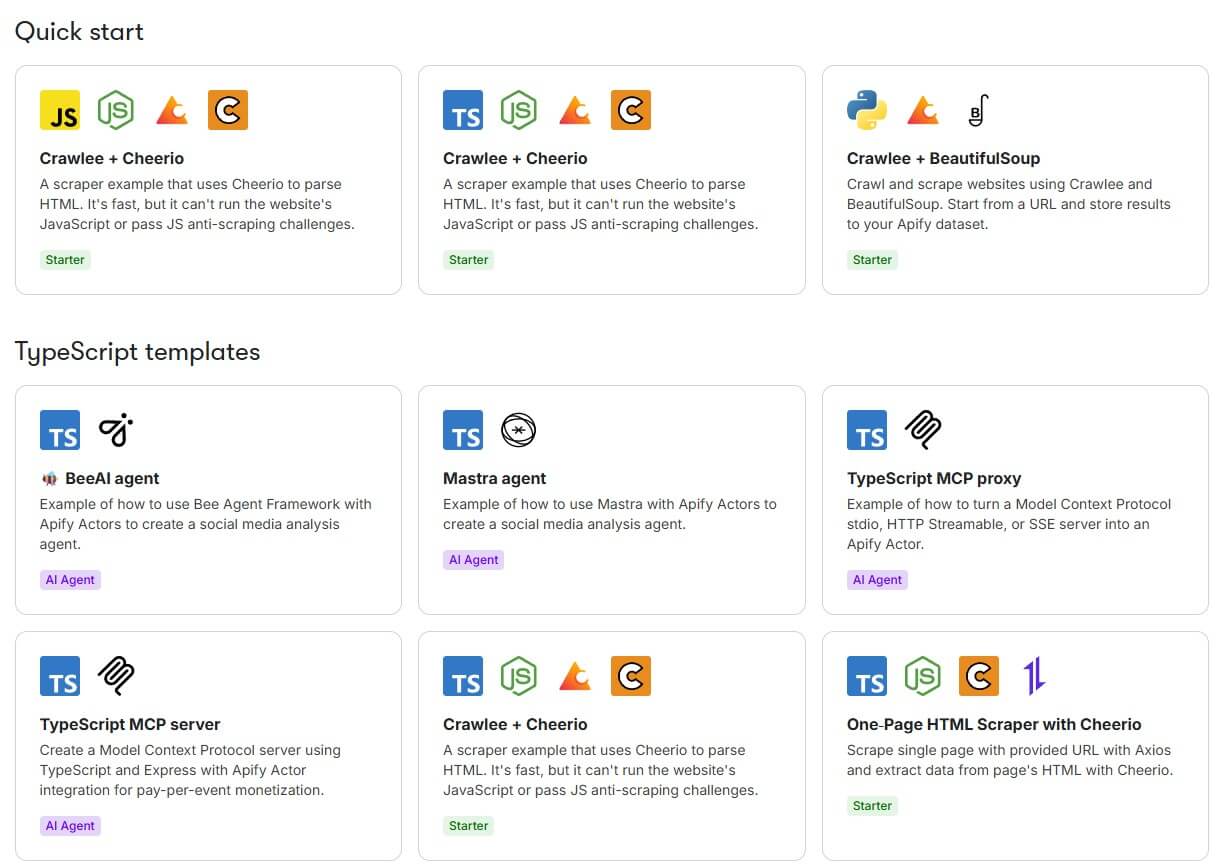
Apify has two levels of use. Non-technical users can run existing Store Actors, fill in inputs, download datasets, and schedule jobs. Developers can build custom Actors, use SDKs, call the REST API, integrate datasets into internal systems, and connect agent workflows.
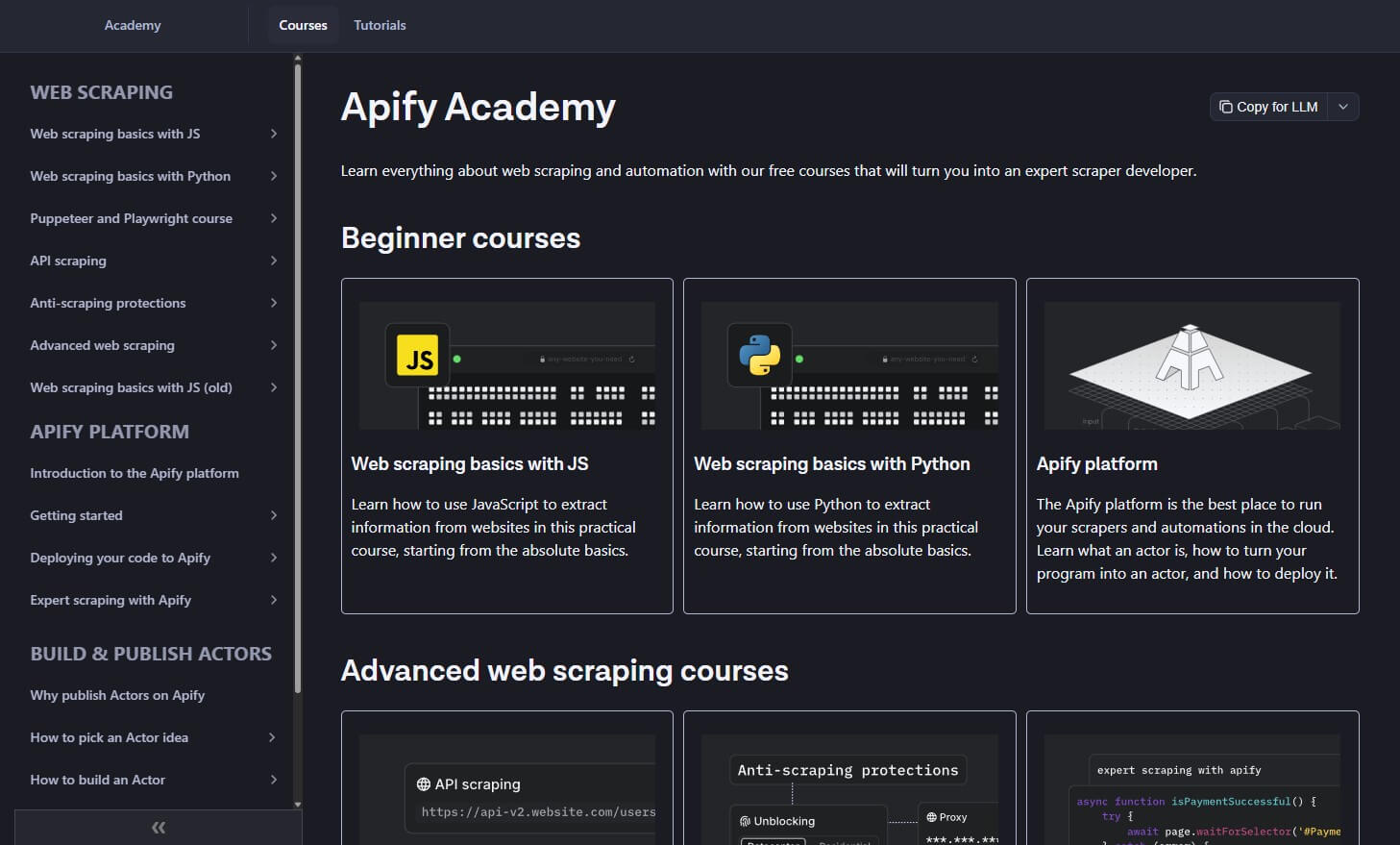
That split is one of Apify’s strengths. It gives beginners a way to start without writing code, but it does not cap the platform at no-code use. Developers still get API access, client libraries, CLI tooling, templates, and open-source scraping libraries such as Crawlee, which Apify promotes from its developer navigation.
The learning curve appears when scraping gets complex. Users still need to understand inputs, output schemas, selectors, rate limits, retries, proxies, website changes, and data quality. Apify reduces infrastructure friction, but it does not remove the need for scraping judgment.
Apify is broader than a simple web scraping API. ScrapingBee focuses on a managed scraping API with JavaScript rendering, proxy rotation, and AI-ready data extraction features. Firecrawl is more focused on turning web pages into clean Markdown or structured data for AI applications. Bright Data is stronger when proxy infrastructure, large-scale web data collection, and ready-made datasets are the center of the buying decision.
Apify’s difference is the Actor ecosystem. It is not only an API endpoint or proxy network. It is a marketplace, runtime, storage layer, automation scheduler, developer platform, and AI-agent tool layer in one place. That makes it flexible, but also more involved than tools built for one narrow scraping workflow.
Apify is a strong fit for lead generation, market research, ecommerce monitoring, price tracking, SEO data collection, social media monitoring, public directory extraction, AI-agent web tools, RAG data pipelines, and recurring competitor intelligence.
It is especially useful for teams that need structured data repeatedly and want the option to start from ready-made Actors, then customize later. Agencies, data teams, growth teams, AI builders, and scraping developers are the most natural users.
The first limitation is scraping fragility. Websites change. Selectors break. Anti-bot systems evolve. Even a good Actor may need monitoring and maintenance.
The second trade-off is compliance responsibility. Apify provides tools, but users still need to respect website terms, privacy rules, robots policies where relevant, and the legal limits of their use case.
The third limitation is complexity. Apify is powerful because it combines many layers, but that also means new users may need time to understand Actors, runs, datasets, tasks, storage, proxies, and integrations.
Apify is best for teams that need reliable web data extraction, browser automation, and AI-ready structured data from the live web. Its strongest value is the combination of ready-made Actors, custom Actor development, datasets, schedules, proxy infrastructure, APIs, monitoring, and MCP support for AI agents. The main caveat is that scraping still needs care. Apify gives you the platform, but good results depend on choosing the right Actor, checking data quality, and maintaining workflows as websites change.
TAGS: Productivity
Related Tools:

Provides real-time understanding and smart assistance for meetings

Enhances the process of online course creation
Designed to enhance learning and productivity

Enhances writing productivity
Simplifies creation of visual content for marketing

Records, transcribes, and summarizes video meetings