

Share this tool:
 |
Description:
Wobo AI is a job-search platform that automates much of the work between finding a vacancy and submitting an application. You provide your CV, career history, goals, and preferences. Wobo then searches for relevant positions, assesses your suitability, prepares tailored application materials, and can submit applications for you.
What sets it apart is how these features work together. Instead of switching between a job board, resume editor, cover-letter generator, and application tracker, you can handle the process in one place.
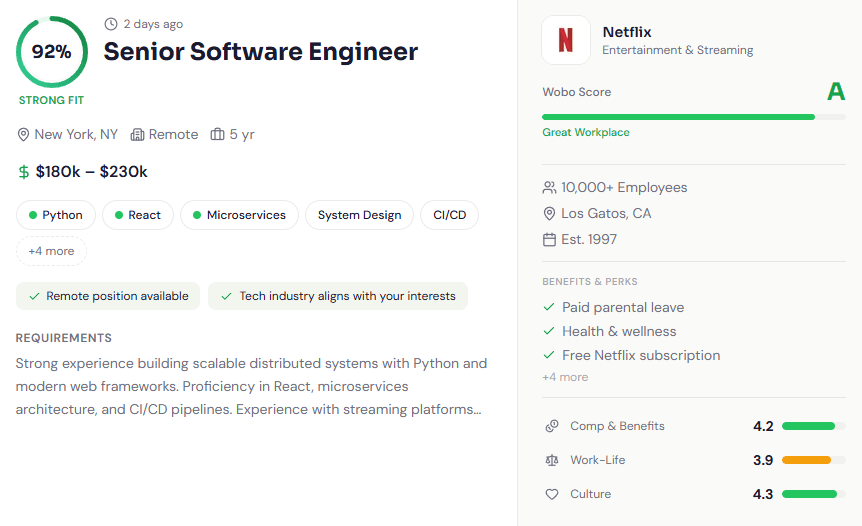
Wobo begins by creating an AI Persona based on your resume, answers, career goals, achievements, skills, and communication style. In effect, it becomes a detailed working profile of you as a candidate.
Wobo uses this profile to match jobs, tailor resumes, write cover letters, and respond to application questions. It also learns from the jobs you approve or skip, so its recommendations should become closer to what you actually want over time.
That is important because automated applications can sound generic very quickly. By grounding each one in the candidate’s background and preferences, Wobo tries to avoid the usual copy-and-paste feel.
Wobo does not rely entirely on conventional job boards. It scans company career pages and checks for new openings each day. You can narrow the search by job title, industry, location, remote-work options, company type, and other preferences.
For every opportunity it finds, Wobo compares the job description with your AI Persona. It looks at your skills, experience, seniority, industry knowledge, and career goals, then produces a match score. That gives you a quick sense of whether the role is worth pursuing before an application goes out.
When Wobo finds a suitable role, it can adjust your resume for the position, write a job-specific cover letter, and answer screening questions using information from your Persona. It can then submit the application directly through the employer’s system.
You can review matches yourself or allow Wobo to apply automatically when a role meets your chosen criteria. This goes well beyond building a resume. The service is trying to manage the full application process.
Wobo has an application tracking dashboard where you can see which jobs you have applied for and review the materials used for each submission. That includes the resumes, cover letters, and answers generated by the platform.
You can also give feedback on those materials. Wobo uses that input to improve future applications, which matters if you plan to let it handle a large number of them.
Wobo is best suited to active job seekers applying for many relevant positions, passive candidates who want someone watching the market, career changers who need to present their transferable skills differently, and graduates who want more focused application materials. It is likely to be most useful when the problem is volume. If searching, rewriting, and filling out forms has become a part-time job of its own, Wobo can take a fair amount of that work off your plate.
Automation saves time, but not every application should be sent without review. Questions about salary expectations, work authorization, availability, or unusual career circumstances may need an exact answer that an automated system cannot safely guess.
Match scores also have limits. They show how well your profile aligns with a job description, not how an employer or recruiter will judge you.
If you prefer choosing every vacancy yourself and rewriting each application by hand, the full auto-apply feature may feel like giving up too much control.
Wobo AI works best as an end-to-end job application assistant. Its AI Persona connects job discovery, qualification matching, tailored resumes, cover letters, application tracking, and automatic submissions in a single workflow.
The tradeoff is control. Wobo can save hours of repetitive work, but it needs an accurate Persona and carefully chosen search settings. Important applications still deserve a final human check before they are sent.
TAGS: Aggregators
Related Tools:

Summarizes news articles from various sources

Automates data collection and report creation

Turns newsletters into concise, easy-to-read digests
Streamlines job search by matching relevant opportunities

Provides users with the latest news in artificial intelligence

Summarizes content to deliver personalized newsletters