Share this tool:
 |
Description:
Particle is an AI-powered news app designed to make it easier to understand a story without opening a long list of articles. Instead of treating each publication’s report as a separate item, Particle groups coverage of the same event and produces a concise, fact-forward overview based on multiple sources. It then keeps those sources visible so readers can dig deeper or compare how different publications frame the story.
Particle originally launched on iOS in November 2024. As of February 18, 2026, it is also available on Android worldwide, giving both iOS and Android users access to its personalized news experience.
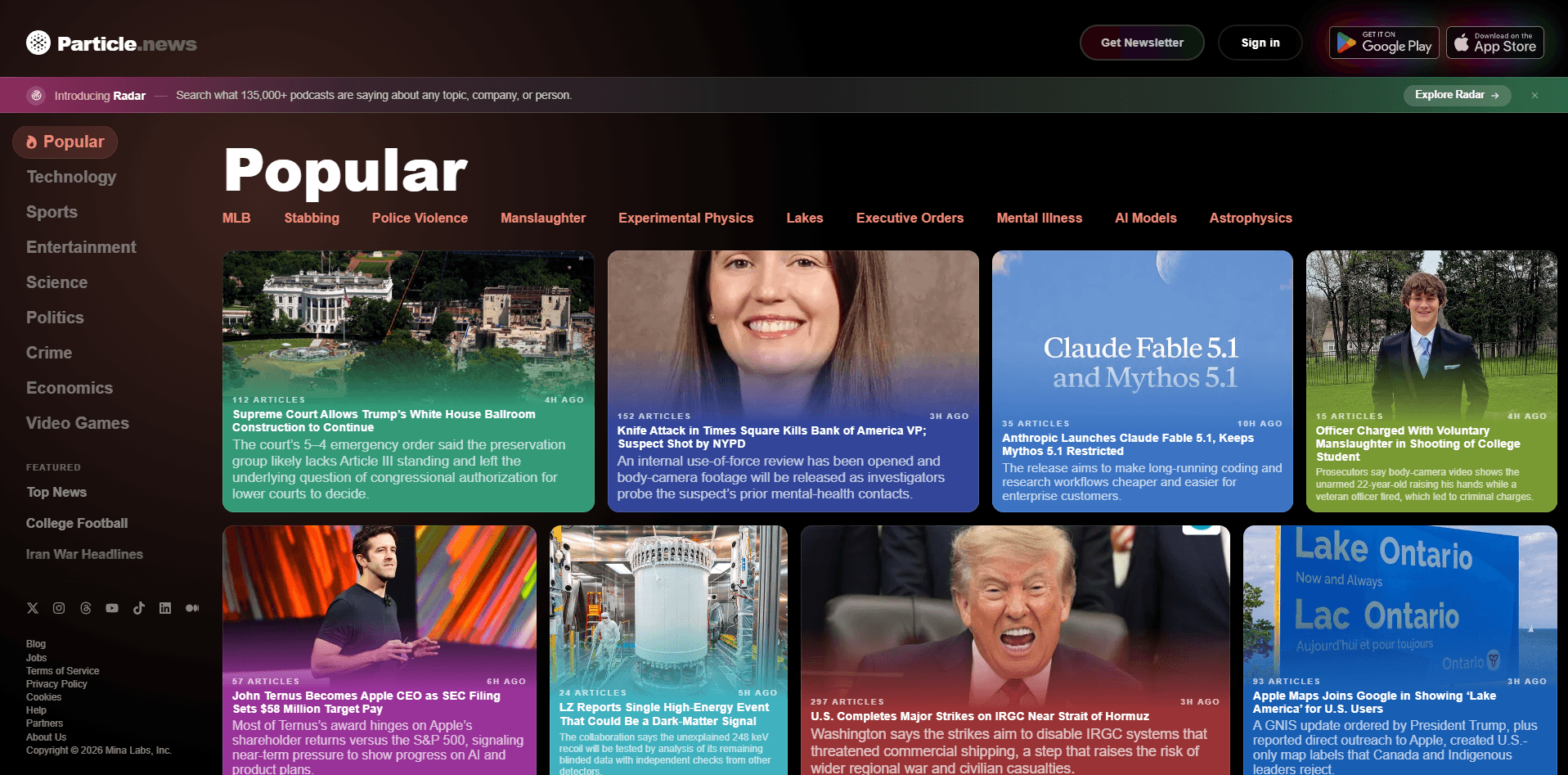
The strongest part of Particle is that it organizes news around stories rather than individual articles. A major event may have dozens or even hundreds of reports, but Particle pulls that coverage together and summarizes the central facts.
This reduces repetition while preserving access to the original reporting. It is especially useful for large stories where jumping between several publications can take more time than understanding the news itself.
Particle also emphasizes source transparency. Each story connects back to the publications and material used to build the summary, which makes it easier to verify details instead of treating the AI-generated overview as the final authority.
Particle becomes more useful when coverage differs between publications. Its perspective tools show how different sources approach the same event, including a political spectrum view for relevant stories and an Opposite Sides feature that surfaces contrasting viewpoints.
That comparison layer matters because news bias is not always about whether a fact is true or false. Publications can emphasize different facts, quotes, context, or interpretations. Particle gives readers a faster way to spot those differences rather than relying on one outlet.
Readers can choose different summary formats, including straightforward bullet points, the 5Ws, and an Explain Like I’m 5 option. Particle can also summarize stories in different languages.
If the summary leaves something unanswered, users can ask Particle follow-up questions about the story. Its answers are drawn from the underlying source material, making the feature closer to a focused news research assistant than a general chatbot.
Other useful elements include key quotes, related-story timelines, podcast clips, personalized feeds, topic and publisher following, and tailored daily digests.
Particle is a strong fit for readers who follow breaking news, politics, technology, business, science, or other areas where several publications often cover the same event. It also suits people who want broader perspective without manually opening multiple outlets.
AI summarization still introduces a layer between the reader and the original reporting. Important nuance can be compressed, particularly in complex or developing stories. Perspective and bias indicators are useful context, but they should not replace reading original coverage when the details matter.
Particle is strongest as a multi-source, fact-forward news reader. Its ability to combine reporting, expose source differences, offer flexible summaries, and answer story-specific questions makes it more useful than a basic news aggregator.
The main caveat is that concise AI summaries are best used as a starting point, with the original sources still available when deeper context matters.
TAGS: Aggregators
Related Tools:
Turns newsletters into concise, easy-to-read digests

Allows users to search, filter, and explore a wide variety of AI models
Enhances web exploration by providing content summarization

Simplifies the use of diverse applications

Summarizes news articles from various sources

Helps users find and select WordPress plugins