
Share this tool:
 |
Description:
Visus is a knowledge-based AI assistant designed to answer questions using information from your own documents rather than relying mainly on a model’s general knowledge. The basic idea is straightforward: upload or connect company material, configure how the assistant should respond, then ask questions in ordinary language.
Visus positions the product as a way to make internal knowledge easier to access. Instead of searching manually through policy documents, product notes, procedures, reports, or other files, users can ask a question and receive an answer grounded in the uploaded material.
That makes it most relevant for teams that already have useful documentation but struggle to find the right information quickly.
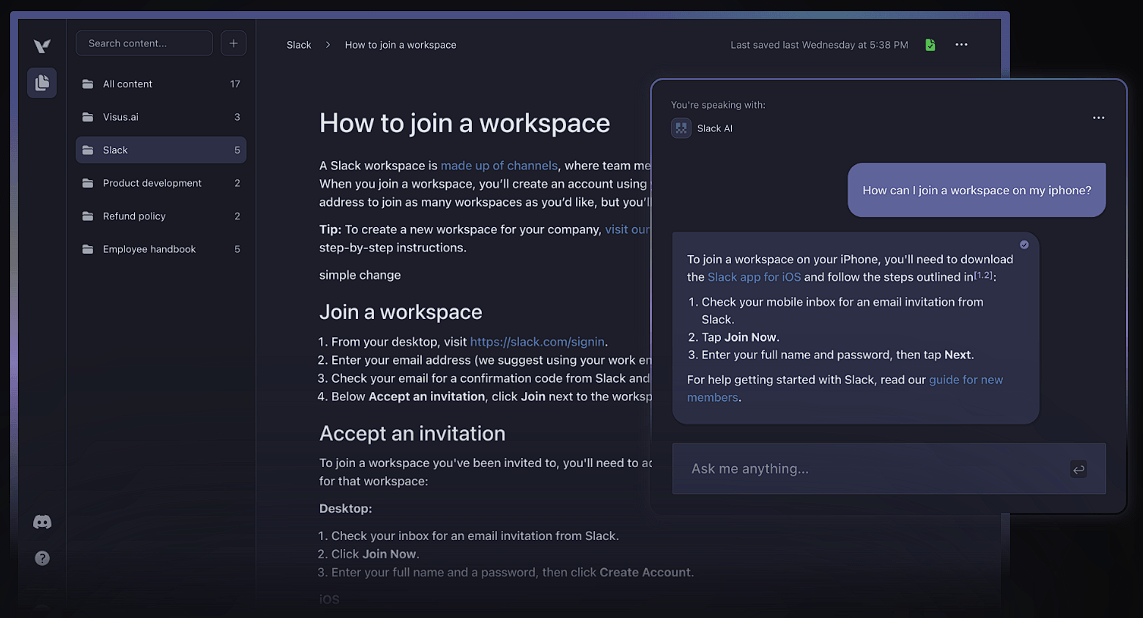
Visus organizes its core workflow into three stages.
First, you train the AI by uploading documents. Visus indexes and analyzes that material so it can retrieve relevant information later.
Second, you configure how the assistant behaves. The platform says users can adjust parameters such as sensitivity and accuracy, giving some control over how strictly the system works with the available knowledge.
Finally, you ask questions. Visus searches across the trained material and produces a conversational answer. Follow-up questions are supported, which makes it easier to explore a topic without repeatedly restating the context.
The workflow is much closer to building an internal knowledge assistant than training an AI model in the machine-learning sense.
Visus emphasizes that answers are based on the training material supplied to the system.
That matters for internal business use. A generic chatbot may know broadly how expense policies, onboarding processes, or product documentation usually work, but a company needs answers based on its own policies.
A useful deployment could include employee handbooks, operating procedures, technical documentation, product information, customer-support guides, or sales material. Employees could then ask questions such as:
“Which approval steps are required for this type of purchase?”
“What does our documentation say about resetting this device?”
This kind of retrieval can reduce time spent searching through folders and knowledge-management systems.
Visus is designed to work with information that teams already store elsewhere.
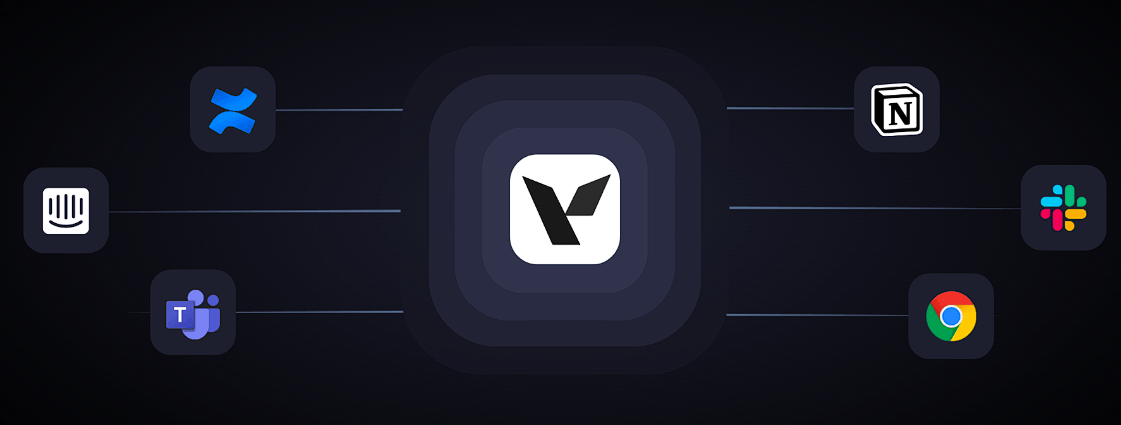
The official site lists integrations with Google Drive, Confluence, and Notion for bringing existing knowledge into Visus. It also lists Slack, Microsoft Teams, and Discord as workplace communication integrations, plus a Chrome extension for accessing the assistant from the browser.
This is an important part of the product. A knowledge assistant is far less useful if employees need to leave their normal workspace every time they want an answer.
For teams using several documentation systems, Visus can also provide a single conversational layer over knowledge that would otherwise be spread across different locations.
Access control is particularly important when an AI assistant works with internal company information.
Visus says it respects user permissions and only returns information that a person is authorized to access. If those permissions change, the system is designed to reflect the update.
The company also states that information is encrypted in transit using TLS 1.2 or later, while servers containing user data use AES-256 full-disk encryption.
One point deserves attention: the public website currently says Visus is working toward SOC 2 compliance, rather than claiming completed certification. Organizations with strict compliance requirements should verify the current status directly before adopting it.
Visus is a good fit for:
- Internal company knowledge assistants.
- Employee onboarding and policy questions.
- Customer-support teams searching documentation.
- Technical teams working across manuals and procedures.
- Sales teams querying product and company information.
- Organizations with knowledge spread across Drive, Notion, or Confluence.
- Teams that want AI access through Slack or Microsoft Teams.
Visus depends heavily on the quality of the material connected to it. Outdated, incomplete, or contradictory documentation can still lead to weak answers.
Its public website also provides relatively limited detail about the underlying AI models, retrieval architecture, supported document formats, and newer product development. Much of the publicly visible product information still carries 2023-era documentation and site material. That makes the platform harder to evaluate technically than competitors with detailed, frequently updated documentation.
Teams considering Visus for regulated or sensitive workflows should therefore verify current security, compliance, data-retention, and integration details directly.
Visus is strongest as a private conversational layer over company knowledge. Its document training, natural-language search, permission-aware answers, and integrations with tools such as Google Drive, Notion, Confluence, Slack, and Microsoft Teams make it useful for organizations that spend too much time searching for internal information.
The main caveat is transparency. The public product material is relatively sparse and appears less frequently updated than some competing knowledge-AI platforms. Visus makes sense when the core requirement is straightforward internal knowledge retrieval, but teams should verify its current technical and compliance capabilities before a larger deployment.
TAGS: AI Chat/Assistant
Related Tools:

Interactive chat assistant that answers questions

AI assistant that excels at deep reasoning and multimodal tasks

Create custom chat and voice bots
Multilingual chatbot for websites
Creates autonomous AI agents that connect with your systems

Project management and team collaboration software