
Share this tool:
 |
Description:
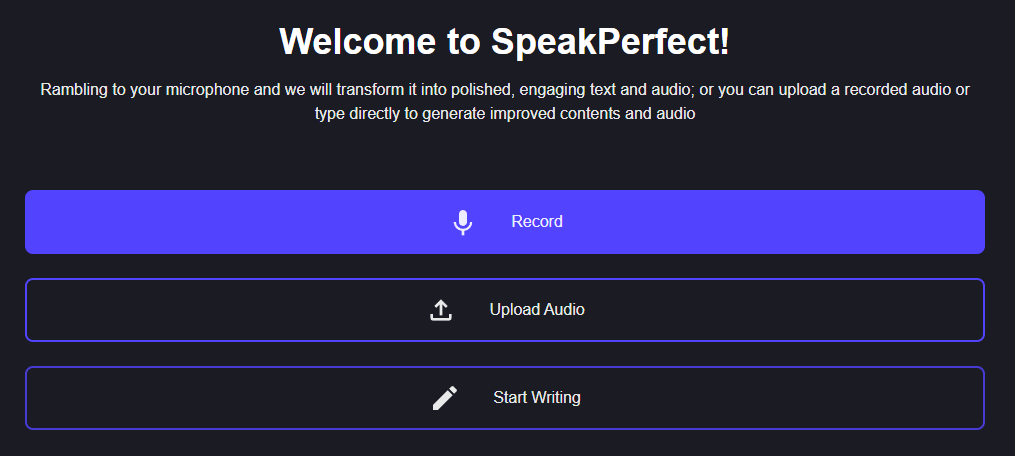
SpeakPerfect is not really a conventional text-to-speech platform first. It is better understood as a “speak messily, clean it up later” workflow. The core idea is simple: record or upload rough speech, let the product rewrite and structure it, then generate polished audio from either your cloned voice or AI voices. The official site leans hard into that sequence—record or upload, transform, generate audio—and that is the real reason to use it.
SpeakPerfect is strongest when the bottleneck is not voice generation by itself, but the messy step before it. A lot of people do not start with a clean script. They start with rambling thoughts, filler words, false starts, and half-formed explanations. SpeakPerfect’s clearest value is that it tries to convert that rough spoken material into a better script and then into usable audio without forcing you to rewrite or re-record from scratch. The homepage examples explicitly show filler-heavy spoken content being turned into tighter, cleaner copy, and the product repeatedly frames that as a way to avoid repetitive recording and editing.
That makes it more interesting for creators than a normal “paste text and pick a voice” tool. If you already have perfect copy, SpeakPerfect is less differentiated. But if your normal workflow is thinking out loud, drafting by talking, correcting yourself as you go, and only later deciding what the final message should be, the product makes more sense. It is trying to sit between dictation, rewriting, translation, and voiceover generation.
SpeakPerfect starts from spoken input rather than assuming you already have a finished script.
The platform highlights filler-word removal, better flow, word selection, and clearer sentence structure as core outputs.
The site explicitly positions post-recording correction as a main advantage.
SpeakPerfect says it can translate content into multiple languages and its examples show transformed output in several languages.
The product says users can choose their own voice clone or AI voices for final output.
The site repeatedly frames the tool around YouTube, online courses, product demos, promotional videos, education, and business communication.
The public workflow is unusually clear. Step one is Record or Upload. Step two is Transform. Step three is Generate Audio. That sounds basic, but it is actually the most important thing to understand about the product: SpeakPerfect is selling a linear cleanup pipeline, not a sprawling audio workstation. You are meant to talk first, improve second, publish third.
The transformation layer is where most of the value sits. The landing page shows “original script” blocks full of hesitation, repetition, and filler, followed by “improved script” versions that are more structured and presentation-ready. It also highlights “Create Great Flow & Remove Filler Words,” “Select Appropriate Word,” and “Re-write content with ease,” which makes it clear that the script-improvement stage is not a side feature. It is the center of the tool.
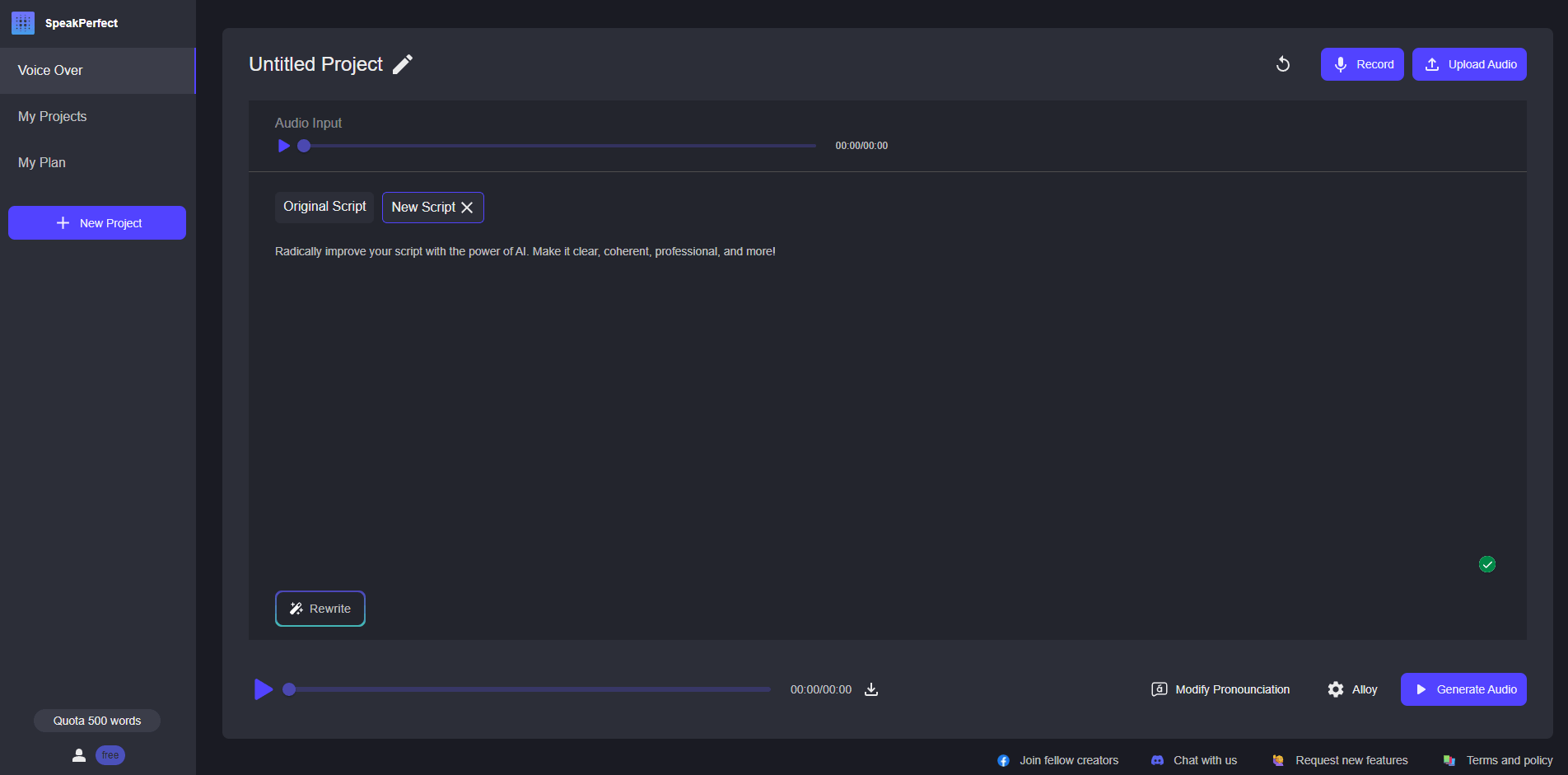
Only after that does SpeakPerfect move into voice output. The site says users can generate professional voice-over and choose either their own voice clone or AI voices. That means the product is not just transcribing and cleaning speech. It is also trying to turn the cleaned result into publishable audio for content workflows.
This is also why SpeakPerfect feels more workflow-specific than broader voice tools. The public product pages do not emphasize deep editing timelines, SSML control, developer surfaces, or large voice-model lineups. What they emphasize is speed and reduced friction for people who want to talk through an idea and get something polished quickly. That is a very specific job, and the site stays focused on it.
Based on the official examples, SpeakPerfect looks strongest when the source material is understandable but messy. Its examples are not about rescuing terrible noisy recordings or producing dramatic character performances. They are about removing “umm,” tightening phrasing, improving structure, and turning rough explanations into cleaner teaching, marketing, or vlog-style narration. That suggests the product is best at clarity and polish rather than voice artistry.
The multilingual angle also matters. The landing page says it can output to multiple languages and the examples show the same basic content appearing in multiple languages. That makes SpeakPerfect more useful for creators who want one rough spoken input to become material for different audiences, rather than only one monolingual audio track.
Voice cloning is clearly part of the pitch, but it is not described in much technical depth on the public pages. The site says “Create flawless voice clone,” “Generate indistinguishable voice clone,” and “Choose from your own voice clone or AI voices,” which is enough to establish the feature, but not enough to evaluate it with the same confidence you could evaluate a platform that publishes more detail about model quality, controls, or cloning workflow. So it is fair to say voice cloning is present and prominent, but less fully documented in public than the cleanup-and-script layer.
SpeakPerfect makes the most sense for YouTubers, course creators, and solo educators who think by speaking. The homepage explicitly calls out YouTube videos, online courses, and educational use, and the examples fit that well: rough explanatory speech turned into cleaner, more audience-ready language.
It is also a good fit for business messaging and lightweight marketing audio. The public pages mention business campaigns, polished marketing communication, product demos, and promotional videos. That lines up with the product’s strength: turning a rough spoken pitch into something more coherent and publishable without demanding a second full recording pass.
Another strong fit is non-native English speakers or anyone who is more comfortable talking than writing. SpeakPerfect’s FAQ explicitly names non-native English speakers as a target audience, and several site examples position the tool as a way to turn imperfect spoken English into cleaner wording. That is one of the more distinctive practical cases for the platform.
It is less obviously the right choice for users who want deep audio engineering control, complex dubbing workflows, or developer-first integration. The official site pages I reviewed do not surface that kind of product depth publicly. The emphasis is on a guided creator workflow, not a large technical platform.
- Use SpeakPerfect when your problem is message cleanup, not just voice generation. The product’s edge is that it helps you start from messy speech, so it is most valuable when you actually use that step instead of feeding it already-perfect copy.
- Talk naturally on the first pass and save perfection for later. The official positioning is explicit: you can make mistakes, fix them afterward, and avoid the pain of repetitive recording. That means the tool is built to reward rough-first workflows rather than cautious line-by-line scripting.
- Use it for multilingual repurposing when you want one spoken idea to reach different audiences. The homepage’s translation framing suggests that this is one of the higher-value use cases, especially for educational or creator content that needs more than one language version.
- If data handling matters to you, check the policy before using sensitive material. SpeakPerfect says inputs and scripts are kept confidential, and its Terms page says collected information is encrypted, retained while the account exists, and deletable by request. That is useful, but it is still worth reviewing carefully if you are working with client or internal business content.
- The first limitation is product visibility. SpeakPerfect’s public site explains the top-level workflow well, but it leaves a lot of depth unclear. There is not much public detail about voice inventory, cloning controls, editing options, or technical infrastructure. So the reviewable part of the product is the outcome-oriented workflow, not a clearly documented deeper stack.
- The second limitation is that the public examples are marketing-style examples. They show rough speech becoming cleaner, but they do not tell you much about failure cases, weak recordings, accent handling beyond broad claims, or how much editorial steering you get inside the transformation step. In other words, the promise is clear, but the public documentation is lighter than what you get from more mature voice platforms.
- The third limitation is that this looks like a relatively narrow product. That is not necessarily bad. It may be exactly why some users will like it. But if your needs are broader—large-scale TTS operations, advanced dubbing, fine-grained audio control, or heavy collaboration—SpeakPerfect’s public positioning does not currently suggest that those are its main strengths.
- There is also a trust-and-policy caveat. The Terms page says certain features require registration, user content must be owned or properly authorized, and the company may remove content if it believes the rules are violated. It also says the public policy is effective August 13, 2023, which is worth noting simply because policy freshness matters for voice and content tools.
SpeakPerfect is most interesting as a speech-to-script-to-audio cleanup tool, not just as another text-to-speech app. Its real strength is helping people start with messy spoken thoughts, improve them into cleaner copy, translate or adapt them, and then turn them into voice output without repeated re-recording.
It is best for creators, educators, marketers, and non-native speakers who think faster out loud than on the keyboard. The main caveat is that the public product pages are much clearer about the basic workflow than about the deeper technical details, so it looks strongest as a focused creator utility rather than a fully documented voice platform.
TAGS: Text to Speech
Related Tools:
Converts written content into audio podcasts

Specializes in converting text to speech

Offers variety of tools for document creation

Turns written content into natural-sounding audio
Generates realistic speech and powers voice-based applications
Digital document management platform