

Share this tool:
 |
Description:
Robofy is an AI agent platform built mainly for customer experience teams. Its agents can search company information, answer questions, collect lead details, connect with outside systems, complete tasks, and transfer conversations to staff when the AI has reached its limit.
The platform organizes this work around three agent types. Support Agents answer customer questions using business knowledge. Action Agents handle jobs such as changing an order or updating an account. Lead Agents identify what a visitor wants, qualify the opportunity, and route promising prospects to sales.
That gives Robofy a wider brief than a conventional FAQ chatbot. It is meant to handle the conversation and, where appropriate, move the customer’s request forward.
Robofy uses retrieval-augmented generation, or RAG, to base its responses on company information.
Businesses can connect website URLs, PDFs, FAQs, and manually entered text. Robofy processes those sources into a searchable knowledge base, then retrieves the relevant sections when a customer asks a question.
According to its technical documentation, the platform uses hybrid search, combining semantic search with keyword matching. Semantic search helps when customers ask familiar questions in unfamiliar ways. Exact keyword matching is better suited to details such as product names, SKUs, model numbers, and specialist terminology.
For a company with an extensive help center, this is easier to manage than writing and maintaining hundreds of individual question-and-answer rules.
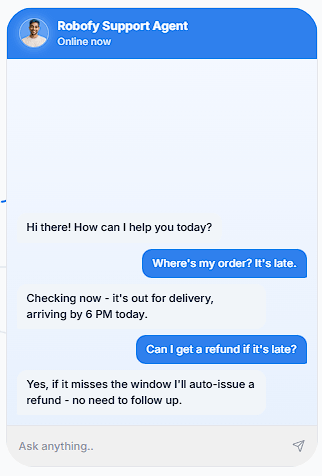
Robofy becomes more useful when the agent can do something with the request.
Through function tool calls, agents can connect to APIs and other business systems. Robofy lists examples such as checking inventory, making reservations, updating CRM records, changing orders, and retrieving current account information.
A customer asking, “Where is my order?” could receive the live status rather than a generic explanation of how to find the tracking page. That is a meaningful improvement, but it also raises the stakes.
A mistaken policy answer is inconvenient. An incorrect order cancellation or account change can cause a much bigger problem. Permissions should be narrow, and teams need to test unusual requests and failure cases before giving an agent access to transactional systems.
Robofy supports customer conversations through website chat, WhatsApp, and voice.
Its WhatsApp integration uses Meta’s official WhatsApp Cloud API, allowing a business to connect a WhatsApp number directly to an AI agent. The platform also includes an inbox, contact management, campaign tools, templates, and support for incoming and outgoing messages.
Recent updates added Excel and CSV contact uploads, along with media support for campaigns.
These tools give Robofy more range than a website widget. The same environment can handle support questions, follow up with prospects, and manage WhatsApp communication.
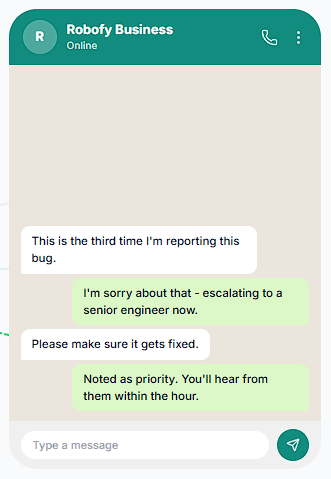
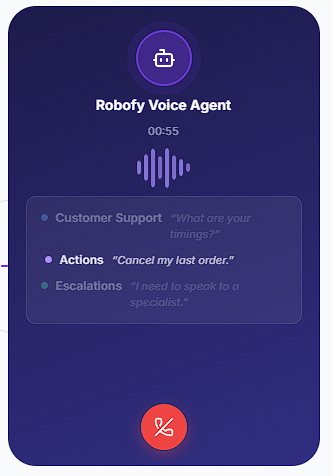
Robofy gives businesses control over what a lead agent should learn during a conversation.
Teams can define the use case, industry, conversion goal, and information to collect. The agent can then adjust its questions to the visitor’s intent and gather details such as budget, product interest, or purchase timeline. Those details can be sent to Google Sheets or another connected system.
This is more flexible than presenting every visitor with the same contact form. A conversation can focus on the details that matter for that particular prospect instead of mechanically working through an identical list of questions.
Robofy is designed with the assumption that some conversations will need a person.
Agents can transfer complicated requests to a sales or support team while passing along the chat history and relevant context. Its documentation also recommends setting fallback responses and clear handoff triggers for situations where the AI is not confident enough to continue.
This is a sensible boundary. Once the agent starts guessing, further automation is more likely to frustrate the customer than help them.
Robofy states that it is ISO 27001 compliant. Its infrastructure documentation describes TLS 1.2+ encryption for data in transit, AES-256 encryption for stored files, role-based access controls, MFA support, and isolation between each business’s knowledge and conversation data.
The company also states that private customer data is not used to train public AI models.
For larger organizations, API access, audit logs, webhooks, and additional deployment options provide more control over how the platform operates.
Robofy is particularly useful for:
- Automating Tier-1 customer support.
- Answering questions from product documentation.
- Running customer service through WhatsApp.
- Handling order-status and account workflows.
- Automating appointments and bookings.
- Qualifying and routing sales leads.
- Giving AI agents a clear route to human support.
- Connecting customer conversations with CRMs and internal APIs.
Robofy takes more work to configure than a basic plug-and-play chatbot. Knowledge sources, actions, permissions, integrations, channel settings, and escalation rules all need careful attention.
The agent is also dependent on the systems behind it. Outdated documentation leads to outdated responses, while an unreliable API can cause an action to fail even when the AI has understood the customer correctly.
Transactional workflows deserve thorough testing. Teams should check ambiguous instructions, backend failures, permission boundaries, and unexpected customer requests instead of assuming the agent will always choose the right action.
Robofy is best viewed as a customer experience automation platform. Its grounded knowledge, API actions, lead qualification, WhatsApp support, human handoff, and enterprise controls allow conversations to continue beyond a simple FAQ response.
Businesses with steady support demand or repeatable customer workflows are the clearest fit. The trade-off is responsibility: every action an agent is allowed to take adds another permission, failure case, and escalation path that the business must design and monitor.
TAGS: AI Chat/Assistant
Related Tools:

Creates conversational AI chatbots

AI assistant that excels at deep reasoning and multimodal tasks
Allows users to create chatbots for websites

Answers questions, generates content, and analyzes information

Automates customer support and lead generation
Multilingual chatbot for websites