

Share this tool:
 |
Description:
Revoicer is a browser-based AI voiceover tool built around one core promise: make text-to-speech sound more expressive by adding emotional delivery, tone variation, and simple voice controls without forcing users into a complicated production workflow. Across its public pages, the product is consistently framed as an online app for ads, explainers, training content, audiobooks, demos, and multilingual voiceovers, with a workflow that is basically paste text, choose a voice, generate, preview, and download.

That is the right way to think about it. Revoicer is not presented as a heavy dubbing platform, a developer-first speech API, or a studio-grade audio workstation. It is a creator-facing voiceover tool designed to reduce friction for people who want usable spoken audio quickly.
Revoicer is strongest when the biggest problem is not “how do I get the absolute best synthetic voice on the market,” but “how do I turn scripts into decent, emotionally shaped voiceovers fast.” Its standout angle is the emotion layer. The main product pages repeatedly emphasize moods and delivery styles such as friendly, hopeful, cheerful, sad, excited, angry, terrified, shouting, and whispering, alongside controls for speed, emphasis, and pauses.
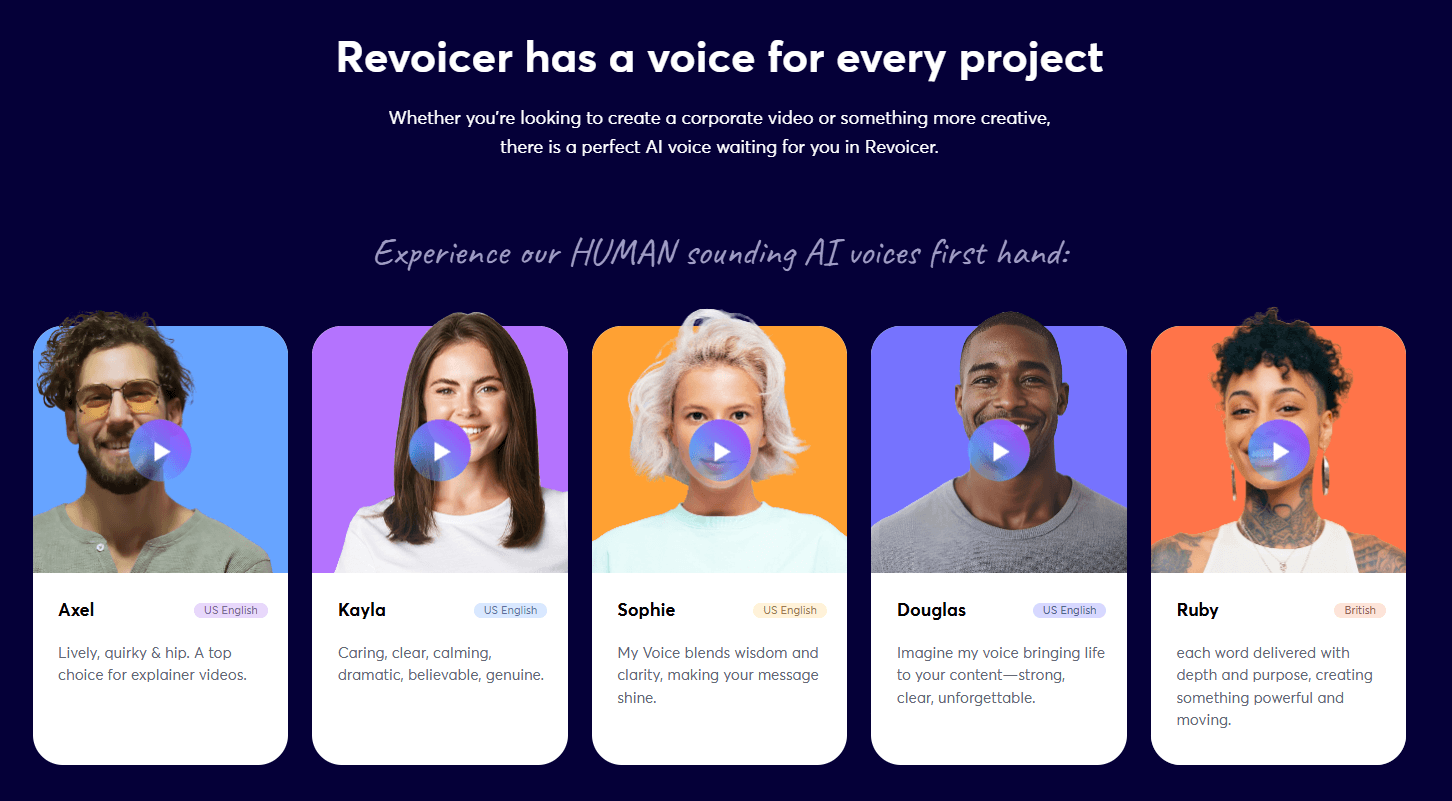
That matters because a lot of lightweight TTS tools are useful only for neutral narration. Revoicer is clearly trying to be better than that for marketing voiceovers, training content, character-style reads, product demos, and educational content where flat delivery makes the output feel cheap. Even Revoicer’s newer editorial pages keep returning to the same idea: emotional text-to-speech is where the product is meant to stand out.
The second thing it does well is simplicity. Revoicer’s public workflow is consistently described as a three-step process: paste text, choose a voice, generate and listen. That simplicity is a real advantage for solo creators and small teams who do not want to spend time learning a full audio stack.
Revoicer’s core differentiation is emotional voice output rather than flat narration, with public demos and pages highlighting moods like cheerful, sad, excited, angry, terrified, whispering, and shouting.
The product is fully online and repeatedly presents a simple paste, convert, preview flow with no install required.
Revoicer highlights speed changes, emphasis, pauses, tone shaping, and on some pages volume adjustment and voice-over merging.
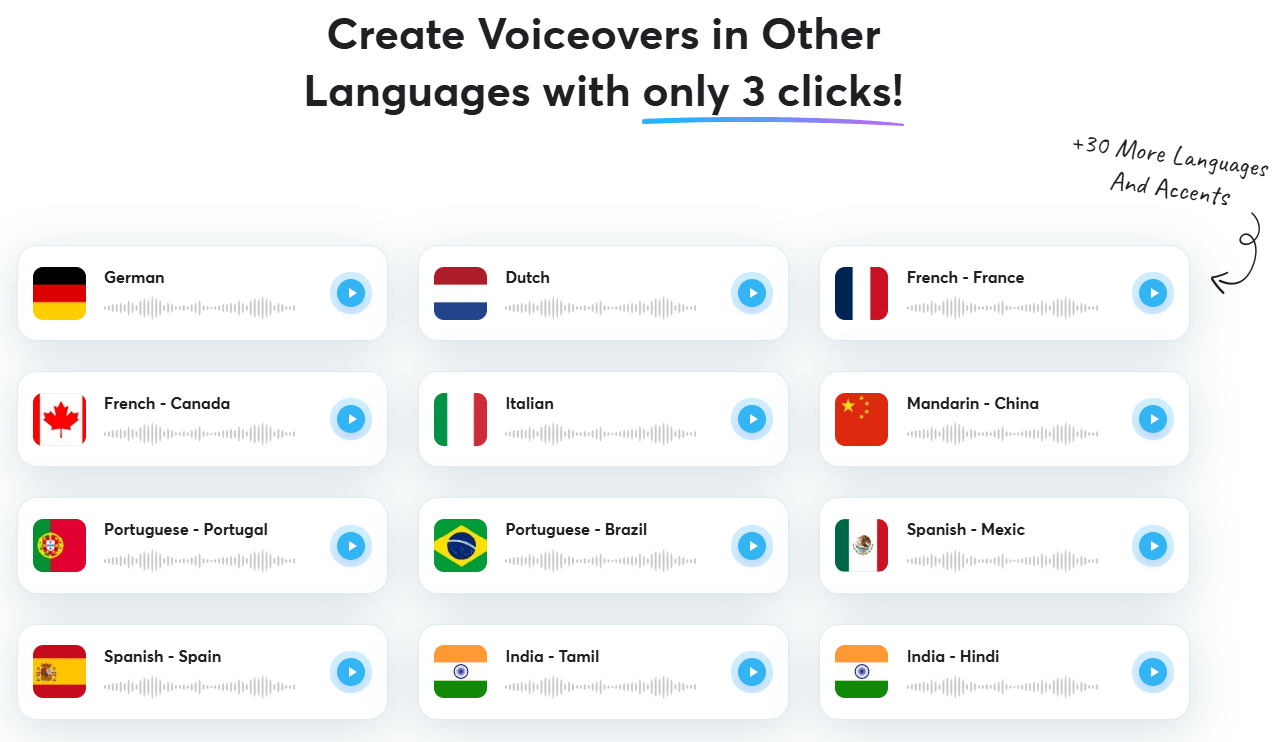
Official pages variously describe support for 40+, 50+, 60+, and even 100+ languages or accents, which clearly signals multilingual intent even if the exact published count shifts by page.
Revoicer publicly claims anywhere from 80+ to 250+ voices depending on the page, with male, female, and kid voices represented.
Revoicer also markets a separate speech-to-text module with TXT and SRT export and multilingual transcription.

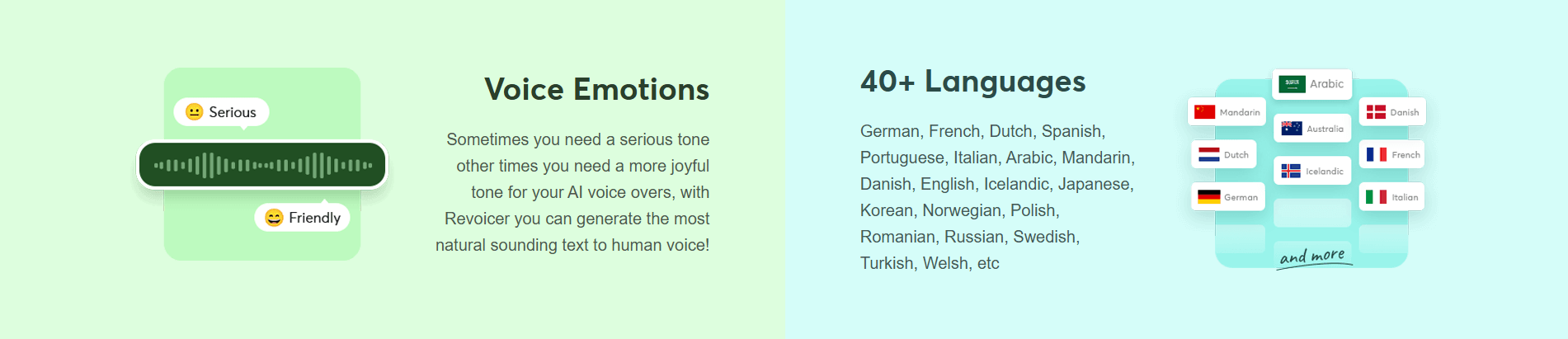
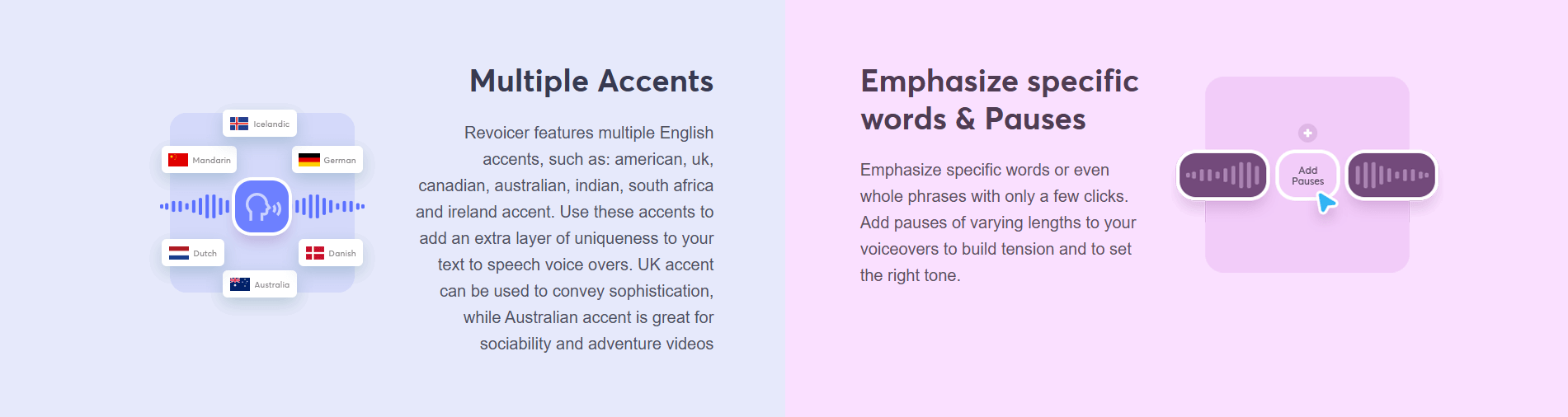
Revoicer is easiest to evaluate as a workflow tool rather than a model story. Its public pages do not spend much time explaining underlying architectures or model families. Instead, they focus on a direct user path: paste your script, choose an AI voice, pick the emotional tone and other delivery settings, generate the audio, then listen and download.
That is a useful product shape for people making repeatable content. If you are producing YouTube intros, sales videos, e-learning modules, support explainers, promo content, or audiobook drafts, a lot of the value comes from how quickly you can revise the text and regenerate instead of rebooking talent or rerecording the same script manually. Revoicer’s pages lean heavily into exactly that “days to minutes” argument.
The editing layer is basic but relevant. Revoicer’s feature pages mention changing speaking rate, emphasizing specific words, inserting pauses, adjusting volume on some pages, and merging voiceovers. That is not deep studio editing, but it is enough to make a practical difference for voiceover timing and tone.
The product also appears to have a wider ecosystem than the homepage alone suggests. Beyond the core TTS app, Revoicer publicly markets a speech-to-text module, maintains a web login on revoicer.app, and has official mobile app listings on both Google Play and the App Store. That does not make it an enterprise platform, but it does show that the product extends beyond a single landing page.
Revoicer’s main quality pitch is not just “human sounding,” but “human sounding with emotion.” The public product pages consistently describe its voices as expressive, natural, and capable of stronger inflection than ordinary flat TTS. Whether that always translates into best-in-class realism is harder to verify from public marketing alone, but the product is clearly optimized around delivery character rather than only clean pronunciation.
In practical terms, the strongest control points appear to be emotion, speech speed, emphasis, pauses, and accent selection. Revoicer also advertises multiple English accents including American, UK, Canadian, Australian, Indian, South African, and Irish, which makes it more flexible for region-specific content than tools that only offer a generic English narrator.



The biggest caveat is that the public catalog numbers are inconsistent. Depending on which official page you read, Revoicer claims 80+, 100+, 140+, or 250+ voices, and 33, 40+, 50+, 60+, or 100+ languages or accents. That does not mean the product is fake. It does mean the marketing pages have not been kept perfectly aligned, so buyers should care more about whether the specific voice and language they need is present than about the biggest headline number on the site.
Revoicer is a good fit for marketing voiceovers and sales videos. Its public examples and use-case pages repeatedly mention commercials, advertisements, Spotify ads, product demos, and explainer videos, and the emotion controls are especially relevant in those formats because the delivery often needs to sound upbeat, persuasive, or warm rather than neutral.
It also fits e-learning, presentations, and training content. Revoicer explicitly names e-learning, audio lessons, and educational videos, and the ability to slow speech, emphasize terms, and add pauses is genuinely useful in that category.
There is also a decent case for audiobook drafts and longer-form narration, at least for users who care more about speed and multilingual flexibility than premium dramatic performance. Revoicer markets audiobook use directly, and some of its voice pages position specific voices for documentary or storytelling-style reads.
Finally, it works for multilingual repurposing. Several official pages emphasize turning the same content into multiple languages and accents, which makes Revoicer a practical option for users localizing straightforward spoken content rather than only producing in one language.
- Use Revoicer when emotion changes the meaning of the message. That sounds obvious, but it is the main reason to choose this tool over a more ordinary TTS option.
- Start with a clean, short script section, then regenerate in chunks instead of trying to perfect a very long script all at once.
- Audition several voices before committing. Revoicer’s value depends heavily on picking a voice that matches the use case, not just using the first available narrator.
- Use pauses and emphasis deliberately. Those controls are most useful when you want sales copy, educational content, or product narration to sound more human and less rushed.
- Check the exact language, accent, and voice you need before buying into the headline catalog number, because the public pages use different counts across different areas of the site.
- The biggest limitation is public-page consistency. Revoicer’s official pages do not always agree on voice and language counts, which makes the platform look less tidy than it should.
- The second limitation is depth. Revoicer looks like a practical creator voiceover tool, not a full studio workstation, enterprise speech platform, or advanced dubbing system.
- The third limitation is that emotional delivery still needs review. A voice can technically sound cheerful, angry, sad, or hopeful but still miss the exact performance needed for the script.
- The fourth limitation is that the platform’s value depends on whether you actually need expressive voiceovers. If all you need is flat narration, Revoicer’s emotion layer may matter less than price, voice realism, or API depth elsewhere.
Revoicer is best understood as a fast, creator-friendly AI voiceover tool built around emotional text-to-speech. Its strongest qualities are simplicity, browser-based generation, mood-based delivery, useful voice controls, multilingual output, and a broad enough catalog for common marketing, education, and narration workflows.
The main caveat is that Revoicer looks strongest as a practical production shortcut, not as a deeply technical voice platform. It is most worth using when the content benefits from emotional delivery and quick iteration rather than when you need maximum audio-engineering depth.
TAGS: Text to Speech
Related Tools:

High-quality multilingual voice generator

Comprehensive document preparation system

Translates, dubs, and add subtitles to videos

Facilitates organization of scripts

Cloud-based document editing and collaboration tool

Converts text into realistic audio content