
Share this tool:
 |
Description:
Reveal AI is a qualitative research platform for teams that need more than checkbox survey answers. It uses conversational surveys, AI-guided interviews, follow-up questions, automated analysis, dashboards, and reports to help teams collect richer feedback at scale.
Reveal AI helps research teams ask open-ended questions and get more detailed answers from customers, employees, or market audiences. The platform describes itself as combining conversational surveys with AI analysis so teams can gather feedback, follow up, analyze, and act in one place.
The key idea is simple: traditional surveys are fast, but often shallow. Interviews are deep, but slow. Reveal AI tries to sit between those two methods by giving respondents a guided conversation while giving teams automated transcription, coding, sentiment analysis, themes, quotes, dashboards, and exportable reports.
That makes it more useful for research teams than a basic form tool. It is not just collecting answers. It is built to help teams understand why people feel a certain way.
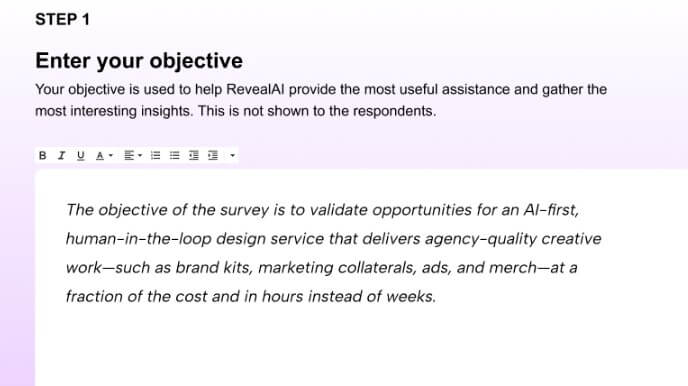
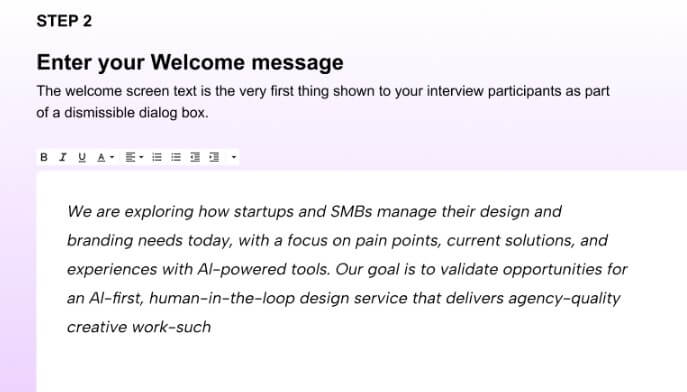
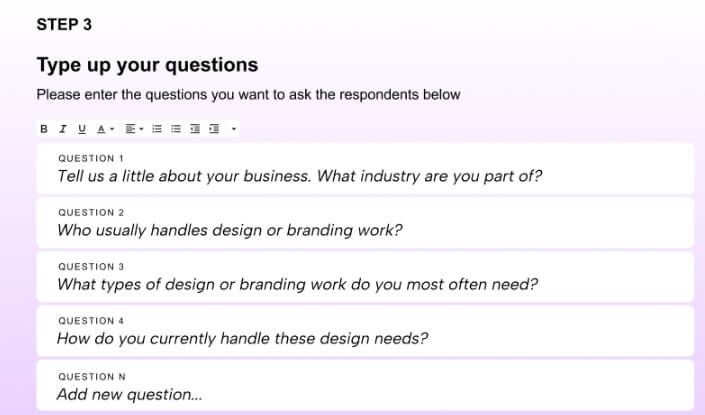
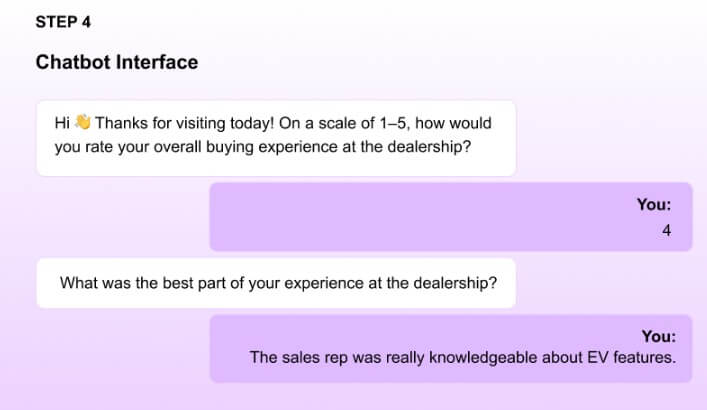
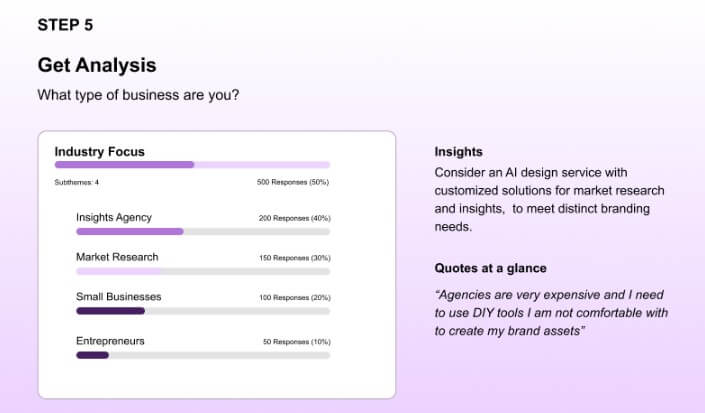
Reveal AI’s product workflow is easy to follow: set an objective, write a welcome, type your questions, launch the survey, and get the analysis. That simplicity matters because research tools can become heavy fast, especially when teams need recruiting, survey logic, transcription, coding, and reporting.
The strongest part is the AI follow-up layer. Reveal AI says its conversational interviews use real-time probing and follow-ups, which means the system can ask respondents for more detail without a human moderator sitting in every session. For example, if a customer says a product “felt confusing,” the system can push for what was confusing, when it happened, and what the person expected instead.
That is where Reveal AI becomes more valuable than a normal survey. It helps prevent vague answers from staying vague.
| Feature | What It Means in Practice |
|---|---|
| Conversational surveys | Open-ended feedback feels more like a guided discussion |
| AI follow-up questions | Respondents are asked for more detail when answers are thin |
| Automated transcription | Voice or interview data can be turned into reviewable text |
| Coding and sentiment analysis | Responses are grouped and scored for easier analysis |
| Insights dashboard | Teams can surface themes, quotes, and audience segments |
| Report exports | Findings can be shared with stakeholders faster |
| Integrations | Works with tools such as Qualtrics, Decipher, Dynata, and in-house platforms |
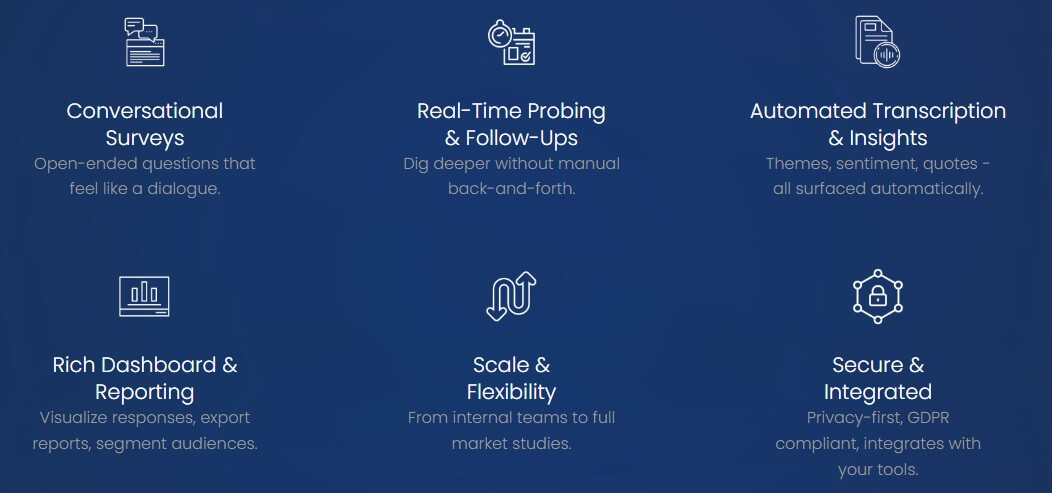
Reveal AI’s product page specifically highlights automated transcription, coding, sentiment analysis, dashboard filtering, instant report exports, and integrations with existing research platforms.
Reveal AI is strongest when the research question needs depth. It fits concept testing, customer journey research, brand perception studies, product feedback, employee listening, and market exploration. Its market research page says the platform supports qualitative work such as concept testing, brand image research, consumer feedback analysis, and AI-powered insight generation.
The employee listening use case is also a natural fit. Reveal AI says it helps HR teams reduce survey fatigue, use follow-up questions, and uncover trends with AI-powered analysis. That can be useful during onboarding, change management, leadership transitions, or post-merger integration, where employees may need space to explain what is working and what is not.
For customer research, the value is speed plus texture. A standard satisfaction survey may tell you that customers are unhappy. Reveal AI is better suited to finding the reason behind that score, especially when teams need quotes, themes, and audience filters to guide product or marketing decisions.
Most survey tools are built around structure: ratings, dropdowns, rankings, and short text boxes. Reveal AI is built around conversation. That changes the type of answer a team can expect.
A rating scale can tell a product team that users dislike a feature. A conversational survey can ask what part felt confusing, what users tried first, and what would have made the experience clearer. That extra context is often where the useful insight sits.
Reveal AI also claims scale as a major advantage. Its brand awareness research content says the platform can support interview campaigns from 1 to 100,000 participants and allows responses from any device at the participant’s chosen time. That kind of scale is hard to match with traditional one-on-one interviews.
The company also reports more than 700,000 AI-powered questions delivered, a 41% higher response completion rate, 2.5x more high-value words, and a 40% reduction in project completion time. These are company-reported figures, so they should be treated as product claims rather than independent benchmarks.
The main limitation is that AI analysis still needs a researcher’s judgment. Reveal AI’s own content says conversational AI should not replace human interviews because humans bring empathy, cultural understanding, and personal connection. It also says researchers should review logs, validate patterns, and adjust conversation flows when AI may misinterpret a conversation.
That is the right caveat. Automated theme detection can speed up synthesis, but it can also overgroup different ideas, miss subtle context, or make a theme look stronger than it is. A dashboard should not be treated as the final answer. Good teams will still inspect raw quotes, compare segments, and ask whether the findings support a real business decision.
The second trade-off is study design. Reveal AI can help ask better follow-up questions, but it cannot fix a vague objective. If the team does not know what decision the research should support, the output may still feel scattered.
Privacy also matters. Reveal AI’s privacy policy says the company may collect contact details, communications, survey or interview chatbot interactions, device data, and usage data. Teams using the platform for employee or customer research should review those details before collecting sensitive feedback.
Reveal AI works best for teams that need open-ended insight at scale: product teams testing ideas, marketers studying campaign reactions, researchers running concept tests, HR teams listening to employees, and consultants collecting stakeholder feedback.
It is less suited for simple polls, one-off forms, strict quantitative studies, or any situation where teams plan to accept AI summaries without checking the underlying responses.
Reveal AI is best at turning qualitative research into a faster, more scalable workflow.
Its strengths are conversational surveys, real-time follow-ups, automated coding, sentiment analysis, dashboards, reports, and integrations with existing research tools.
The main caveat is interpretation. Reveal AI can speed up research, but useful insight still depends on clear study design, source review, and human judgment.
TAGS: Research
Related Tools:

Provides real-time insights for stock and crypto

Research assistant for explaining academic papers
Automates modeling, forecasting, and reporting to help businesses

Research assistant that lets you interact with web content

Simplifies legal documents into plain language

Designed for efficient data discovery