
Share this tool:
 |
Description:
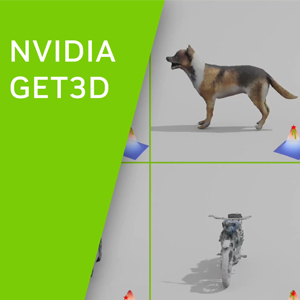
GET3D is an NVIDIA research model for generating textured 3D assets directly as explicit meshes. Presented at NeurIPS 2022 by researchers from NVIDIA, the University of Toronto, and the Vector Institute, it was designed to address a weakness in earlier 3D generative systems: many could produce convincing rendered views but did not output conventional textured geometry that could move easily into standard 3D workflows. GET3D instead generates mesh geometry and surface color together, with demonstrated categories including cars, chairs, animals, motorbikes, human characters, and buildings.
The most important thing about GET3D is its output.
Rather than representing a shape only as a neural field that needs a special renderer, GET3D produces an explicit 3D surface. NVIDIA describes the model as generating meshes with complex topology, detailed geometry, and high-fidelity textures that can be used by conventional rendering engines.
That distinction made GET3D notable when it appeared. A generated chair can contain separate wheels or openings, a vehicle can contain windows and mirrors, and an animal can include protruding features such as ears or horns. The model is not restricted to one fixed mesh template.
| Capability | Why It Matters |
|---|---|
| Explicit textured meshes | Produces geometry rather than only rendered views |
| Arbitrary topology | Supports holes, separate parts, and varied structures |
| Separate geometry and texture codes | Lets shape and appearance vary independently |
| Latent interpolation | Creates gradual transitions between generated assets |
| Local latent variation | Produces related assets with smaller differences |
| Text-guided adaptation | Can be fine-tuned toward text concepts as an experimental extension |
| FlexiCubes support | Adds an alternative surface-extraction method |
GET3D separates generation into two learned components: a geometry latent code and a texture latent code.
The geometry side generates a signed distance field, or SDF, which represents the object's surface mathematically. NVIDIA's original implementation uses DMTet to extract that field as a mesh. A separate texture field is then queried at points on the generated surface to determine color.
Training happens through rendered 2D views. GET3D uses a differentiable renderer to turn its generated objects into RGB images and silhouettes, then two discriminators judge whether those renders resemble the training examples. The full system is trained end to end.
This is a useful architectural compromise. The training supervision comes from images, but the final representation is still an actual 3D mesh.
One of GET3D's more interesting research features is its separation of shape and appearance.
Keep the geometry latent code fixed while changing the texture code, and the same basic object can receive different surface appearances. Keep the texture code fixed and vary geometry, and its form changes while retaining related visual characteristics. NVIDIA also demonstrates interpolation between latent codes, producing gradual transitions from one generated object to another.
This makes GET3D particularly relevant to large-scale asset generation. Instead of producing one chair or vehicle, a trained generator can create families of related assets with meaningful variation.
For games, simulation, synthetic datasets, or virtual worlds, that ability to generate diversity is arguably more valuable than producing one carefully art-directed object.
GET3D's project page includes text-guided generation, but this should not be confused with a modern text-to-3D web interface.
NVIDIA demonstrates a workflow based on StyleGAN-NADA where the trained generator is fine-tuned using a text description and a directional CLIP loss calculated from rendered images. That allows prompts to push the generator toward concepts described in text.
In practice, though, GET3D is fundamentally a category-trained generative model driven by latent codes. Text guidance is an additional research technique rather than its central user experience.
NVIDIA released an official PyTorch implementation, but running it is much closer to operating a research repository than using a creative SaaS tool.
The published requirements recommend Linux, CUDA 11.1 or later, Python 3.8, PyTorch 1.9, and high-end NVIDIA GPUs. Development and testing used V100 and A100 hardware. Training configurations can use up to eight GPUs, while NVIDIA says inference on the released pretrained models can run on a single GPU with 16 GB of memory.
The repository includes ShapeNet rendering scripts and pretrained models for categories such as cars, chairs, and motorbikes. In September 2023, NVIDIA also added FlexiCubes as a drop-in alternative to DMTet for extracting surfaces.
GET3D makes the most sense for 3D generative research, game-asset experimentation, synthetic datasets, virtual-world population, simulation, and researchers studying explicit generative geometry.
It is especially interesting when a project needs many variations within a known object category. A trained vehicle generator, for example, can sample many related but distinct shapes without modeling each one manually.
The geometry-texture separation also makes GET3D useful for studying controllable 3D representation and latent-space manipulation.
GET3D is not a general-purpose “type anything and get a production-ready model” application.
Its generators learn distributions from category-specific datasets, so generating a completely new object class is not as simple as entering another prompt. Training is computationally demanding, and even inference requires capable NVIDIA hardware. The official setup also reflects a 2022-era research stack rather than a polished modern desktop workflow.
Generated meshes can still need cleanup for production. Explicit geometry is a major advantage, but it does not automatically provide artist-authored topology, rigging, UV conventions, animation readiness, or precise engineering dimensions.
It is also worth noting that the repository's visible development news tops out with the FlexiCubes integration from September 2023, so GET3D is better viewed today as an influential research implementation than an actively evolving commercial product.
GET3D's lasting strength is that it treats usable 3D geometry as the output, not merely something implied by rendered images. Its explicit meshes, topology variation, separate geometry and texture controls, and latent-space generation made it an important step toward scalable generative 3D content.
It is best for researchers and technically experienced 3D developers rather than casual creators. The main caveat is accessibility: GET3D offers an interesting generative foundation, but using or retraining it requires far more technical work than today's browser-based text-to-3D tools.
TAGS: 3D Model
Related Tools:

Offers online courses taught by industry experts
Transforms text or images into detailed 3D models

Designed for creating, marketing, and selling online courses

Generates videos and 3D models

Transforms text prompts detailed 3D models

Offers courses from leading universities and companies