Share this tool:
 |
Description:
Zep is an agent memory and context engineering platform built for developers creating AI applications that need to remember users, business information, previous conversations, and work completed by agents. Rather than stuffing an ever-growing chat history into every prompt, Zep converts incoming information into structured context and retrieves what matters when an agent needs it.
Its main idea is that useful AI memory should not just store old messages. It should understand entities, relationships, facts, changes over time, and where each piece of information came from.
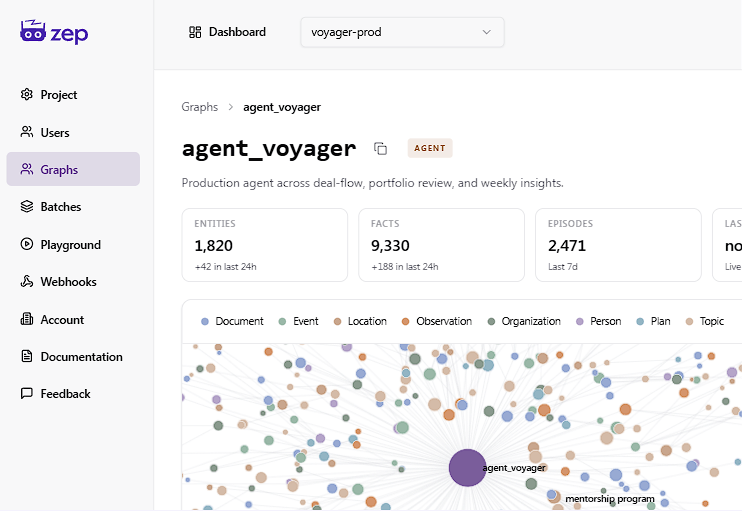
Zep builds what it calls a Context Graph, a temporal knowledge graph created from sources such as chat messages, business data, documents, and JSON. The graph stores entities, relationships, facts, and the original episodes that produced them.
The temporal part matters. Suppose a customer once preferred one product but later switches to a competitor. Zep can invalidate the outdated fact while preserving it as historical information. An agent can therefore reason about what is true now without losing what was true before.
That is more useful than basic vector retrieval for applications where preferences, account states, commitments, relationships, or business conditions change.
Storing information is only half the problem. The model also needs the right information at the right time.
Zep assembles relevant information into a Context Block, which can contain facts, entity information, source episodes, thread summaries, and other context selected for the current interaction. Its documentation reports retrieval latency below 200 milliseconds at the 95th percentile.
This approach helps control context-window waste. Instead of repeatedly sending an entire customer history to the model, an application can provide a smaller set of relevant details.
A more unusual feature is Observations. Zep can analyze information across a graph and derive evidence-backed patterns, decisions, commitments, recurring behavior, or state changes.
For example, individual transactions may look unrelated on their own. Across time, Zep might identify a recurring behavior that becomes useful context for an agent.
This is where Zep starts to look less like a memory database and more like context infrastructure. It is not only retrieving stored facts. It can help surface patterns across them.
Zep’s graph technology is powered by Graphiti, its open-source temporal knowledge graph framework. Graphiti can build and incrementally update graphs without requiring full batch recomputation whenever new data arrives.
There is an important distinction between the two products. Graphiti is the framework developers can run themselves, while Zep is the managed platform that handles extraction, retrieval, storage, governance, and larger-scale graph operations.
That gives technical teams a useful choice depending on how much infrastructure they want to manage.
Zep provides SDKs for Python, TypeScript, and Go. Its quick-start workflow centers on creating users and threads, adding messages or business data, and retrieving assembled context for the next model call.
It also supports agent frameworks including LangGraph, CrewAI, Google ADK, and AutoGen. This makes Zep easier to add as a memory layer without forcing developers to rebuild their agent stack around one framework.
| Use Case | Why Zep Fits |
|---|---|
| AI assistants | Remembers preferences and prior interactions |
| Customer agents | Tracks changing account and relationship context |
| Sales agents | Maintains long-term customer and deal information |
| Healthcare or coaching apps | Preserves evolving user history and patterns |
| Research agents | Connects information across multiple sessions |
| Enterprise agents | Adds governed memory across users and data sources |
Zep is developer infrastructure, not a finished chatbot. Teams still need an LLM, application logic, agent framework, interface, and sensible rules for deciding how retrieved context should be used.
Knowledge graphs also introduce more structure than basic conversation storage. That is useful for complex applications, but it may be unnecessary for a small bot that only needs a short conversation history.
Enterprise deployments also need to think carefully about memory permissions. Zep addresses this with role-based and attribute-based access controls, retention policies, provenance, and audit logging, but teams still have to configure those policies correctly.
Zep is best for developers building AI agents that need long-term, changing, and structured memory. Its strongest idea is the temporal Context Graph, which can connect facts, preserve history, retrieve relevant context, and adapt when information changes.
For simple chat memory, it may be more infrastructure than necessary. For personalized or enterprise agents that need to remember people, business data, and ongoing work across many interactions, Zep offers a much more serious memory layer than simply saving conversation transcripts.
TAGS: AI Chat/Assistant