

Share this tool:
 |
Description:
AgentGPT is a browser-based autonomous agent tool from Reworkd that lets users name an AI agent, give it a goal, and watch it plan steps toward that goal. It became popular because it made the “AI agent” idea easy to try: no terminal, no custom setup, no complex orchestration. The main thing to know now is that AgentGPT is still useful as an accessible agent demo and open-source reference point, but it should not be treated like a fully modern agent platform.
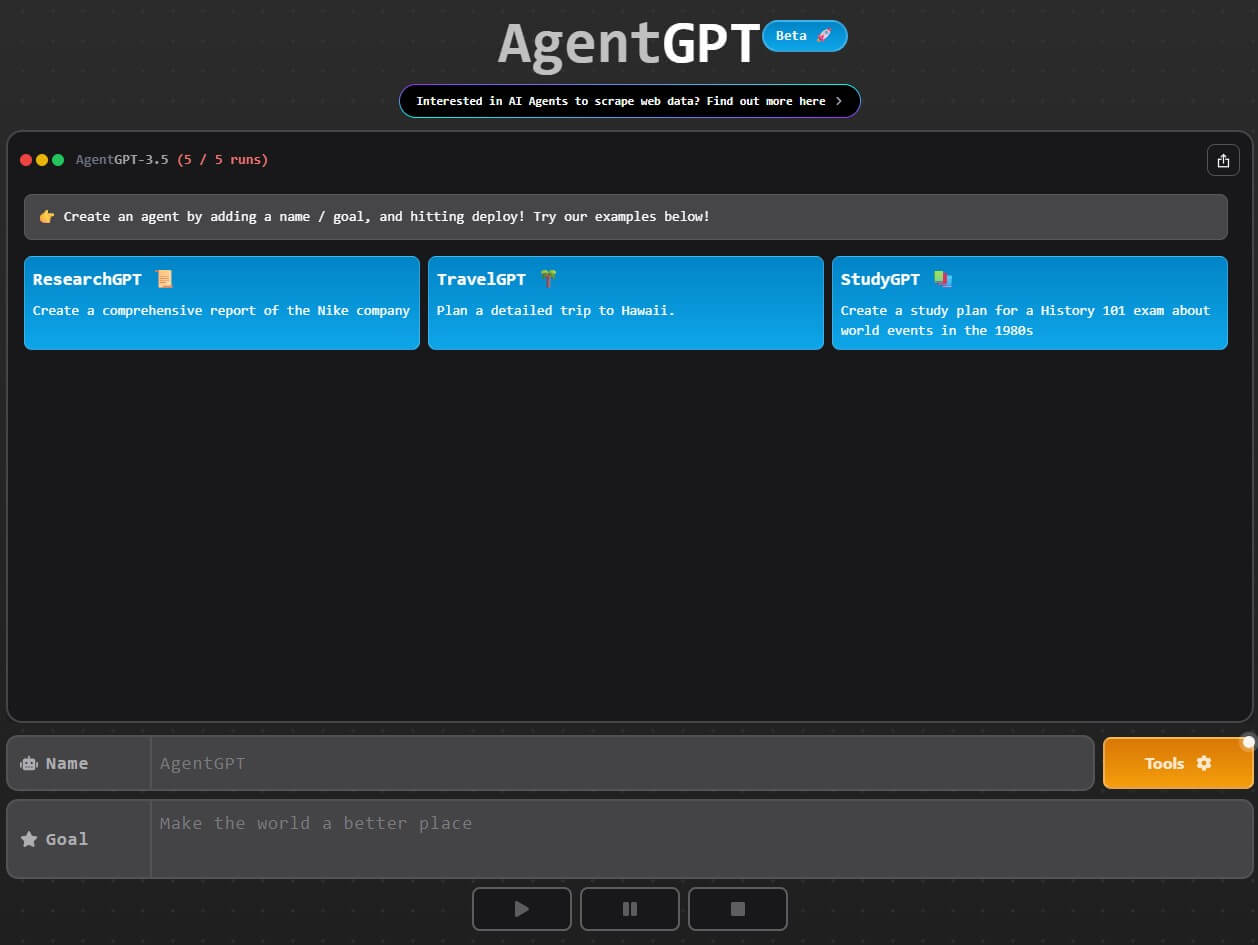
AgentGPT lets you “configure and deploy” autonomous AI agents in the browser. The GitHub description explains the core loop well: users name a custom AI, give it a goal, and the agent attempts to reach that goal by thinking of tasks, executing them, and learning from the results.
The official web app keeps the setup simple. It asks users to create an agent by adding a name and goal, then hitting deploy. The page also shows sample agents like ResearchGPT, TravelGPT, and StudyGPT, which gives a good sense of its intended use: research, planning, studying, and structured task exploration.
That simplicity is the product’s biggest appeal. AgentGPT takes an idea that can feel technical, autonomous agents, and turns it into a small browser workflow. You don’t need to design a chain of prompts manually. You state the outcome, and the tool tries to form a task list around it.
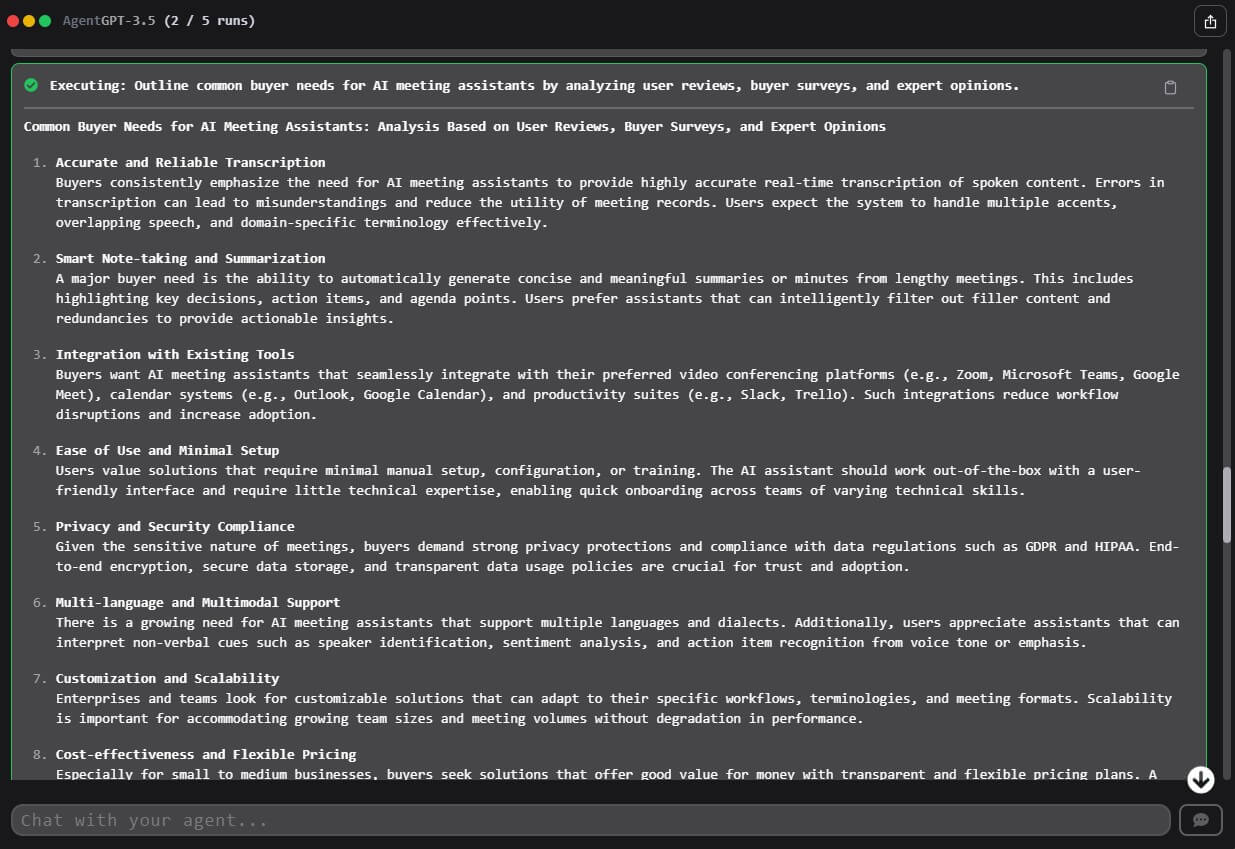
Market research
Prompt:
“Create a concise research brief on the current market for AI meeting assistants. Include major product categories, common buyer needs, risks, and three opportunities for a small startup.”
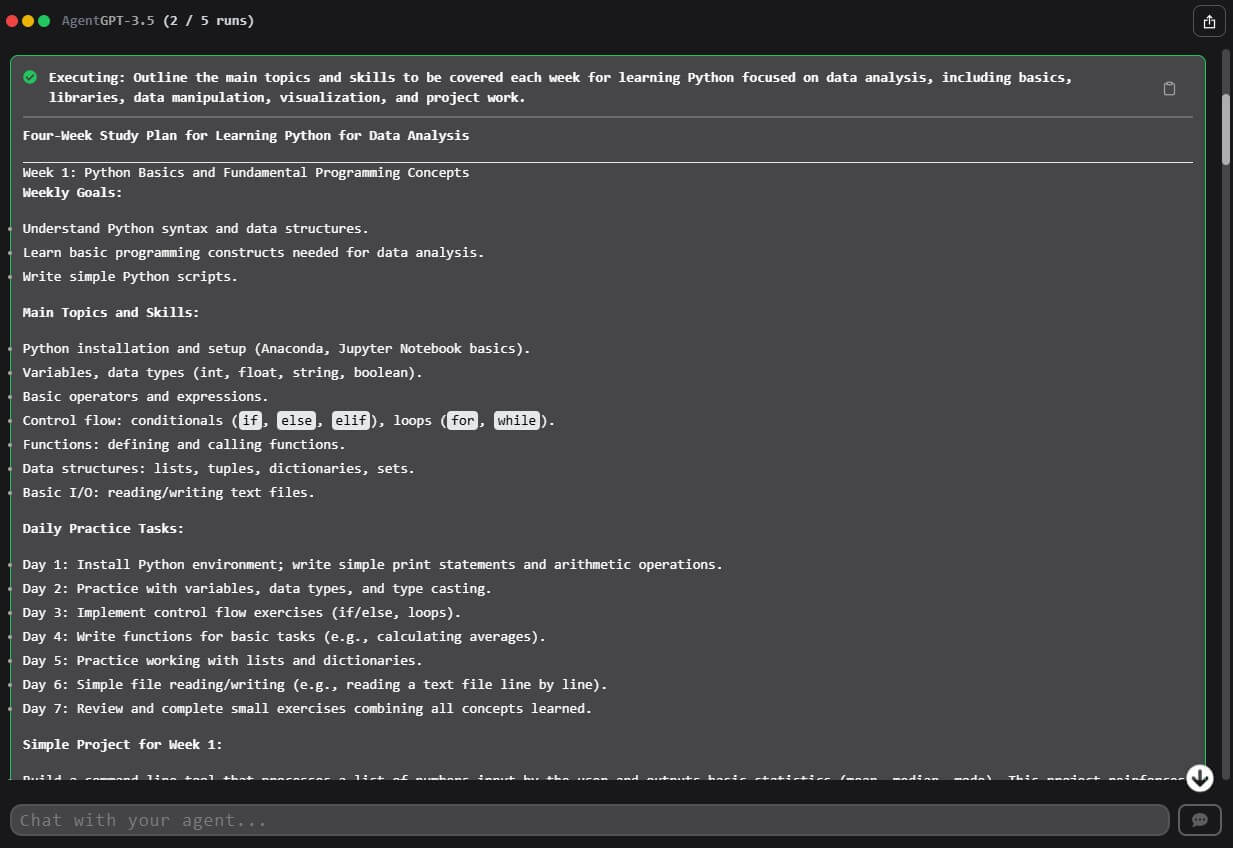
Learning plan
Prompt:
“Create a four-week study plan for learning Python for data analysis. Include weekly goals, daily practice tasks, and a simple project for each week.”
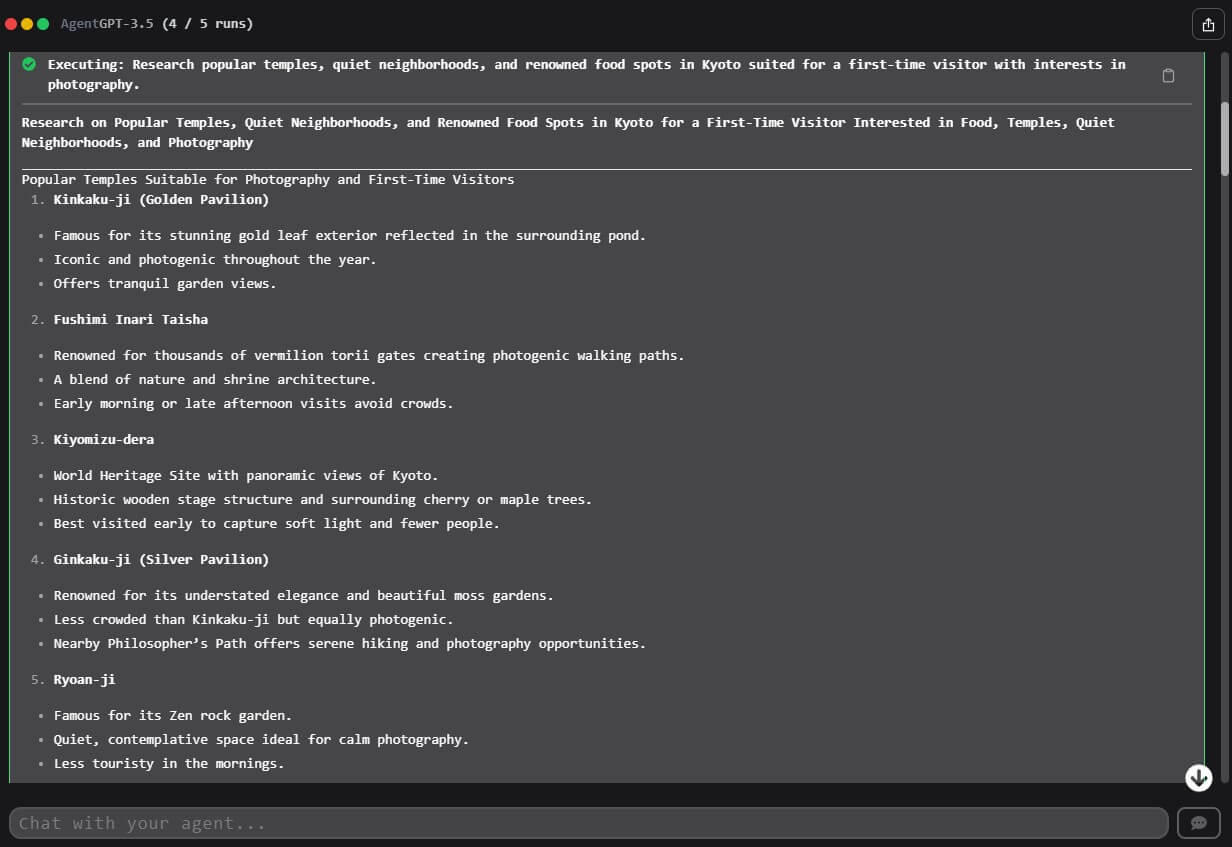
Trip planning
Prompt:
“Plan a five-day trip to Kyoto for a first-time visitor who likes food, temples, quiet neighborhoods, and photography. Include a daily route and practical travel notes.”
Business planning
Prompt:
“Develop a launch checklist for a small online course about personal finance. Include content preparation, landing page tasks, email sequence ideas, and launch-week priorities.”
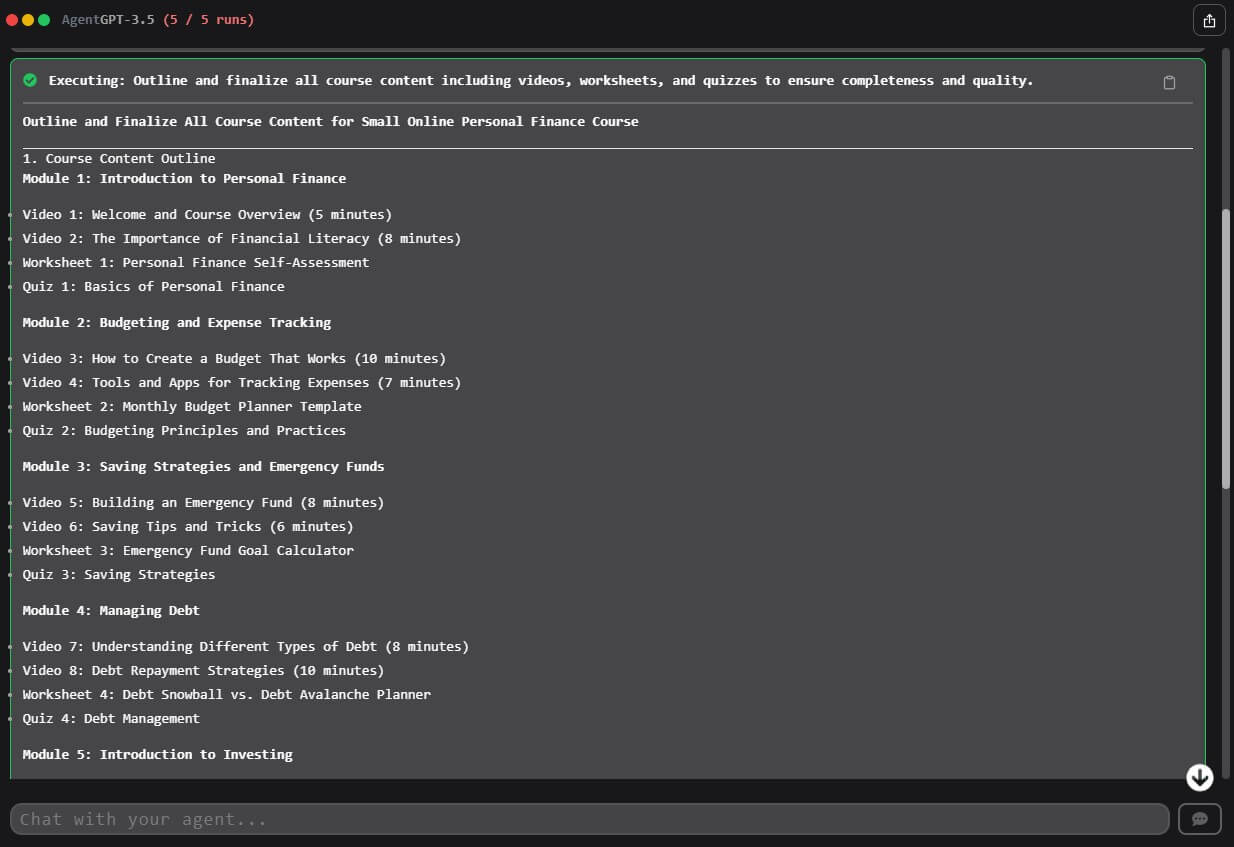
Users create an agent by entering a name and objective, which keeps the starting point simple.
The agent attempts to break a broad goal into smaller tasks, which is the main difference from a normal one-shot chatbot prompt.
The main hosted experience runs in the browser, so casual users can try the agent concept without setting up a local environment.
The repository is public, uses a GPL-3.0 license, and shows the project’s architecture and setup requirements.
Developers can clone the repository, run setup scripts, and configure local services, API keys, database, backend, and frontend components.
AgentGPT is still useful for understanding how early autonomous agents planned, looped, and worked toward a broad objective.
The hosted workflow is almost intentionally minimal: name the agent, enter the goal, deploy it, and watch the steps unfold. That makes AgentGPT approachable for beginners. It is less intimidating than AutoGPT-style local setups, where users often have to manage dependencies, environment variables, keys, and runtime errors.
For developers, the open-source path is more involved. The GitHub README lists requirements such as Node.js, Git, Docker, an OpenAI API key, plus optional Serper and Replicate credentials. It also describes the stack around Next.js, FastAPI, Prisma, SQLModel, TailwindCSS, Pydantic, Zod, and LangChain.
That split matters. Non-technical users should think of AgentGPT as a browser demo for goal-driven agents. Developers can treat it as an older but still informative codebase for studying how browser-based agents were assembled.
AgentGPT works best for exploratory planning, rough research, brainstorming, and turning broad goals into a task path.
It is useful when you do not know where to start. A user can give it an outcome, then watch the agent form a plan. That can help with first drafts of research briefs, study plans, product ideas, trip plans, content calendars, business checklists, and project outlines.
The real value is not perfect execution. It is seeing the agent reason through the problem in steps. That makes it helpful for people who want to understand agent-style AI without learning a development framework first.
The current public web app labels the experience as “Beta” and shows “Agent GPT-3.5” in the interface. It also provides built-in examples such as ResearchGPT, TravelGPT, and StudyGPT.
The open-source repository is important, but it comes with a serious caveat. GitHub marks the AgentGPT repository as archived by the owner on January 28, 2026, and read-only. It still has strong historical interest, with tens of thousands of stars and forks, but that archive status means users should not expect the same development pace as an actively maintained agent platform.
Reworkd’s current documentation also points people looking for AgentGPT information back to GitHub, while Reworkd itself now presents its main product around AI-powered web data extraction at scale.
AgentGPT is a good fit for students who want study plans, project breakdowns, and research outlines.
It also works for founders and creators who need a fast first pass on market research, content planning, feature ideas, or launch checklists.
For developers, it is most useful as an open-source reference for early autonomous agent design. The codebase shows how the project combined a web interface, backend, database layer, authentication, and LLM tooling.
It is less suitable for regulated workflows, production business automation, sensitive data handling, or tasks that require reliable tool use across external systems.
The biggest limitation is maturity. AgentGPT helped popularize the browser-based agent idea, but the official repository is archived. That changes how users should evaluate it. It is better viewed as a useful agent experiment and reference project than as a leading current agent workspace.
The second limitation is execution depth. AgentGPT can plan and iterate, but users should not expect it to reliably complete complex real-world tasks the way a modern agent with browser control, file handling, app integrations, and workflow permissions might.
The third limitation is accuracy. Like other LLM-based tools, it can produce confident but incomplete plans. Research briefs, business advice, and study materials still need review.
Finally, its best prompts need careful scope. If the goal is too broad, the agent can wander. If the goal is too narrow, a normal chatbot may be faster.
- Write the goal like a project brief. Include the audience, output format, constraints, and what “done” should look like.
- Use AgentGPT for planning before execution. It is better at breaking down a project than acting as a dependable production assistant.
- Keep tasks bounded. A three-day plan, one-page report, or 20-item checklist will usually behave better than an open-ended mission.
- Check every claim before using it in work that matters. Agent-style output can feel more complete than it is.
AgentGPT is best understood as an approachable early autonomous-agent tool: easy to try, useful for goal-based planning, and valuable as an open-source reference. It is strongest for research outlines, study plans, project breakdowns, and idea exploration.
The main caveat is that the public repository is archived, so AgentGPT is no longer the freshest choice for users who need a modern, production-ready AI agent platform.
TAGS: Productivity AI Chat/Assistant
Related Tools:
Helps teams plan, organize, and automate projects
Designed to enhance learning and productivity

Analyze complex information, write and debug code

Helps to optimize resume and cover letters

Enhances efficiency in Excel and Google Sheets

Assists in creating classroom content