Share this tool:
 |
Description:
- Introduction
- What Whisper Actually Is
- What Whisper Does Best
- Core Features and Capabilities
- Whisper vs OpenAI’s Newer Transcription Models
- Workflow and Ease of Use
- Output Quality and Control
- Best Use Cases
- Who Should Use Whisper
- Comparison to Other Speech-to-Text Tools
- Practical Tips
- Limitations and Trade-Offs
- Final Takeaway
Whisper is OpenAI’s automatic speech recognition system for turning speech into text. Its original strength was simple but important: robust multilingual transcription that handled accents, background noise, technical language, and translation into English better than many earlier speech systems. Today, Whisper remains useful as a reliable general-purpose transcription model, but buyers and developers should understand where whisper-1 still fits now that OpenAI also offers newer GPT-4o transcription models.
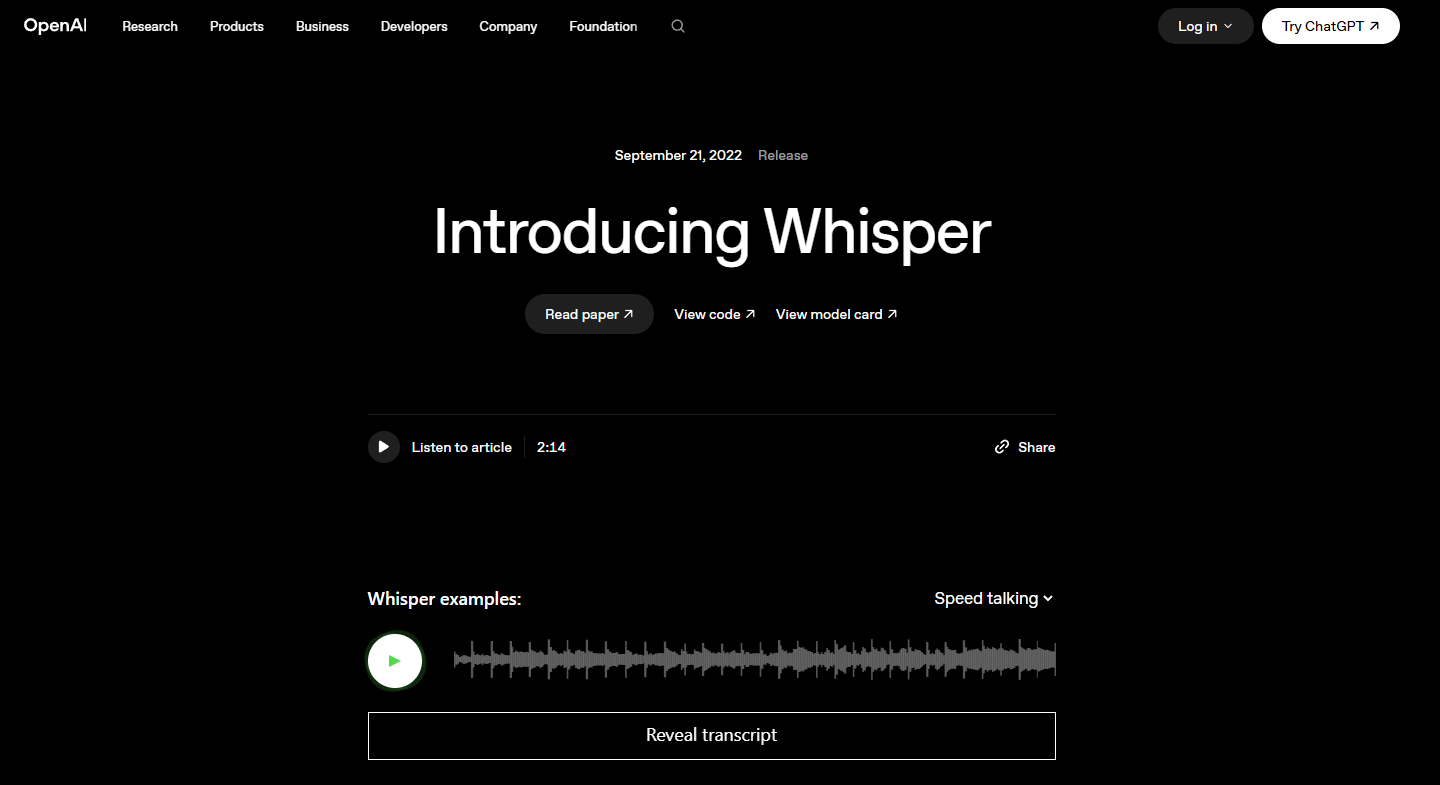
Whisper is a general-purpose speech recognition model. OpenAI describes it as trained on a large and diverse dataset and capable of multilingual speech recognition, speech translation, and language identification. The original Whisper announcement said it was trained on 680,000 hours of multilingual and multitask supervised data collected from the web.
The easiest way to understand Whisper is through four layers:
| Layer | What it does | Why it matters |
|---|---|---|
| Speech recognition | Converts spoken audio into written text | Core workflow for transcripts, captions, notes, search, and accessibility |
| Multilingual transcription | Transcribes audio in many languages | Useful for global content, interviews, meetings, and media archives |
| Translation to English | Translates non-English speech into English text | Helpful for research, journalism, support, education, and multilingual review |
| Language identification | Detects the spoken language | Useful when processing mixed or unknown-language audio |
Whisper is not a meeting assistant, podcast editor, voiceover generator, or dubbing studio by itself. It is the transcription layer. The real value comes from using it inside workflows that need accurate audio-to-text conversion.
Whisper is strongest when you need dependable transcription from messy, real-world audio.
That is why it became popular with developers, researchers, journalists, podcasters, educators, and product teams. It can take recorded interviews, calls, lectures, voice notes, podcasts, videos, meetings, and field recordings and turn them into searchable text.
Its original design goal was not only clean studio speech. OpenAI specifically highlighted robustness to accents, background noise, and technical language. That is one of the reasons Whisper became widely used beyond simple demo transcription.
The best use case is not “I want a polished meeting summary.” Whisper does not do that on its own. The best use case is “I need reliable transcripts that I can search, summarize, caption, translate, analyze, or feed into another system.” That makes Whisper especially useful as a foundation model inside bigger workflows.
Whisper can transcribe speech in multiple languages, making it useful for global audio, interviews, lectures, and media content.
Whisper can translate speech from other languages into English, which is useful for research, international content review, and multilingual workflows.
Whisper can help identify the spoken language in audio, useful when processing unknown or mixed-language media.
OpenAI’s Audio API supports transcription and translation endpoints, historically backed by the open-source Whisper model through whisper-1.
The API supports common transcript and subtitle-oriented outputs, with available formats varying depending on the model and endpoint used.
Whisper is also available as an open-source model family, giving developers another path besides using the hosted OpenAI API.
This is the most important update for current users.
Whisper is still relevant, but OpenAI’s speech-to-text documentation now separates the older Whisper-backed endpoint from newer transcription models. The current Speech-to-Text guide says the Audio API has transcription and translation endpoints, historically backed by whisper-1, and that the transcription endpoint now also supports newer models including gpt-4o-mini-transcribe, gpt-4o-transcribe, and gpt-4o-transcribe-diarize.
| Model | Best For | Practical Meaning |
|---|---|---|
| whisper-1 | General transcription, translation, stable older workflows | Reliable default for many existing apps and pipelines |
| gpt-4o-mini-transcribe | Lower-cost or lighter transcription workflows | Useful when newer-model quality is desired with a lighter model |
| gpt-4o-transcribe | Higher-accuracy transcription | Better fit when transcript quality matters more than sticking with older Whisper workflows |
| gpt-4o-transcribe-diarize | Speaker-labeled transcripts and timestamps | Better fit for non-latency-sensitive workflows where speaker separation matters |
The practical takeaway is simple: Whisper is still useful, especially where existing workflows depend on it, but new OpenAI transcription builds should compare whisper-1 against the newer GPT-4o transcription models before choosing a default.
Whisper’s workflow is straightforward at the concept level: provide audio, choose a transcription or translation endpoint, receive text back, and then use that text in another workflow.
For developers, the hosted API path is usually the easiest. It removes the need to run local inference, manage GPUs, optimize model size, or handle deployment infrastructure. You send an audio file or audio stream through the supported OpenAI workflow and receive transcription output.
For technical users who want local control, the open-source Whisper release is still important. Running Whisper locally can make sense when you need offline processing, direct control over model behavior, custom batch jobs, or experimentation without routing files through a hosted service.
The trade-off is operational complexity. Hosted API use is simpler. Local open-source use gives more control, but it requires more technical setup, compute planning, storage management, and performance tuning.
Whisper’s output quality depends heavily on audio quality, language, accent, speaker overlap, background noise, and domain vocabulary.
Clean speech, good microphone placement, low background noise, and one speaker at a time will produce better transcripts. Overlapping speakers, music, echo, low bitrates, strong accents, quiet voices, and noisy field recordings can make results less reliable.
Whisper is often strong on real-world audio compared with older speech systems, but it is still not a perfect record of what was said. Like other AI transcription systems, it can make errors, miss short words, mishear names, smooth out uncertainty, or produce confident-looking text that should be reviewed before publication or high-stakes use.
The most useful mindset is to treat Whisper as a powerful first-pass transcription engine. For casual notes, that may be enough. For legal, medical, financial, academic, journalistic, or compliance-sensitive work, the transcript should be reviewed by a human.
- Podcast and video transcription: Whisper is useful for turning audio content into transcripts, show notes, searchable archives, captions, and summaries.
- Research interviews: Researchers can transcribe interviews and then code, summarize, or search the text more easily.
- Journalism and field reporting: Whisper is useful for processing interviews, public statements, press briefings, and multilingual source material.
- Meeting and call workflows: Whisper can act as the transcription layer inside meeting note, sales call, coaching, or support analytics products.
- Accessibility and captions: Transcripts and subtitle formats can help make audio and video content more accessible.
- Language learning and translation review: Whisper’s multilingual transcription and translation-to-English workflows are useful for comparing spoken language with written output.
- Developer speech features: Apps can use Whisper or newer OpenAI transcription models as the foundation for voice notes, audio search, dictation, or media indexing.
Whisper is best for developers, technical creators, researchers, journalists, podcasters, educators, and product teams that need speech-to-text as part of a larger workflow.
It makes less sense for users who want a complete finished app with meeting summaries, highlights, action items, speaker coaching, project folders, and team collaboration already built in. Whisper can power those workflows, but it does not provide the full product experience by itself.
It is also worth separating Whisper the model family from OpenAI’s broader current audio stack. If you are starting a new hosted transcription project today, you should test whisper-1 against the newer GPT-4o transcription models and choose based on accuracy, latency, speaker-label needs, output support, and total workflow fit.
| Tool | Strongest Fit | Where Whisper Stands |
|---|---|---|
| Deepgram | Real-time transcription, voice AI infrastructure, streaming workflows | Deepgram is stronger as a full production speech API platform; Whisper is simpler and widely known as a general transcription model |
| AssemblyAI | Transcription plus audio intelligence and higher-level analysis | AssemblyAI gives more built-in intelligence features; Whisper is more foundational and model-focused |
| Google / AWS / Azure Speech | Enterprise cloud speech services | Cloud speech platforms offer mature enterprise controls; Whisper remains attractive for robust general transcription and open-source availability |
| Otter.ai | Meeting notes, summaries, collaboration, searchable meeting history | Otter is a complete meeting app; Whisper is a transcription layer that could power similar workflows |
| OpenAI GPT-4o transcription models | Newer OpenAI speech-to-text workflows | These are now the models to compare against whisper-1 for new hosted API builds |
The simple version: use Whisper when you need a strong transcription foundation. Use a full meeting or audio intelligence product when you need the workflow around the transcript already built for you.
- Start with clean audio whenever possible. Microphone quality, speaker distance, background noise, and overlapping speech all affect transcript quality.
- Use the hosted API if you want the fastest setup. Use open-source Whisper locally if you need more infrastructure control or offline processing.
- Compare whisper-1 with newer OpenAI transcription models before starting a new production workflow.
- Use subtitle formats when the output is meant for video captions, accessibility, or editing workflows.
- Review names, numbers, timestamps, acronyms, and technical terms manually because these are common transcription failure points.
- Do not treat transcripts as perfect records in high-stakes situations without human review.
- Build downstream workflows around uncertainty. A transcript may need correction before summarization, search indexing, quoting, or publication.
- The biggest limitation is that Whisper is not a complete workflow product. It transcribes and translates audio, but it does not automatically give you polished meeting notes, CRM updates, highlights, action items, or editorial review workflows.
- The second limitation is transcript reliability. Whisper can still mishear, omit, or invent text, especially with noisy audio, silence, music, overlapping speakers, and difficult recordings. Human review matters for anything sensitive or public-facing.
- The third limitation is model positioning. Whisper is no longer OpenAI’s only speech-to-text option. The newer GPT-4o transcription models may be a better fit for some new workflows.
- The fourth limitation is local deployment complexity. Open-source Whisper gives control, but running it efficiently at scale requires compute planning, batching, storage, monitoring, and optimization.
- The fifth limitation is speaker handling. Basic transcription is not the same as diarization. If you need clear speaker labels, choose a model or workflow that explicitly supports diarized output.
Whisper is one of the most important general-purpose speech recognition systems because it made robust multilingual transcription and translation widely accessible to developers and technical users.
Its strongest value is as a transcription foundation: take audio, turn it into text, then use that text for captions, summaries, search, analysis, translation review, accessibility, or product workflows.
The main caveat is that Whisper should not be confused with a finished meeting assistant or audio productivity app. It is the model layer. It becomes powerful when paired with the right workflow around review, storage, search, summaries, speaker labels, and publishing.
For existing workflows, whisper-1 remains useful. For new OpenAI API builds, it is worth comparing Whisper with gpt-4o-transcribe, gpt-4o-mini-transcribe, and gpt-4o-transcribe-diarize before choosing the final transcription path.
TAGS: Translation Speech to Text
Related Tools:
AI-powered mobile keyboard app that enhances typing efficiency

Translates videos into multiple languages

Translates text and media into over 130 languages
AI-driven translation across multiple languages

Automates captioning and video translations
Enables real-time video dubbing