

Share this tool:
 |
Description:
Digest is a briefing tool for people whose daily reading is scattered across too many places. You choose the sources you care about, and the service collects their latest updates into a single email delivered on your schedule.
The range of supported sources is unusually broad. It includes newsletters, RSS feeds, X, Reddit, YouTube, Instagram, TikTok, Hacker News, Product Hunt, Google News, weather, stocks, and more. Instead of giving you another feed to remember to check, Digest lets you assemble something closer to a personal morning paper or weekly roundup.
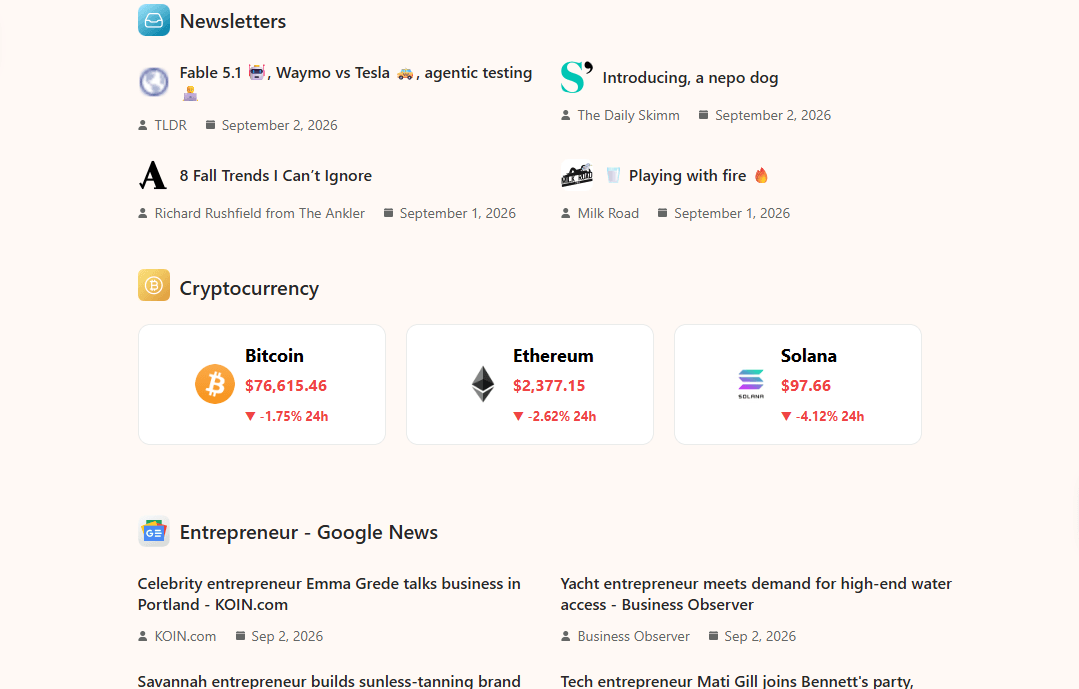
Control is the main appeal. You choose what goes into each Digest, decide how the sources are arranged, and set the delivery time.
The format works well when your interests cross several platforms. A founder might combine industry newsletters, a few carefully chosen X accounts, Product Hunt, company blogs, and Hacker News. Someone following financial markets could keep news, stock updates, and specialist publications in a separate briefing.
Newsletter handling is especially practical. Digest gives you a dedicated @usedigest.com email address for subscriptions. Newsletters stay out of your main inbox but remain available through Digest’s reader and scheduled emails.
Digest introduced AI Newsletter Summaries in May 2026. The feature analyzes incoming newsletters and reduces them to short bullet points, helping you decide what is worth opening.
That solves an obvious problem. Putting 30 newsletters in one place is tidier, but it does not save much time if you still have to read all 30. The summaries provide a quick first pass, while the original newsletter remains available when a topic needs more attention.
Digest added Smart News in March 2026, powered by Kagi News.
Rather than showing isolated headlines from a single publisher, Smart News draws from thousands of RSS feeds, groups related coverage, and creates multi-source summaries. The idea is to give readers the main facts and show how different outlets are covering the story. Available topics include world news, business, technology, science, sports, and culture.
Smart News fits neatly alongside the sources you select yourself. It can provide a wider view of current events without replacing the niche newsletters and feeds you already trust.
Digest is a good fit for knowledge workers, founders, researchers, developers, investors, and anyone else who regularly checks several information sources. It may also help people who want to spend less time bouncing between apps without losing touch with the subjects they follow.
You can create multiple Digests for different purposes. For example, you might have a daily news briefing, a separate industry roundup, and a personal-interest email that arrives once a week.
A scheduled briefing is better for catching up than for following a fast-moving event in real time. AI summaries can also flatten context or overlook the detail that made an article or newsletter useful in the first place. Important items still deserve a visit to the original source.
There is another, more mundane problem: a Digest can become just as overwhelming as the feeds it replaces. Keep adding sources and the supposedly concise briefing starts looking like an inbox all over again. The service works best when you are willing to remove sources that no longer earn their place.
Digest works best as a personal information-filtering system. It brings newsletters, social feeds, RSS, news, and other updates into a scheduled briefing, while AI summaries and Kagi-powered Smart News reduce some of the work involved in sorting through them.
It will not fix information overload on its own. The real benefit comes from choosing a manageable set of sources and letting the rest go.
TAGS: Aggregators
Related Tools:
Enhances web exploration by providing content summarization

Personalizes and simplifies news content

Matches users with suitable job opportunities

Turns newsletters into concise, easy-to-read digests

Allows users to search, filter, and explore a wide variety of AI models

Enables users to discover, share, and discuss the latest tech products