
Share this tool:
 |
Description:
Dante AI is an AI customer-support platform built around a simple idea: give one AI system your business knowledge, then use that same knowledge wherever customers ask questions.
You can train an agent on website pages, uploaded files, pasted text, and manually written question-and-answer pairs. Dante then uses that private knowledge to respond through a website chatbot and other supported channels. The platform also covers voice, email handling, lead capture, integrations, and analytics, making it broader than a basic FAQ bot.
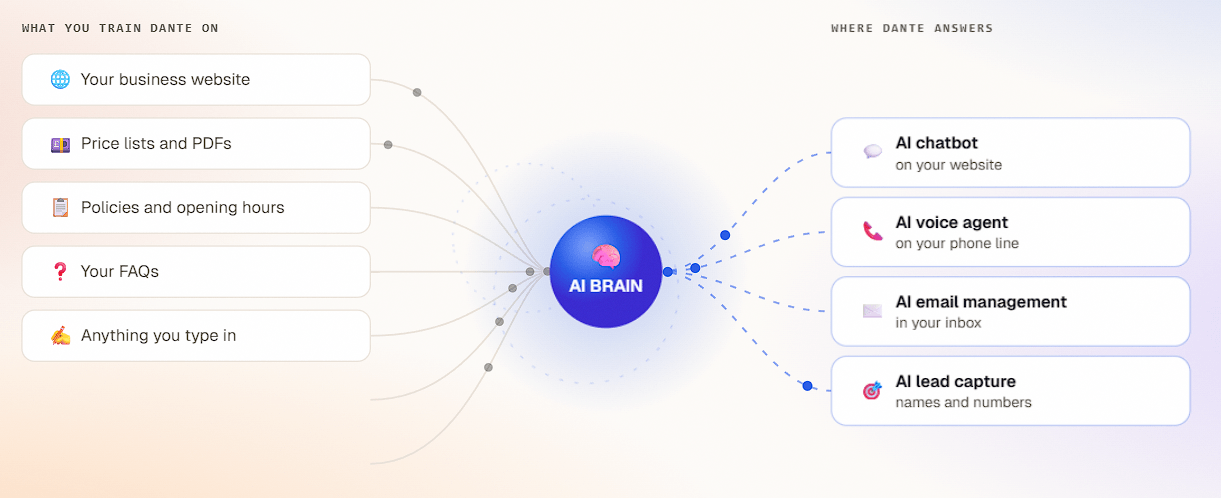
The knowledge workflow is one of Dante AI’s stronger areas. Website URLs can be crawled for public content, while uploaded sources can include PDFs, Word documents, slides, spreadsheets, and images. Teams can also paste internal instructions or create specific Q&A entries when an answer needs tighter control.
This setup makes sense for businesses that already have useful information scattered across a site, policy documents, guides, and FAQs. Instead of rewriting everything for an AI bot, you can bring those existing sources together.
Dante is also designed to avoid answering freely from general knowledge when your own source material is missing. That is an important choice for customer support, where an invented policy or inaccurate product answer can cause more trouble than admitting the information is unavailable.
Before publishing, the Sandbox lets you test responses privately. You can ask real customer questions, adjust the agent’s behavior, and change its language, tone, response length, or boundaries. Model selection is also available inside this workflow.
Dante supports models from OpenAI, Anthropic, and Google rather than locking every agent to one AI provider. That gives teams room to choose between faster models and more capable options depending on the job.
The useful part here isn’t just model choice. It is being able to test how a change affects actual answers before pushing it to customers.
Dante’s scope extends beyond a chat bubble. The same knowledge system can support website conversations, voice interactions, email responses, and lead capture. This gives businesses a better chance of keeping answers consistent instead of maintaining separate systems for every channel.
The platform also supports more than 100 languages, automatically responding in the language used by the customer. Branding controls cover elements such as colors, logos, tone, launcher appearance, and more advanced styling options.
Integration support is another major strength. Dante can connect with WhatsApp and booking tools such as Calendly and Cal.com. Zapier expands the platform into thousands of external apps, including CRM, communication, productivity, and data tools. There is also a REST API for teams that want to build custom workflows.
This opens up more practical workflows. A support agent can answer a question, capture a lead, trigger another application, or help move a customer toward a booking rather than stopping at a text response.
Dante tracks conversations after deployment and includes analytics around customer questions, lead activity, and support performance. More importantly, its Insights tools can surface common questions and identify knowledge gaps where the AI lacked enough information to give a useful answer.
That feedback loop matters. An AI support tool improves far more when teams can see exactly where customers are getting stuck.
Dante AI fits businesses dealing with repeated customer questions across several channels. E-commerce teams can use it for product, delivery, and policy questions. SaaS companies can turn documentation into interactive support. Service businesses can combine FAQs with lead capture and appointment booking.
It is also useful for organizations serving multilingual audiences or teams that want one knowledge source feeding several customer-facing channels.
Dante can only be as reliable as the information supplied to it. Poorly maintained documents, conflicting policies, or missing details will weaken the answers.
Some of its more advanced integrations, customization controls, models, and support features also depend on the account level being used. Teams planning complex automation should check which capabilities are available before designing the workflow.
Dante AI is strongest when you want one business knowledge system to handle more than website chat. Its combination of knowledge training, private testing, multiple AI models, multilingual support, voice and email workflows, analytics, and broad integrations makes it useful for teams trying to automate repetitive customer contact.
The main caveat is familiar but important: good automation still depends on accurate source material. Dante gives teams plenty of ways to distribute and act on that knowledge, but keeping the knowledge itself current remains the human part of the job.
TAGS: AI Chat/Assistant
Related Tools:

Generates text, code, and reasoning solutions
Generates descriptive narratives from images

Creates lifelike AI agents that engage customers

Create interactive chatbots from various content types

Design, deploy, and manage AI chatbots
Creates multilingual chatbots that automate customer support