Share this tool:
 |
Description:
CrawlChat is an AI support platform built mainly for software companies and teams with technical documentation.
It takes product guides, API references, internal knowledge, discussions, and other support material and turns them into an agent that can answer questions. Responses include links to the original sources, so users can check the documentation behind an answer.
That technical focus sets CrawlChat apart from general-purpose website chatbots. It is aimed at SaaS companies, developer-tool teams, support staff, and DevRel teams that repeatedly answer the same product and setup questions.
The goal is not simply to add a chat bubble to a website. It is to make technical documentation easier to use.
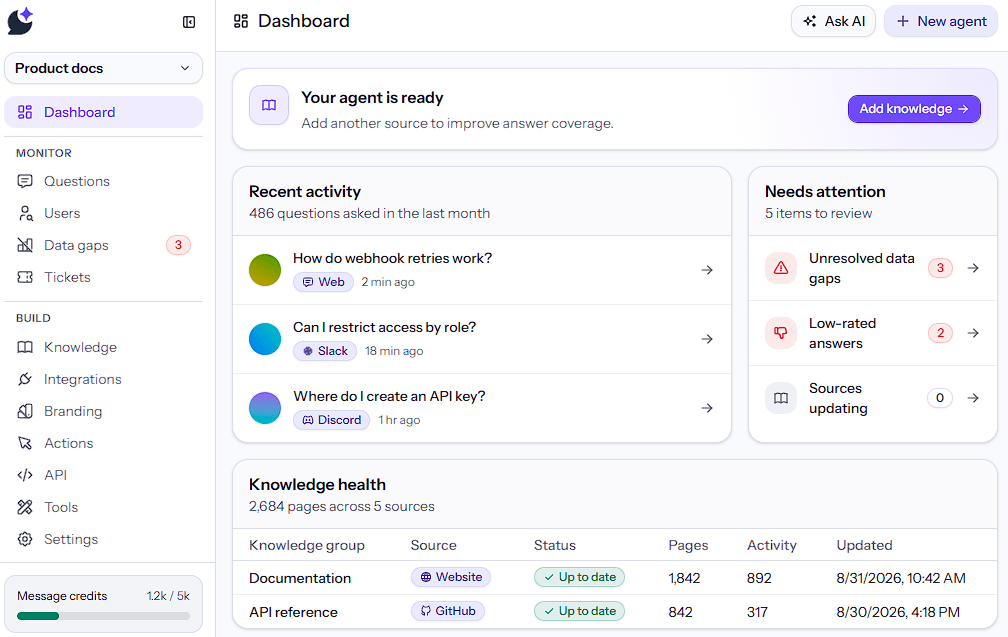
Setup begins by importing the information a team already maintains.
CrawlChat can crawl documentation websites and combine content from web pages, PDFs, Docusaurus sites, Notion, Confluence, GitHub repositories and discussions, and Linear. Sources can be arranged into groups when one agent needs to work across several documentation sets.
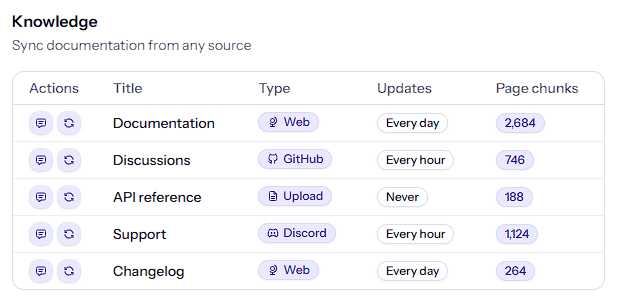
Automatic synchronization is particularly useful here. Technical documentation has a habit of changing just after someone has memorized the old version. An assistant that still refers to a deprecated API or outdated installation guide quickly becomes a liability.
CrawlChat can keep supported sources synchronized, helping the agent stay closer to the documentation customers are currently reading.
CrawlChat retrieves information from the connected knowledge base to ground its responses.
Users can inspect the material behind an answer instead of receiving an unsupported block of generated text. The Answer API also returns information about the source pages alongside its response.
For technical support, those links are not a decorative extra. A developer asking how an API behaves will often want the short explanation first and the full documentation immediately afterward.
Sources also make weak answers easier to diagnose. If the linked page is vague, incomplete, or unrelated, the team has a much clearer idea of what needs fixing.
The CrawlChat agent is not limited to a website widget. It can also be deployed through Slack, Discord, GitHub, a REST API, and MCP.
Teams can customize the web experience and adjust the agent’s tone, behavior, policies, and escalation rules.
MCP is especially relevant for developer-facing products because it allows compatible AI applications and coding tools to access the documentation agent directly. CrawlChat also offers an authenticated MCP interface that can expose agent details, messages, analytics, data gaps, and selected management controls.
This extends the same knowledge beyond customer support. Engineering, sales engineering, DevRel, and support teams can all work from a shared technical reference instead of maintaining their own scattered collections of answers.
CrawlChat’s analytics go beyond counting conversations.
The platform examines categories, sentiment, contextual relevance, and answer performance. Teams can inspect poorly rated responses and add corrections when an answer is incomplete or inaccurate.
The more interesting feature is Data Gaps. It identifies relevant questions that the existing documentation does not answer well.
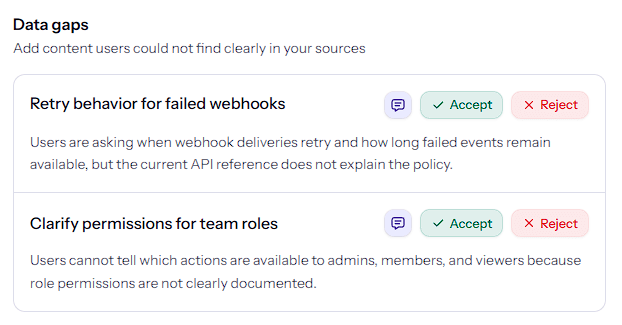
That changes how teams can interpret a failed response. The problem may not be the chatbot at all. It may be a missing guide, an unclear API reference, or a help article that assumes too much knowledge.
Fixing that gap improves both the agent and the documentation used by everyone else.
CrawlChat provides APIs for asking questions, creating support tickets, adding pages to a knowledge base, and generating content from stored documentation.
The Compose API supports iterative writing based on an agent’s knowledge. An n8n integration can pass answers or newly resolved support information into wider automated workflows.
There is also a Chrome extension for generating documentation-based text inside web text fields. Support staff can use it to draft replies without repeatedly switching tabs and copying material between tools.
CrawlChat is a natural fit for SaaS products, developer platforms, API companies, open-source projects, and technical communities.
It is particularly helpful when the same installation, troubleshooting, and product questions keep appearing across documentation, Discord, Slack, GitHub, and support channels.
The platform can also work as an internal knowledge agent for teams whose technical information is spread across several systems.
CrawlChat’s specialization is also its clearest limitation.
Businesses primarily looking for sales chat, marketing automation, CRM workflows, or general e-commerce support may be better served by a broader customer-service platform.
Its answers are only as reliable as the connected documentation. Source grounding reduces unsupported claims, but it cannot resolve contradictions or fill in missing details by itself.
Teams still need to review low-rated responses, correct errors, and maintain the source material. There is no escaping the documentation work; CrawlChat simply makes the payoff from that work more visible.
CrawlChat places an interactive AI layer over technical documentation. Source-linked responses, documentation connectors, Slack and Discord deployment, MCP support, APIs, and Data Gaps make it a good match for software and developer-focused teams.
It works best when documentation is already treated as part of the product rather than an afterthought.
For teams willing to keep that knowledge accurate, CrawlChat can make static documentation far easier to question, verify, and improve.
TAGS: AI Chat/Assistant
Related Tools:
Allows users to interact with various advanced AI models

Creates multilingual AI chat and voice agents
Generates interactions with detailed user personas
Integrates task management and time tracking
Allows users to create chatbots for websites
Facilitates project management and team collaboration