
Share this tool:
 |
Description:
AutoGPT is one of the best-known early examples of an autonomous AI agent: instead of answering one prompt at a time, it tries to take a larger goal, break it into smaller tasks, decide what to do next, and continue working through the objective. The Hugging Face version you linked is best treated as a lightweight, hosted entry point into that idea, not the full modern AutoGPT platform.
The core idea behind AutoGPT is simple: give the system a goal, and it attempts to manage the steps needed to complete it. A normal chatbot waits for the next instruction. AutoGPT-style agents try to plan, act, observe, and revise without needing the user to guide every move.
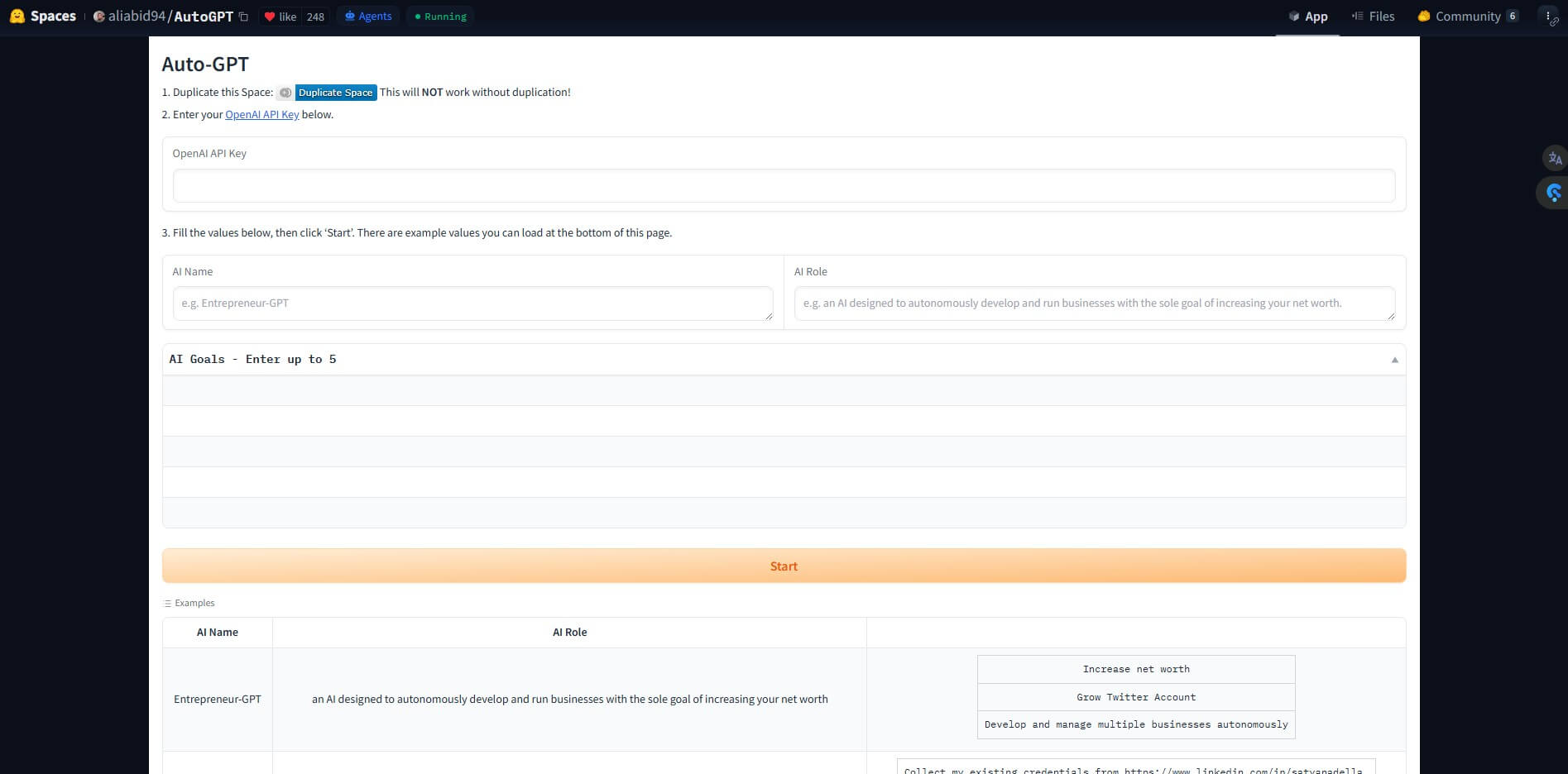
The linked Hugging Face Space appears to be based on an older AutoGPT implementation. Its file page lists project metadata with the package name “auto-gpt,” version “0.1.0,” and the description “A GPT based ai agent.” The Space itself is hosted by aliabid94 and marked as an Agents Space on Hugging Face.
That distinction matters. The current official AutoGPT project has evolved beyond the original experimental agent into a broader platform. Its GitHub README says AutoGPT lets users create, deploy, and manage continuous AI agents that automate complex workflows. So when reviewing “Auto GPT,” it helps to separate the historical concept, the Hugging Face demo, and the newer AutoGPT platform.
AutoGPT is strongest when the task has multiple steps and a clear outcome. It is not just for asking, “Write me an email.” It is more interesting when the user says something like: research a topic, compare options, draft an outline, gather information, create a plan, or complete a repeatable workflow.
The official AutoGPT platform now emphasizes continuous agents, low-code workflows, deployment controls, ready-to-use agents, monitoring, and workflow management. Its README describes a frontend where users can customize agents, connect action blocks, manage deployment, and interact with either custom or pre-configured agents.
That makes AutoGPT more compelling as an automation idea than as a one-off chatbot. The best use case is not “give me a quick answer.” It is “help me complete a process.”
AutoGPT-style agents can break a goal into smaller steps, act on those steps, and keep moving without constant prompting.
The user starts with an objective, not a long back-and-forth conversation.
The current AutoGPT platform includes a low-code interface for designing agents and workflows by connecting blocks.
The official platform describes agents that can run continuously and be triggered by external sources once deployed.
AutoGPT’s current materials mention ready-to-use agents and a marketplace-style direction for finding and deploying agents.
The project remains tied to open-source development, self-hosting, and technical setup, which makes it attractive for builders who want more control.
The Hugging Face Space is the easier entry point because it removes some setup friction. You open the Space and interact with the hosted app. However, the linked Space should be viewed with realistic expectations. Its repository files show older commits, and Hugging Face-hosted Spaces can vary in uptime, performance, and maintenance status.
The official AutoGPT platform is more capable but also more technical. The README says self-hosting requires Docker, Docker Compose, Git, Node.js, npm, a modern code editor, and a stable internet connection. It also states that setting up and hosting the platform yourself is a technical process.
That is the main usability trade-off. AutoGPT is powerful in concept, but it is not as frictionless as opening a normal AI chat app. Non-technical users may prefer a hosted agent tool. Developers and automation-focused users will get more value from the full platform.
AutoGPT’s output quality depends on the model, the tools available, the goal wording, and how much supervision the user provides. The agent loop can be useful because it keeps working through a task, but that same loop can also create problems.
An autonomous agent can make weak assumptions, repeat a poor strategy, overcomplicate the task, or continue down the wrong path. This is why AutoGPT is most useful when the user checks its work at key points. The tool can help explore and execute, but it should not be trusted blindly.
The newer platform direction, with blocks, workflow management, deployment controls, and monitoring, is a practical improvement because it gives users more structure than the early “let the agent run” style.
AutoGPT is a good fit for developers experimenting with agents, founders exploring automation, researchers testing multi-step AI workflows, and technical operators who want to prototype agentic systems.
Good use cases include market research drafts, content pipeline planning, lead research, internal workflow automation, data gathering, competitive analysis, and prototype task agents. The official README gives examples such as generating viral videos from trending Reddit topics and identifying top quotes from YouTube videos for social posts.
It is less suitable for sensitive decisions, regulated work, high-accuracy research, or tasks where mistakes could create real business or legal risk.
AutoGPT’s biggest limitation is reliability. Autonomous agents can look impressive while still making fragile choices. They may misread a task, hallucinate facts, or get stuck in an inefficient loop.
Setup is another barrier. The Hugging Face Space is simpler, but limited. The full AutoGPT platform is more serious, but technical. Users who expect a polished consumer app may be disappointed.
There is also a control issue. More autonomy is not always better. For many workflows, a well-structured assistant with human checkpoints is safer than an agent acting freely.
AutoGPT is best for users who want to explore autonomous AI agents rather than just chat with an assistant. The Hugging Face Space is a convenient way to see the concept, while the current AutoGPT project is more of a serious agent-building platform for technical users.
Its biggest strength is multi-step automation. Its main caveat is reliability: the more freedom you give the agent, the more carefully you need to supervise the result.
TAGS: Productivity
Related Tools:

Helps teams organize, search, and collaborate on information
Assists in creating classroom content

Streamlines creation of business plans

Helps you capture ideas with sticky notes
Enhances efficiency in Excel and Google Sheets

Provides tools for writing, image creation, coding