

Share this tool:
 |
Description:
Rizzle is an AI-assisted video production and distribution platform built mainly for publishers, media companies, and enterprises that want to turn written content into video at scale. Its current public positioning is not just “type a prompt and get a video.” Rizzle combines AI-generated first cuts, human video experts, licensed media assets, branded templates, syndication support, and performance insights into a workflow for making editorial-style videos from articles, blogs, stories, and other text-based content.
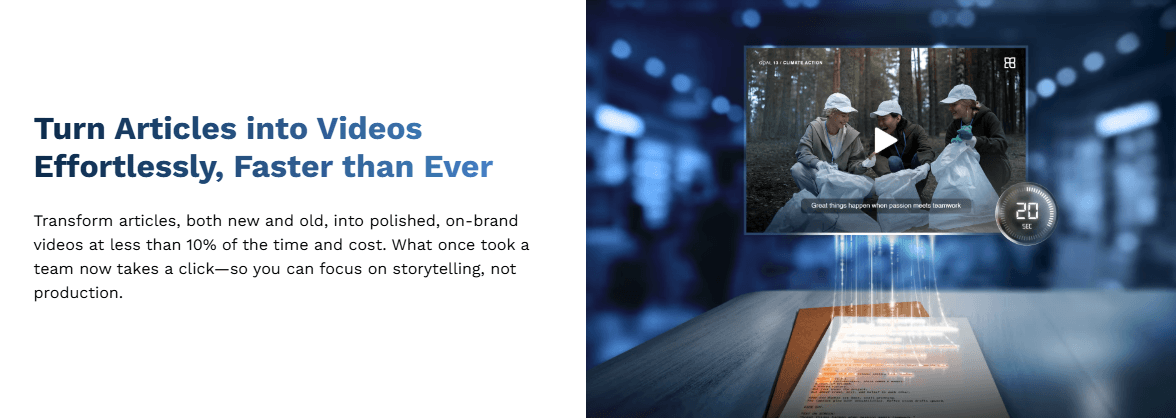
Rizzle turns articles, blogs, stories, ideas, and other written content into videos using AI-assisted assembly and editorial workflows.
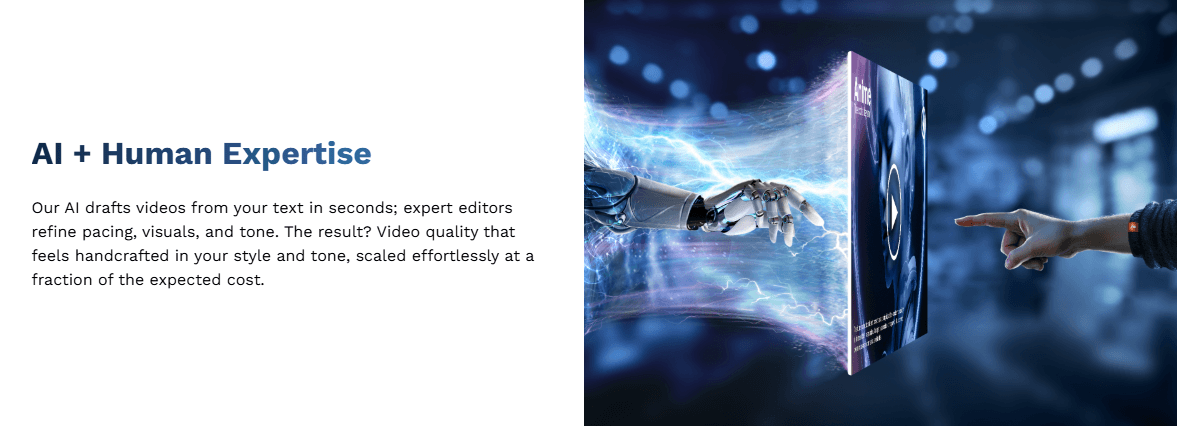
AI creates the first draft, while human video experts refine pacing, visuals, tone, and final quality.
Rizzle highlights access to Getty creative and editorial media, plus licensed visuals, music, and related assets for safer publishing workflows.
Rizzle supports syndication across aggregator and media platforms such as MSN, Yahoo, NewsBreak, social platforms, and online video platforms.
The platform supports branded templates, brand-aligned editing, custom assets, and human refinement to keep videos consistent with a publisher’s voice.
Rizzle positions its workflow around viewer behavior, platform trends, content performance, and smarter distribution decisions.
The easiest way to understand Rizzle is to separate it from ordinary AI video generators.
A standard AI video generator usually works like this: type a prompt, choose a style, generate a clip, then fix whatever the AI got wrong. Rizzle’s current public site presents a different model. It is closer to a managed video infrastructure layer for publishers. You bring the written content. Rizzle analyzes the article’s context, tone, and key messages, generates a video storyboard, pairs the story with visuals, templates, music, transitions, and voiceovers, then has a human team refine the output for publishing.
That difference matters. Rizzle is not trying to be the most experimental text-to-video toy. It is trying to solve a publisher problem: how do you turn a large library of written stories into videos that can be distributed, monetized, and reused without building a large internal video operation?
This makes Rizzle more serious, but also more specific. A solo creator who wants to make a funny AI clip from a wild prompt may not be the ideal user. A publisher with hundreds or thousands of articles, however, is much closer to the target audience. Rizzle’s own solutions page says the service is built for publishers and enterprises, and its FAQ says it is optimized for news articles, blog posts, listicles, and editorial pieces.
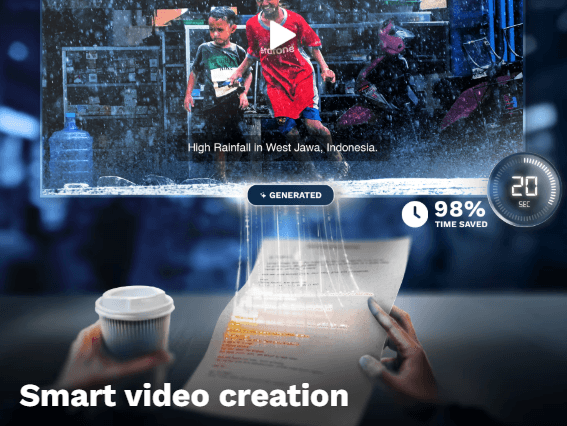
The product is best understood as a production-to-distribution system for written content, not a blank-canvas video generator.
| Stage | What Rizzle Does | Why It Matters |
|---|---|---|
| Text input | Uses articles, blogs, stories, ideas, and editorial content as the source | Best for publishers with existing written libraries |
| AI assembly | Analyzes context, tone, and key messages to create a storyboard | Reduces the manual production lift |
| Asset matching | Pairs the text with relevant visuals, templates, music, transitions, and voiceovers | Helps written stories become watchable videos |
| Human refinement | Editors refine pacing, visuals, tone, and quality | Keeps output from feeling generic or under-edited |
| Branding | Applies templates, custom assets, and brand DNA | Makes output more consistent across a publisher’s catalog |
| Distribution | Supports syndication to web aggregators, social platforms, and OVPs | Turns production into a larger video strategy |
| Insights | Uses performance and viewer behavior data | Helps publishers learn what works over time |
This is where Rizzle’s positioning is strongest. It is not just a creation tool. It is a production-to-distribution workflow. Rizzle’s homepage specifically says it transforms text into videos using AI-supported assembly and human video experts, while its solutions page emphasizes syndication and monetization across high-traffic platforms.
Rizzle is strongest when the source content already has editorial value.
A breaking news story, evergreen explainer, listicle, lifestyle article, science piece, sports story, political update, or entertainment roundup can all become stronger distribution assets if they are converted into video. Rizzle’s public video library shows examples across categories including sports, automobiles, entertainment, lifestyle, politics, science, and general topics, with filters for English and Spanish as well as landscape and portrait formats.
That makes Rizzle especially useful for publishers sitting on large archives. Many media companies already have written content, but not enough video production capacity to convert that content into video consistently. Rizzle is built for exactly that gap.
The other strong fit is editorial safety. AI-only video tools can create quick drafts, but they often need manual checking for tone, accuracy, source fit, asset quality, and brand alignment. Rizzle’s human review layer is meant to solve that. Its site repeatedly emphasizes human video experts, human editing, quality assurance, brand alignment, and licensed assets.
The most important part of Rizzle is the hybrid model.
The AI side handles speed and scale. It can analyze text, identify key messages, create a storyboard, match visuals, apply templates, add music, include transitions, and create voiceover-based videos. That first layer is what makes large-volume production possible.
The human side handles judgment. Editors refine pacing, visuals, tone, cultural fit, and brand consistency. Rizzle describes this as AI drafting videos from text in seconds, with expert editors refining the final result so the video feels aligned with the publisher’s style and tone.
That is a smart category choice. For publishers, the problem with pure automation is not just quality. It is risk. A video can technically match an article but still feel wrong because the music is too dramatic, the visuals are too generic, the pacing is off, or the tone does not match the story. Human review helps catch those issues.
The trade-off is that Rizzle is less of a self-serve creative playground than some AI video apps. It is more of a production system. That is good for publishers that want reliability, but less appealing for users who want instant experimental control over every clip.
Rizzle’s asset story is one of its biggest differentiators.
The platform says its videos use safe, licensed content and highlights access to Getty creative and editorial media, Soundstripe music, ElevenLabs voiceovers, and data-related resources such as Statista.
This matters because publisher video is not just about making something look good. Rights matter. Brand safety matters. Editorial context matters. If a video is going to travel across platforms, syndication partners, and monetized environments, the visuals and music need to be usable, not just attractive.

Rizzle’s solutions page also says all content is backed by proper licensing and full rights protection, and its FAQ says publishers retain full rights to videos created with Rizzle while the platform uses ethically sourced editorial and creative assets.

That makes the tool more relevant for serious publishing teams than casual AI video tools that may not make asset provenance as clear.
A lot of AI video tools stop at export. Rizzle goes further by making distribution part of the product story.
The homepage says Rizzle can distribute and monetize videos across MSN, Yahoo, NewsBreak, social platforms, online video platforms, and other destinations. Its solutions page also describes built-in syndication tools and video distribution across high-traffic aggregator platforms.
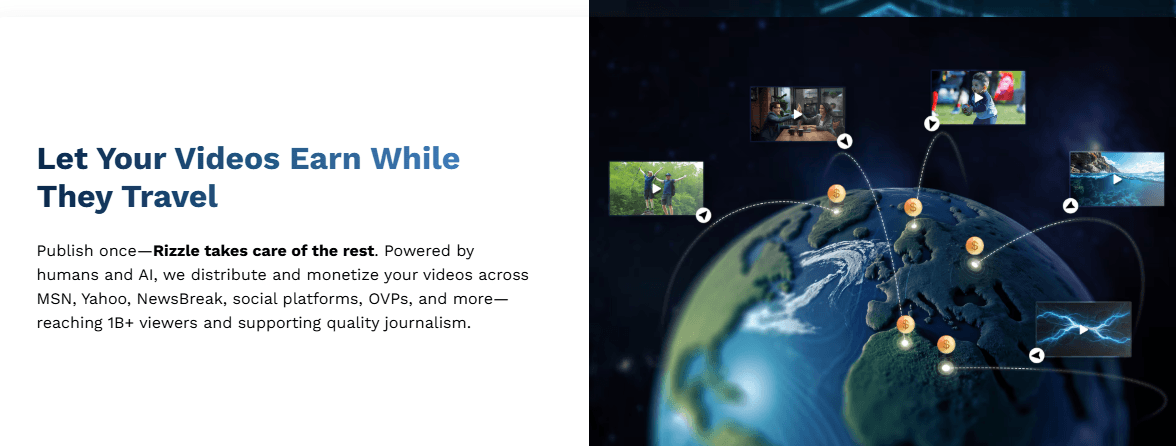
This is important because video creation is only one part of the publisher problem. A media company does not just need videos. It needs those videos to reach audiences, create new inventory, and support a broader content strategy. Rizzle’s distribution layer is one of the clearest reasons it is positioned for publishers rather than only creators.
That said, this also narrows the audience. If you only need a few videos for Instagram or YouTube, a lighter self-serve tool may be enough. Rizzle makes more sense when distribution, licensing, editorial quality, and repeatable output all matter together.
Rizzle’s public library gives a useful view of the kind of content the platform produces. It includes finished videos across categories such as sports, science, politics, entertainment, lifestyle, automobiles, and general topics. The library also exposes language and aspect-ratio filters, including English, Spanish, landscape, and portrait.
That tells us something important about the product: Rizzle is not mainly focused on cinematic fiction, avatar-led sales videos, or abstract AI visuals. Its strongest visible output style is editorial video. Think narrated explainers, article-based summaries, news-adjacent packages, lifestyle videos, science explainers, listicles, and publisher-friendly clips.
For the publisher, the workflow appears intentionally hands-off.
Rizzle’s services page says its managed services team handles storyboarding, editing, reviewing, and polishing. The same page also says publishers can upload custom assets, including images, footage, and music, and Rizzle’s AI will prioritize those assets when generating videos.
That creates a useful balance. If a publisher wants a mostly managed process, Rizzle can handle the production pipeline. If the publisher has brand assets, footage, music, or custom imagery, those can be brought into the workflow.
The ease of use is not the same as a consumer app where you drag clips around a timeline. It is more about reducing operational burden. The platform is built for teams that want fewer production bottlenecks, not for editors who want frame-level control inside a traditional editing interface.
- Digital publishers with large article libraries: Rizzle is strongest when a publisher already has a deep archive of written content and wants to convert that material into video without rebuilding each story manually.
- News and editorial teams: The platform is well suited for news articles, listicles, explainers, lifestyle features, sports recaps, entertainment updates, and science stories. Rizzle’s own FAQ says it is optimized for news articles, blog posts, listicles, and editorial pieces.
- Media companies expanding into video: Teams that are strong at written content but weaker at video production can use Rizzle as a bridge into video-first distribution.
- Publishers focused on syndication: Rizzle makes the most sense when the goal is not just producing a video, but distributing it across aggregator, social, and online video environments.
- Evergreen content repurposing: Old articles, explainers, and listicles can become new video assets. This is especially useful for publishers with archives that still have search, social, or syndication value.
- Multilingual editorial video workflows: Rizzle’s public library includes English and Spanish filtering, which suggests the platform is being used across more than one language environment.
Rizzle is best understood as a hybrid AI-and-human video production system for publishers, media companies, and enterprises that want to turn written content into editorial-style video at scale.
Its strongest value comes from combining article-to-video production, licensed assets, human editorial review, brand customization, syndication, monetization support, and performance insight into one publishing-focused workflow.
The main caveat is audience fit. Rizzle is not the most natural choice for casual creators who want prompt-based experimentation or detailed manual editing. It is much more compelling for publishers with large written libraries, distribution needs, rights concerns, and repeatable video production goals.
TAGS: Video Editing Text to Video Generative Video
Related Tools:

Turns text into short, faceless videos with voiceovers

Transforms text and images into animated videos

Automates key sales and marketing tasks

Generates and translates subtitles for videos

Creates cinematic videos from text prompts and images

Enhances lead management and campaign effectiveness