

Share this tool:
 |
Description:
- Introduction
- Strong Features and Capabilities
- What Kafkai Actually Is
- Competitor Tracking
- Content Gap Analysis
- SERP Rank Tracking
- Multi-Country Visibility Tracking
- Competitor Ranking Overview
- Keyword Grouping by Theme
- SEO-Optimized Content Generation
- Monthly Change Digest
- Simplified Reporting
- Ideal Users
- Best Use Cases
- Practical Benefits
- Limitations and Trade-Offs
- How Kafkai Differs from Regular SEO Tools
- Pricing Overview
- Final Verdict
Kafkai is a competitive intelligence platform built for teams that want a clearer view of their market, their competitors, and where their content strategy has gaps. Instead of centering everything on your own site alone, Kafkai frames your performance in competitive context: what competitors rank for, where you are behind, where you are ahead, and where there are content opportunities no one has claimed yet. That is the core value of the platform, and it is what separates it from a more standard “check your own rankings” SEO workflow.
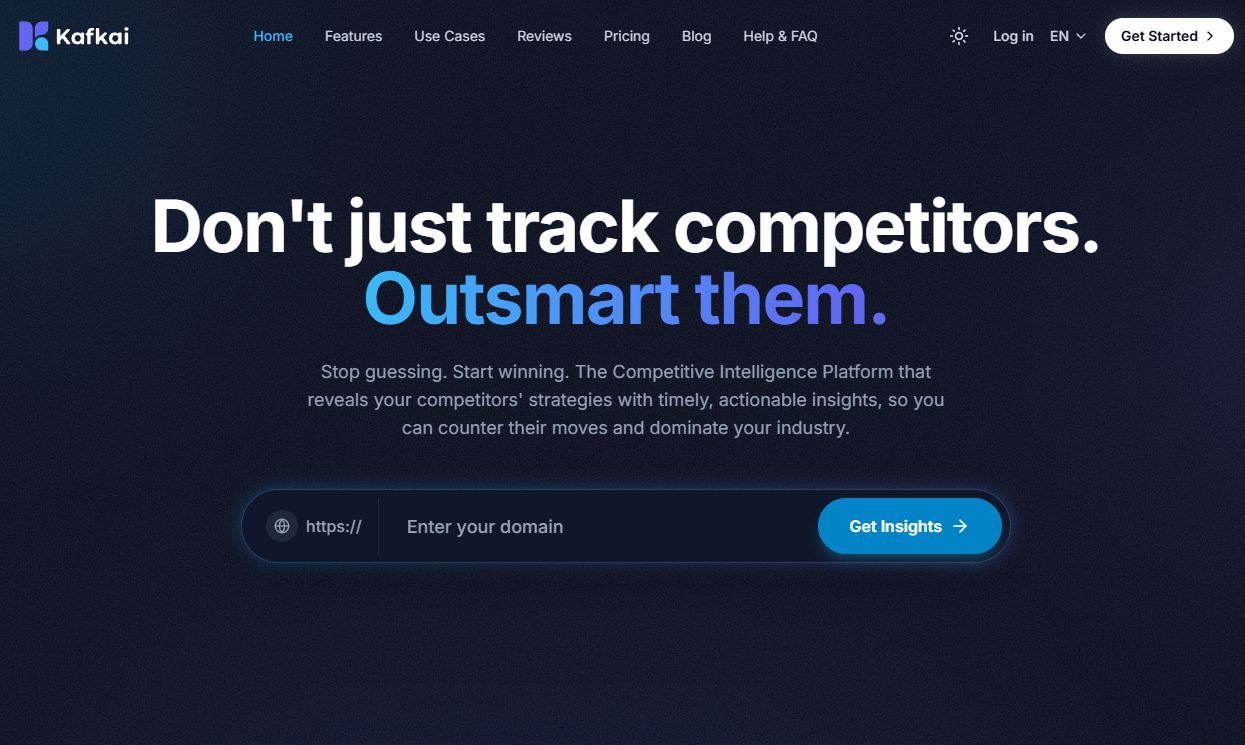
Monitors how competitors move in rankings over time so you can spot gains, losses, and new threats early.
Surfaces keywords and topics your competitors rank for that you do not, helping turn market data into content decisions.
Tracks ranking positions with competitive context instead of showing your positions in isolation.
Organizes keywords into themes so teams can plan content by topic cluster rather than by flat keyword list.
Generates content from the competitive and keyword insights already inside the platform instead of starting from a blank page.
Packages market movement into easier-to-read summaries for agencies and strategy teams.
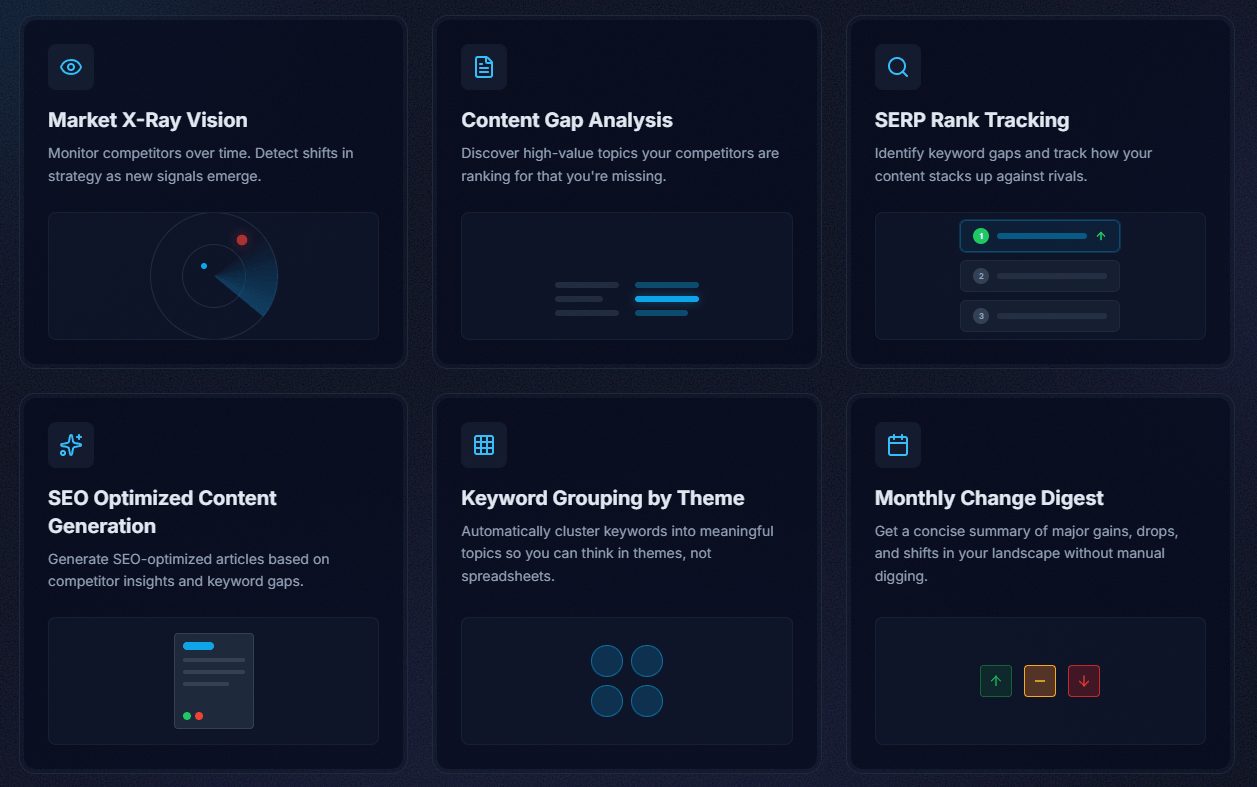
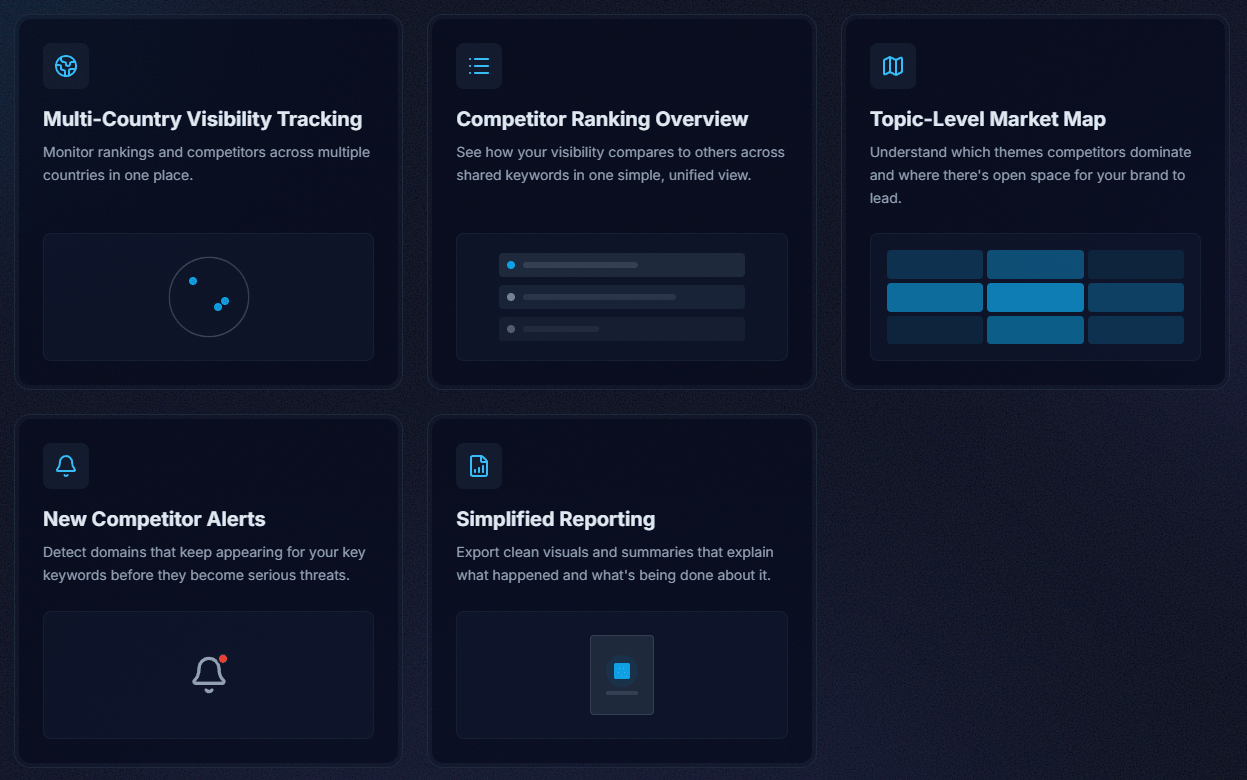
Most SEO tools start with your own domain. You plug in your site, watch your rankings, and monitor your own traffic and keywords. Kafkai takes a wider view. It is built around competitive intelligence first, then content planning, then content generation. The goal is not only to tell you what is happening on your site, but to show you how your position compares to everyone else competing for the same search visibility.
That makes Kafkai less like a full-stack technical SEO suite and more like a strategic SEO and content planning layer. Kafkai’s own help content explicitly frames the platform around simplicity, strategy, and its 4C framework for opportunity discovery, rather than overwhelming users with raw data alone.
Competitor tracking is one of the platform’s most practical features. You add your own website, add competitors, and Kafkai monitors how those competitors move over time. The official features page describes this as “monitor competitors over time” and “detect shifts in strategy as new signals emerge.”
That matters because markets do not stay still. A competitor that barely mattered six months ago may now be ranking across topics you care about. Kafkai’s value here is that it shows those shifts before they become obvious through lost traffic or weakened visibility. It also helps you see where competitors are gaining or losing positions, which turns ranking movement into something you can actually respond to.
Content gap analysis is one of the most useful parts of Kafkai’s workflow. The platform compares what your site ranks for against what competitors rank for, then shows you the topics and keywords they cover that you do not. Kafkai’s features page explicitly positions this as a way to discover high-value topics your competitors already rank for and you are missing.
Kafkai’s help and product materials also describe a framework around opportunity categories such as Catch-Up, Complement, and related strategic buckets. The practical value is that the tool does not just show missing keywords as a list. It tries to classify them into more actionable groups so teams can decide what to prioritize.
That makes this feature especially useful at the start of a content planning cycle. Instead of asking what to publish next in the abstract, you can work from a list of competitive gaps with proven search demand behind them.
SERP rank tracking is more useful when it is attached to competitive context, and that is where Kafkai’s version makes more sense than a basic rank checker. The features page describes SERP rank tracking as a way to identify keyword gaps and track how your content stacks up against rivals.
That means you are not only seeing “you rank in position five.” You are seeing that position relative to the competitors you care about. In practical terms, that changes how you read the data. A stable ranking can still be a warning sign if multiple competitors are climbing toward it. Longer-term rank tracking also helps separate short volatility from real trend shifts, which is important in organic search.
Kafkai also emphasizes visibility tracking across different countries and markets. That matters if your business or your clients operate across multiple regions. A competitor may dominate one market and barely exist in another, and treating those two markets as if they behave the same leads to bad strategy. Kafkai’s feature set positions this as part of its broader market visibility view rather than just local keyword counting.
This is especially useful for agencies and teams entering new regions, because it gives a more realistic view of how search competition changes from one market to another.
The competitor ranking overview is one of the more useful summary views because it pulls the competitor data together into something you can scan quickly. Instead of checking one competitor at a time, you get a broader read on who ranks for the most terms, who is gaining, and who is losing momentum. Kafkai’s own feature language centers around ranking overviews and market-level visibility, which fits this use case directly.
This is especially useful for agencies and small in-house teams, where the time cost of manually piecing together many competitor reports is high.
One of the platform’s more practical organizational features is keyword grouping by theme. Raw keyword lists become hard to use very quickly at scale. Grouping related keywords into themes makes the planning side cleaner because content is usually created around topics, not isolated keyword rows. Kafkai’s strategy-first positioning and correlate-based discovery approach both support this topic-first view of the market.
This is also useful for reporting. Theme-level reporting is much easier to explain to clients or internal stakeholders than hundreds of individual keyword movements.
Kafkai includes SEO-optimized content generation, but it is important to describe this accurately. This is not positioned as a blank-slate general writing assistant. The point is that the content generation step is tied to the research and gap analysis already happening inside the platform. Kafkai’s use cases and feature pages both describe AI content generation that is aligned with keyword and strategy workflows rather than disconnected from them.
That matters because the workflow is stronger when it goes:
- identify keyword or content opportunity
- understand the competitive context
- generate the draft around that opportunity
- review, improve, and publish
Kafkai’s newer materials also reference automatic source citations on pricing and brand voice controls in its blog and help ecosystem, which suggests the content side is moving toward more structured and brand-aware outputs rather than generic AI text alone.
Markets shift month by month, and most teams do not have time to re-analyze every competitor movement manually. Kafkai’s monthly change digest is useful because it rolls those changes into a simpler summary. While the official feature pages emphasize change awareness and decision support more broadly, the help center and platform messaging reinforce that Kafkai is built to help teams monitor trends over time rather than only run one-off analyses.
This is especially useful for agencies, where monthly reporting and client updates are recurring work rather than occasional work.
Kafkai’s reporting is designed to be easier to read than a typical data-heavy SEO dashboard. That is one of its more intentional product choices. Its own positioning emphasizes clarity, simplicity, and actionable insight rather than overwhelming users with a giant raw keyword database.
That makes the tool more accessible to people who care about strategy and execution but are not deeply technical SEO analysts.
Kafkai is a strong fit for:
- SEO and organic growth agencies
- full-service digital marketing agencies
- in-house content and growth teams
- smaller businesses that want competitive visibility without enterprise-level complexity
- marketers who want direction, not just dashboards full of numbers.
It is a weaker fit for:
- teams needing deep technical SEO workflows like crawling, log file analysis, structured data auditing, or advanced backlink analysis
- enterprise teams that need very granular raw data control and highly customized data exports
- users looking for Kafkai to replace a technical SEO suite entirely.
That is not really a weakness as much as a category distinction. Kafkai’s lane is strategy, competitive context, and content opportunity discovery.
Kafkai makes the most sense when you need to:
- identify content gaps before planning a new content cycle
- monitor a new or fast-growing competitor
- prepare monthly client or stakeholder reporting
- prioritize content refreshes based on market movement
- evaluate a new country or region before investing in content there
- connect keyword opportunity research directly to AI-assisted content generation.
These are the kinds of workflows where competitive context saves time and improves decisions.
The practical benefits of Kafkai come down to five things.
First, it reduces the time spent figuring out what to create next by grounding content ideas in competitive data.
Second, it keeps you connected to what is actually happening in your market instead of only what is happening on your own site.
Third, it makes monthly reporting cleaner and easier to explain.
Fourth, it is usable by marketers who are not deeply technical SEO specialists, because the platform is designed around simplified strategic signals.
Fifth, the content generation layer closes the loop between insight and execution.
Kafkai is not a full-stack technical SEO platform. If you need crawling, backlink management, page speed analysis, schema auditing, or log analysis, you will still need other tools alongside it.
It is also worth being realistic about the AI content generation. Like any AI-assisted writing workflow, it works best when treated as a first-draft accelerator rather than a publish-without-review machine. Kafkai’s own content-generation framing supports using the output as part of a broader strategy workflow, not as a substitute for human review.
The platform’s value also increases a lot when it is used consistently over time. A one-off analysis can be useful, but the real benefit comes from repeated tracking, recurring digests, and ongoing competitor monitoring. That is where the strategic layer becomes more valuable.
Traditional SEO tools usually start with your own site. Kafkai starts with the competitive layer around your site. It is not trying to replace a technical SEO suite. It is trying to add a market intelligence and strategy layer above one. Kafkai’s own help content explicitly frames this difference around simplicity, actionability, and the 4C framework rather than large generic keyword databases.
That makes Kafkai most useful when paired with a more technical SEO tool rather than used as the only tool in the stack.
Kafkai’s official pricing page currently shows a Starter plan at €28/month, including:
- 1 project
- 1 competitor
- up to 400 keywords
- 10 monthly articles
- Correlate Strategy
- automatic source citations.
Because Kafkai’s pricing and packaging can change, the live pricing page is the best place to check the current higher-tier structure and article limits before making a buying decision.
Kafkai is a competitive intelligence and content strategy platform designed to show you what competitors are doing, where your content gaps are, and what to create next. That is the clearest way to judge it. It is not a technical SEO suite. It is a strategic one.
For agencies and in-house marketing teams that want a clearer view of the competitive field, Kafkai offers a useful mix of competitor tracking, content gap analysis, rank monitoring, keyword grouping, market visibility, content generation, and simplified reporting. Its biggest strength is that it turns all of that into something easier to act on.
If your content planning still relies too heavily on guesswork and internal brainstorming, Kafkai is worth a serious look.
TAGS: Copywriting Content Creation
Related Tools:

Simplifies the creation of high-quality blog content

Automates content creation

Enables users to create, edit and share high-quality videos

Video editor that offers precision trimming and real-time effects

Simplifies rewriting and enhances content

Simplifies the creation of professional-quality video