Share this tool:
 |
Description:
Finta is an AI-powered capital workflow platform for founders, fund managers, and teams that need to manage fundraising or deal relationships without living in spreadsheets. Its strongest idea is simple: combine investor CRM, warm-intro discovery, AI-personalized outreach, data rooms, engagement tracking, and deal execution into one focused workspace. The result is not a general CRM with an AI button added on top. It is a capital-raising system built around relationship movement, follow-up discipline, and investor context.
Finta describes itself as “The Capital Copilot” and positions the product as a workspace where deals run themselves. That sounds broad, but the product is easier to understand if you break it into four practical layers: CRM, Aurora AI, prospecting, and closing tools. The homepage frames Finta around deal workflows, relationship building, AI-personalized email scripts, contact enrichment, email integration, deal rooms, prospect recommendations, warm introduction paths, and collaboration across teams, shareholders, and advisors.
The core product is a fundraising and deal CRM. You connect your inbox and calendar, manage investor or prospect relationships, track pipeline stages, use Aurora to draft or suggest follow-ups, and share materials through deal rooms or data rooms. It is aimed at people managing capital conversations, not people who need a broad sales CRM for every kind of customer lifecycle.
That focus is the main reason Finta is useful. Fundraising is not just a list of names. It is a sequence of warm introductions, deck sends, follow-ups, meeting notes, investor updates, due diligence requests, engagement signals, and eventual commitments. Finta tries to keep those pieces together so founders and fund managers do not have to stitch together Google Sheets, Gmail, LinkedIn, DocSend, calendar reminders, shared drives, and a generic CRM.
Finta is strongest when the fundraising process has too many moving parts for a spreadsheet but does not justify building a custom investor relations system. It gives users a single place to track who they are talking to, how strong the relationship is, what materials have been shared, who might make an intro, and what should happen next.
The standout piece is warm-intro intelligence. Finta’s prospecting page says the platform can visualize second-degree connections from teammates, advisors, and backers, tap into public investor lists, rank investors by thesis fit and warm-intro potential, and let users save or segment investors by vertical, stage, or relevance. That is much more useful than a plain investor database because it connects “who might invest” with “who can help me reach them.”
Aurora also matters because it is embedded into the workflow. Finta describes Aurora as an AI deal maker that understands the user’s company, relationships, and pipeline. It can connect to inbox and calendar data, surface warm paths to capital, enrich contacts, draft replies in the user’s tone, and support follow-up and closing workflows.
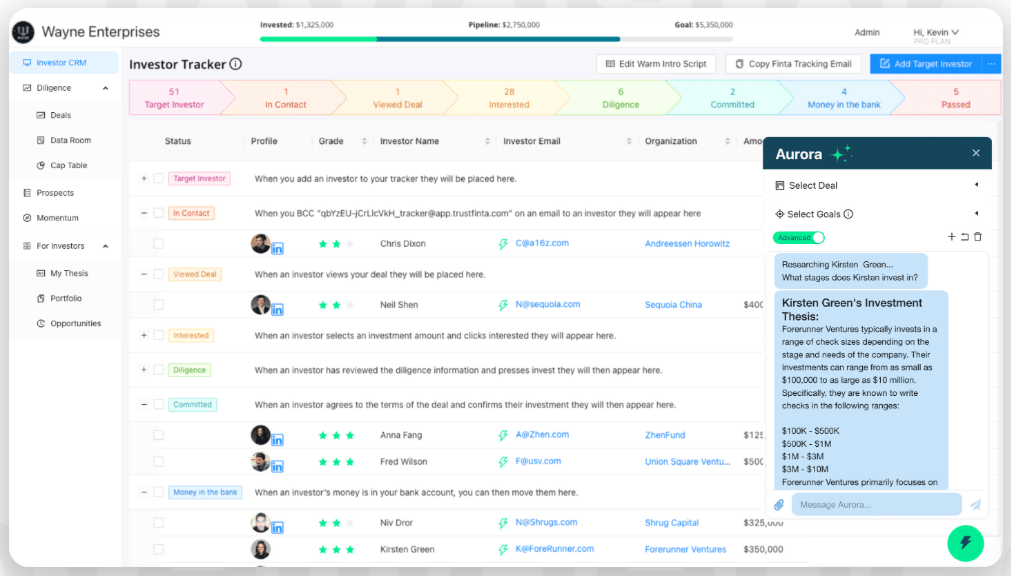
Finta centralizes conversations, pipeline stages, inbox activity, calendar context, and follow-up tracking for fundraising and deal workflows.
Aurora works inside the CRM to research contacts, draft personalized messages, understand deal context, and help move relationships forward.
Finta can show introduction pathways through teammates, advisors, investors, and other trusted networks.
The platform supports investor discovery, AI-powered matching, dynamic lists, and collaboration around target prospects.
Users can share pitch decks, diligence materials, closing documents, and other deal assets through structured links with engagement tracking.
Finta’s Aurora MCP lets compatible AI apps connect to Finta data and perform CRM actions through natural language.
Aurora is the most important AI component in Finta. It is not only a text generator. It is tied to CRM context, email activity, prospect data, deal stages, and relationship paths. Finta says Aurora can research contacts, enrich investor details, draft replies in the user’s tone, track investor movement, and sync actions back into the CRM.
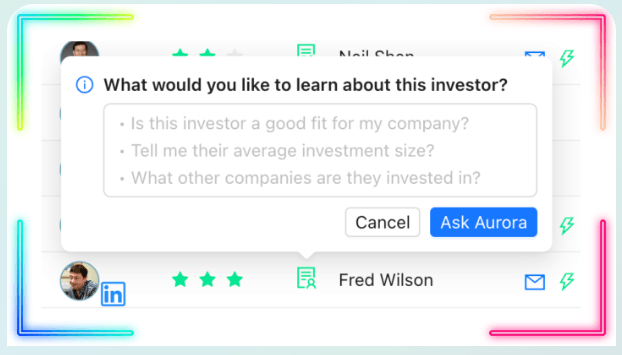
The MCP layer makes Aurora more interesting for AI-heavy users. Finta says Aurora MCP can connect AI apps such as ChatGPT, Claude, Grok, Gemini, Cursor, and others to Finta Deal and CRM data. The examples include commands like listing contacts, deciding who to follow up with, adding an investor to the CRM, updating an investor’s stage, and deep researching leads.
That is a real product direction worth watching. Many AI tools still stop at “write this email.” Finta is moving toward “take action inside my fundraising system.” The difference is important. Drafting is helpful, but execution is where capital workflows get messy.
There is one caveat: natural-language control over a CRM requires trust. Users should review what Aurora changes, especially when updating investor stages, adding contacts, drafting sensitive outreach, or researching people. A wrong follow-up or badly timed message can damage a relationship faster than a typo in a normal sales email.
Finta sits between several categories. It is part CRM, part fundraising platform, part investor database, part deal room, and part AI agent workspace. That makes direct comparison tricky, but useful.
| Alternative | Where Finta is stronger | Where the alternative may be better |
|---|---|---|
| Google Sheets | Better for reminders, relationship tracking, smart links, and AI-assisted follow-up | Sheets are easier for quick custom lists and lightweight collaboration |
| Generic CRMs | More tailored to fundraising, warm intros, data rooms, investor stages, and deal context | Larger CRMs are better for broad sales operations and deep enterprise customization |
| Investor databases | Adds workflow, outreach, CRM, and relationship paths | Dedicated databases may have deeper market coverage or richer firm profiles |
| DocSend-style deck sharing | Adds CRM context, prospecting, and deal workflow | Dedicated document platforms may have more mature analytics or sharing controls |
| AI chatbots | Can connect to live CRM and deal data through Aurora MCP | General chatbots are better for open-ended writing, research, and strategy outside Finta |
The simple version: choose Finta when fundraising is the workflow. Use a generic CRM when fundraising is only one small part of a much broader sales or relationship operation.
Finta is a strong fit for founders raising pre-seed, seed, or later rounds who need to manage investor lists, warm intros, email follow-ups, deck sharing, and pipeline status in one place.
The platform is also positioned for fund managers managing LP pipelines, investor relationships, deal flow, document sharing, and outreach workflows. Finta’s own fund manager material describes the platform as combining automation, CRM, AI, and document management for fund managers.
Finta’s “Powered by Finta” program is aimed at accelerators, funds, and entrepreneurship centers that want to provide portfolio companies with structured fundraising workflows, warm intro access, CRM support, investor update drafting, data rooms, and engagement tracking.
Finta can also make sense for high-trust sales processes where warm introductions, long conversations, and document sharing matter. It is less ideal for simple transactional sales.
If your round depends on advisors, angels, operators, or existing investors making introductions, Finta’s network and pathway tools are more relevant than a plain CRM.
- Start with clean contact data. Aurora and the CRM will be more useful if investor names, firms, roles, emails, stages, and notes are not messy from day one.
- Connect your inbox and calendar early. Finta’s strongest workflows depend on relationship context, activity history, recent correspondence, and meeting data. Without those inputs, the AI layer has less to work with.
- Use warm-intro pathways before cold outreach. Finta’s biggest advantage is not bulk emailing. It is finding better routes into the right people.
- Review AI-drafted emails before sending. Aurora can draft in your tone and personalize outreach, but fundraising messages are sensitive. The final wording should still feel like it came from you.
- Use engagement signals as prioritization, not proof. Deck opens, time on page, and document activity are helpful signals, but they do not guarantee investor intent. They should guide follow-up timing, not replace judgment.
- Keep your pipeline stages specific. Generic stages like “Interested” or “Follow-up” can get vague quickly. Finta 2.0 supports customizable pipeline management, so use stages that match how your actual raise works.
- Test MCP on low-risk actions first. Before letting an AI assistant update important records or add many leads, try simple commands such as listing contacts or surfacing follow-ups. Finta’s MCP setup allows AI apps to access and act on Finta data, so permissions and review habits matter.
Finta is best for founders, fund managers, and capital-focused teams that need more than a spreadsheet and less friction than a generic CRM stack. Its strongest features are Aurora AI, investor CRM workflows, warm-intro mapping, prospect ranking, data rooms, engagement tracking, and Aurora MCP for natural-language CRM actions.
The main caveat is that Finta’s value depends on relationship data quality and user discipline. It can make fundraising more organized and proactive, but it will not replace the human work of building trust, refining the story, and making the right ask at the right time.
Related Tools:

Streamlines email marketing

Automates management of investment data

Enables teams to plan, track, and manage their work

Optimizes small business operations
Helps businesses find investors

Enhances e-commerce operations