

Share this tool:
 |
Description:
Article Fiesta is a focused AI SEO writer, not a general-purpose writing suite. Its pitch is simple: give it the topic, let it generate a long-form article, optimize the structure for search, add images and metadata, and optionally publish straight to your blog. The homepage and features pages make that positioning very clear, with direct blog posting, internal linking, FAQ schema, meta descriptions, royalty-free images, and scheduled automation sitting at the center of the product.

Articles can be sent straight to your blog as drafts, scheduled posts, or published posts.
The platform generates optimized titles, URLs, meta descriptions, headings, internal links, FAQ schema, and authority links.
Scheduled automatic posting is built in, and bulk article creation appears on Pro and Enterprise.
Article Fiesta says you can feed in your brand voice and control headers, personality, and opinions expressed in the article.
The platform includes royalty-free images, AI-generated featured images on Growth, unlimited AI images on Pro, alt tags, videos, and in-content graphs.
There is an on-site editor with Grammarly support for polishing before publishing.
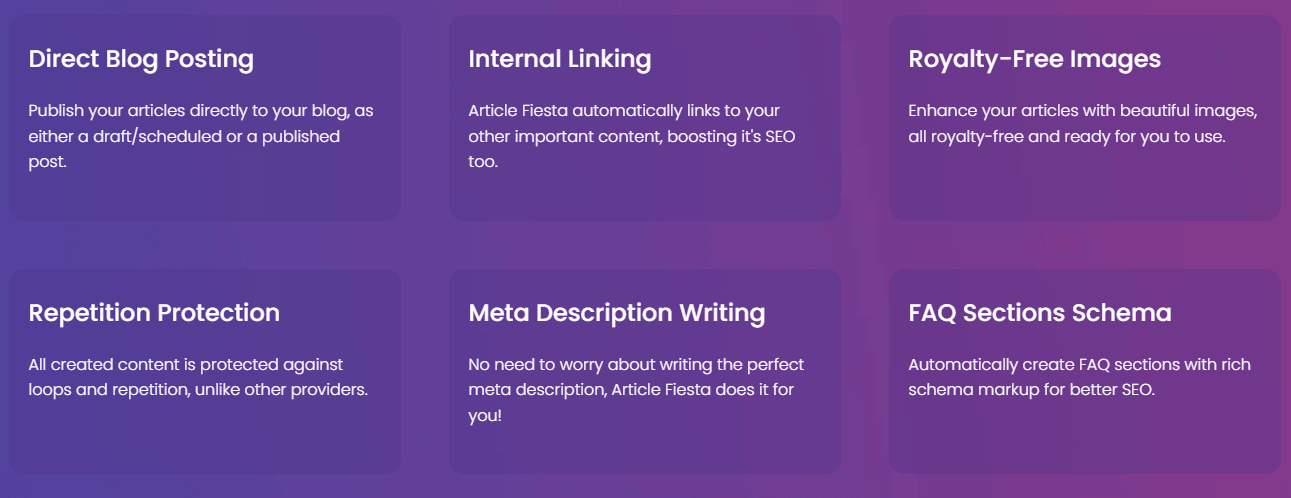
The clearest way to think about Article Fiesta is as an SEO content pipeline rather than just an AI text box. It generates long-form articles, writes titles, URLs, and meta descriptions, adds internal links, can create or include images and graphs, supports on-site editing with Grammarly, and can publish to a blog directly as a draft, scheduled post, or live post. That makes it feel more like a small publishing machine than a blank-page assistant.

It is also notably opinionated. Article Fiesta keeps emphasizing that you do not need to understand SEO because it handles headings, links, metadata, FAQ schema, and other search-oriented structure for you. That is a real strength for bloggers and site owners who want output speed, but it also tells you the product is aimed more at practical search publishing than at deep editorial craftsmanship.
Article Fiesta is strongest when you need a lot of search-oriented content without building a large content operation. The product is built around high-volume blog workflows: direct posting, scheduled automatic posting, bulk article creation on higher tiers, internal-link automation, tag and category detection, and brand-voice controls. Those are the kinds of features that matter when you are filling a content calendar, managing multiple sites, or trying to scale SEO output without hiring a full writing team.
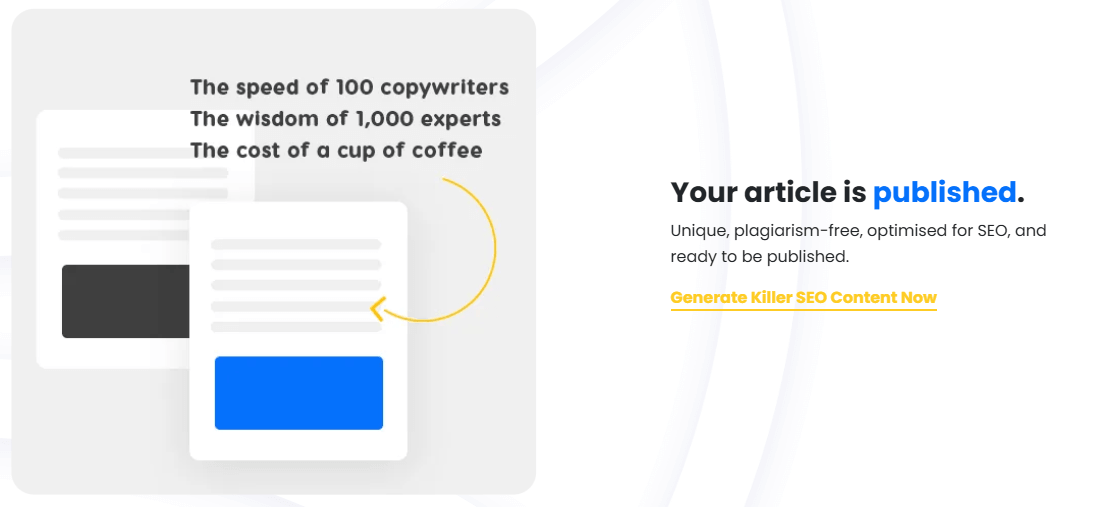
Its second big strength is that it packages SEO mechanics into the same workflow as writing. Article Fiesta says it handles H1/H2/H3 structure, meta descriptions, internal links, alt tags, FAQ schema, authority links, and even live-search writing on Growth and above. That is much more useful than a generic chatbot if your actual goal is not “write something decent,” but “publish something that has a chance to rank.”
Article Fiesta’s workflow looks intentionally lightweight. The homepage frames it almost as a two-step process: decide on the article, then publish it. That simplicity is part of the product appeal. For many SEO users, the real problem is not that they lack a text generator. It is that the full process of planning, drafting, formatting, linking, and publishing takes too long. Article Fiesta tries to compress that chain into one system.
The workflow gets stronger the more repetitive your publishing process is. Scheduled posting, direct blog integration, automatic linking, automatic tag and category detection, and higher-tier bulk creation all point toward ongoing content production rather than one-off article experiments. In other words, this is a better fit for someone publishing every week or every day than for a brand that only needs the occasional thought-leadership piece.
The trade-off is that Article Fiesta does not publicly look like a rich collaborative editor. The visible product story is about automation and output, not multi-user editorial review, content briefs, source management, or layered approval workflows. If your team needs a serious editorial workspace, this will likely feel narrow.
Article Fiesta makes very aggressive quality claims. It says the output is high-quality, human-readable, plagiarism-free, and produced with GPT-5.2 plus custom-trained models. It also claims repetition protection and says the content can be customized through brand voice and content controls. Those features matter, and they do suggest the company is trying to move beyond barebones AI article generation.
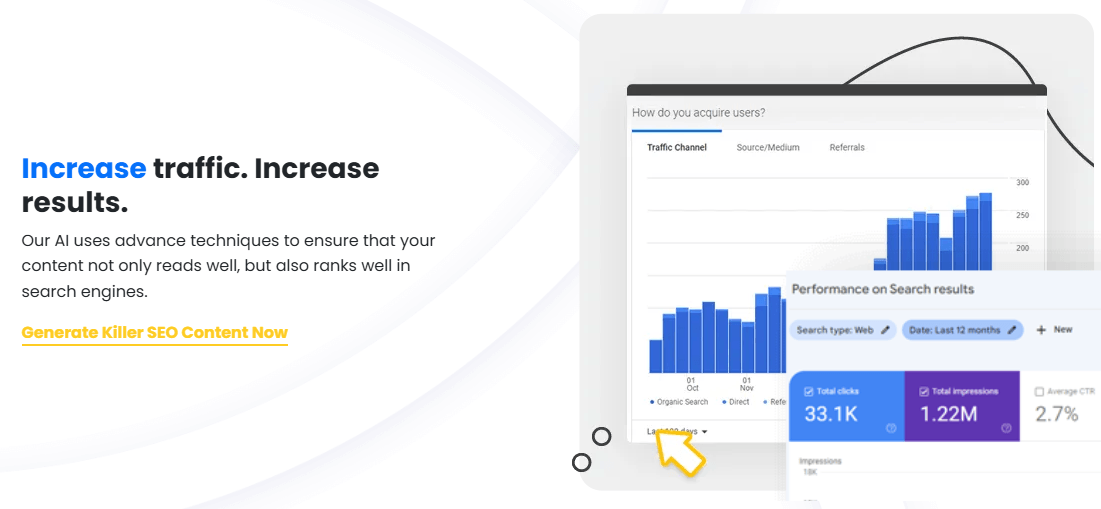
Still, this is one of those products where the marketing language should be treated as marketing language. Claims like page-one ranking, 6.4x click growth on a test blog, or “rewrite without AI detection” are vendor claims, not guarantees. They may help explain the product’s intended audience, but they are not the same thing as independently verified performance. That means Article Fiesta is best treated as a drafting-and-publishing accelerator, not as a set-and-forget SEO outcome machine.
Article Fiesta is best for affiliate publishers, niche-site operators, solo bloggers, SEO freelancers, and small agencies that need steady article production more than deep editorial originality. The direct-blog workflow, scheduling, internal linking, SEO formatting, and volume-based plans all point in that direction.
It also makes sense for site owners who do not want to become SEO specialists just to publish decent search content. The product repeatedly says it handles the SEO details for you, and that is a real category advantage if your bottleneck is execution rather than strategy.
It is less compelling for editorial teams that care heavily about interviews, original reporting, nuanced subject-matter expertise, or a strict human-led review process. Nothing on the official site suggests Article Fiesta is built for that kind of publishing. It is built for scalable SEO content production.
- Use Article Fiesta for repeatable search content, not for your highest-stakes brand narratives. Its strongest value is speed and process compression, not deep originality. That is an inference from its automation-heavy feature set and plan structure.
- If you are choosing a paid tier, start by deciding whether scheduling and internal-link automation matter. Those features begin on Growth, and they are some of the most practical reasons to use the platform instead of a generic AI writer.
- Treat brand voice as a setup step, not an afterthought. Article Fiesta explicitly says you can control headers, personality, and opinions, so spending time on that is likely one of the easiest ways to improve output consistency.
- The biggest limitation is trust calibration. Article Fiesta makes bold ranking and quality claims, but official pages do not give the kind of source transparency, fact-check traceability, or editorial workflow depth that would justify treating the output as publish-without-review content. Human review still matters.
- The second limitation is category narrowness. That focus is also a strength, but it means Article Fiesta is not trying to be your all-purpose writing platform. If you need campaign copy, collaborative editing, research-backed thought leadership, or a broader content operations suite, it may feel too specialized.
- The third limitation is that some of the more eye-catching features sit behind higher plans. Live-search writing begins on Growth, while bulk creation, unlimited AI images, rewrite controls, trending-search queries, and Chat with Writer are reserved for Pro or Enterprise. So the cheapest tier gives you the basic engine, but not the full workflow advantage.
Article Fiesta is a strong fit for people who want an SEO content machine more than a writing playground. Its best features are the ones that reduce operational drag: direct blog posting, scheduled automation, internal linking, SEO metadata, media support, and higher-tier bulk creation.
The main caveat is that it should be judged as a scale-and-structure tool, not as a guarantee of ranking success or a substitute for careful editorial review.
TAGS: Copywriting Content Creation
Related Tools:

Enhances writing process

Quickly generate high-quality, customizable written content

Creates marketing copy and content from short prompts

AI-driven scriptwriting software

Automates content creation for social media
Enhances writing process