
Share this tool:
 |
Description:
ReadPo is built for people who read a lot before they write. Its core idea is not just “generate an article with AI.” It is closer to a research-to-content workspace: gather information, filter what matters, summarize it, understand a topic from multiple sources, then create written or visual content from that material. ReadPo describes itself as an AI-powered reading and writing assistant for collecting, curating, and creating content quickly.
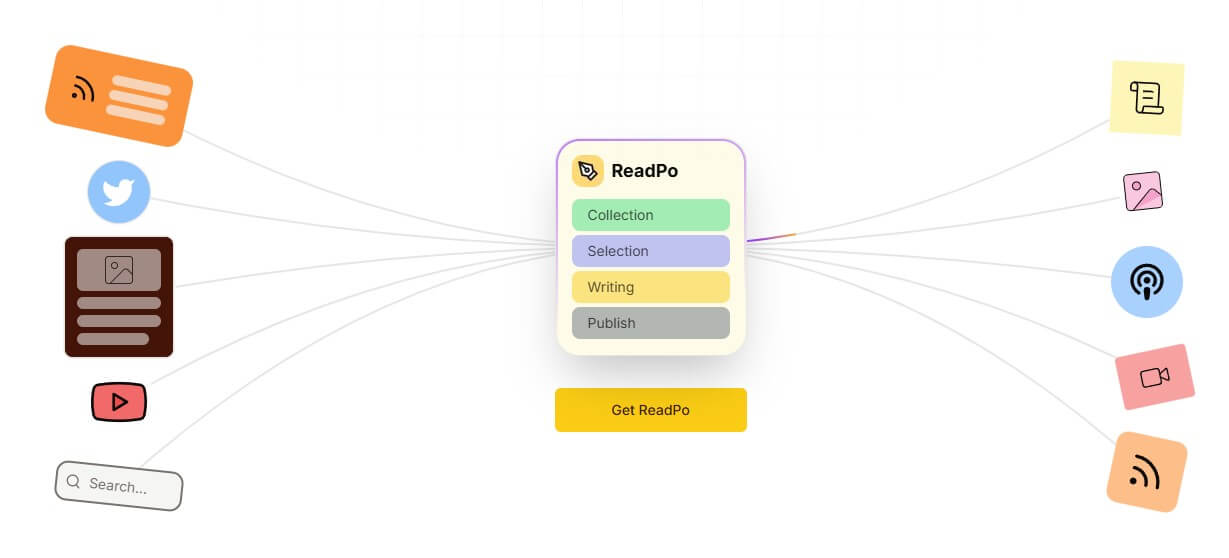
ReadPo can collect material around a topic from news, RSS, Twitter/X-style sources, and other content channels referenced in its public materials.
The tool is designed to help users narrow large amounts of content into a smaller, more useful set of source material.
ReadPo emphasizes topic-level understanding across multiple sources, which is useful when you need to compare ideas rather than summarize one article in isolation.
The product references RAG technology for more timely article generation, meaning the writing layer is intended to work from retrieved source material rather than only from a generic model response.
ReadPo’s Early Bird announcement mentions 12 built-in summary and writing AIs, plus custom prompt support for creating content from collected material.
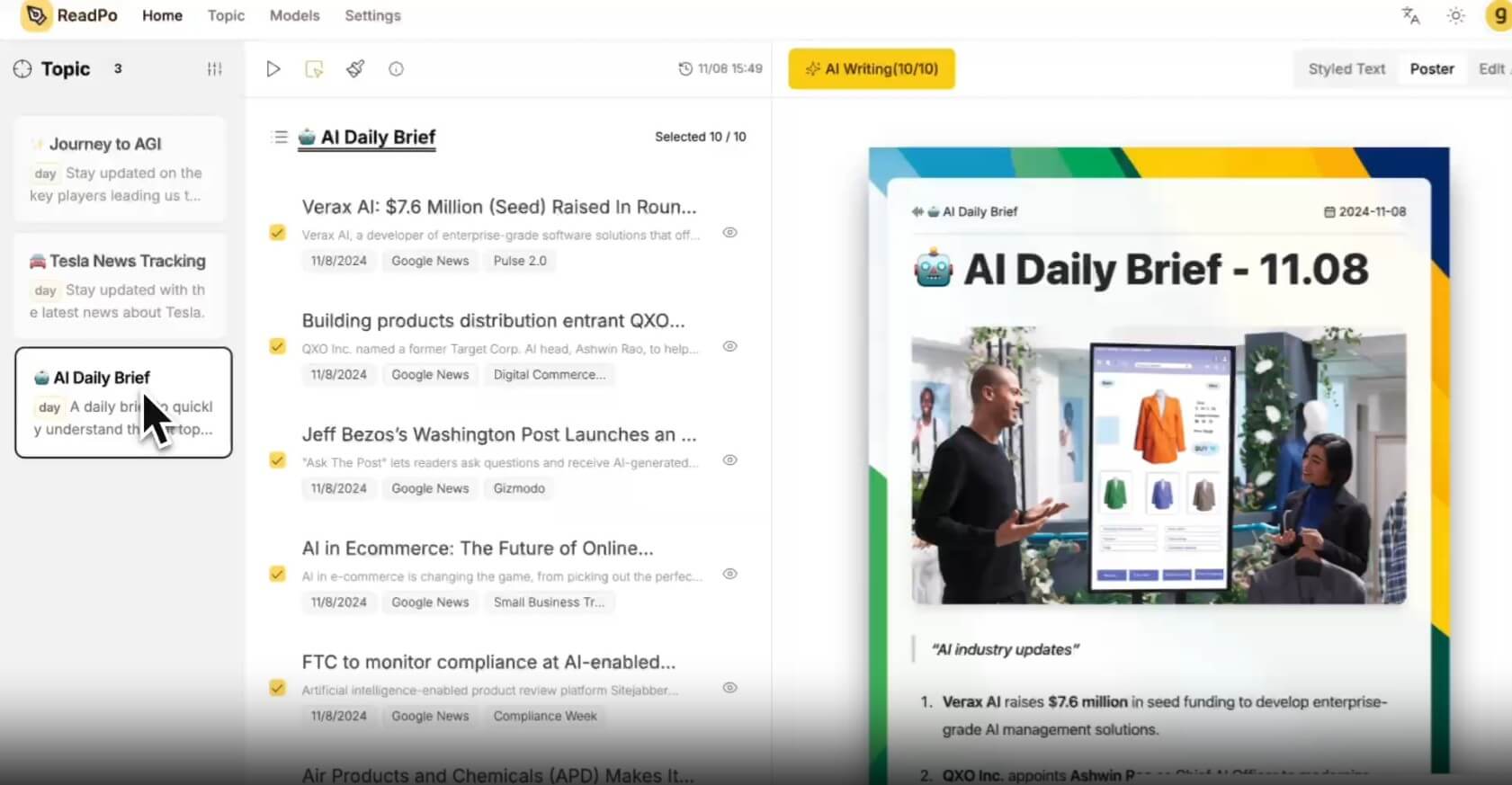
ReadPo also offers a Markdown Poster tool for creating graphic posters with Markdown, real-time preview, and image export.
ReadPo is best understood as a content intelligence tool for writers, researchers, bloggers, newsletter creators, and marketers. Instead of starting from a blank page, you start with a topic or source set. ReadPo then helps pull together relevant material, evaluate it, summarize it, and use it as the basis for new content.
That workflow matters. Many AI writing tools are strong at drafting but weak at the messy work before drafting: finding source material, choosing what is useful, comparing angles, and turning scattered reading into a usable outline. ReadPo’s public materials position the product around that earlier stage of the writing process, with content aggregation, AI filtering, scoring, syntopical reading, and RAG-based article generation listed as key capabilities.
The name also explains the product well: read, then post. It is not only a writing assistant. It is a system for moving from information intake to publishable output.
ReadPo is strongest when the user has to produce content from multiple sources on a regular schedule. That includes weekly newsletters, industry roundups, niche blog posts, market summaries, social posts, and research-backed briefs.
Its best use case is not a one-off essay. The tool makes more sense when you have a repeatable content workflow: choose a topic, collect fresh material, filter the best items, summarize the key points, and turn them into something readable. ReadPo’s blog describes content aggregation from sources such as Google News, RSS, Twitter, and more, along with AI-powered filtering and scoring.
That is useful for creators who struggle less with writing sentences and more with managing too much input. ReadPo’s value is speed plus structure. It helps reduce the “I saved 40 articles and now I don’t know where to start” problem.
The practical workflow is straightforward: collect, process, write, and output. That makes ReadPo feel more structured than a blank chatbot. You are not just asking for “an article about AI news.” You are building a small content pipeline around a topic.
This is useful because content creation often breaks down between research and drafting. A writer may have enough information but no clean way to turn it into a coherent piece. ReadPo’s topic-first approach helps by keeping the source material close to the writing step. The AI can summarize, compare, and assist with writing without forcing the user to copy articles into a separate document.
The Markdown Poster tool adds a second output lane. If your written content needs to become a shareable image for social media, ReadPo can help turn Markdown into visual poster content. That is not a replacement for a full design tool, but it is practical for quote cards, summaries, announcement posts, and digest-style visuals.
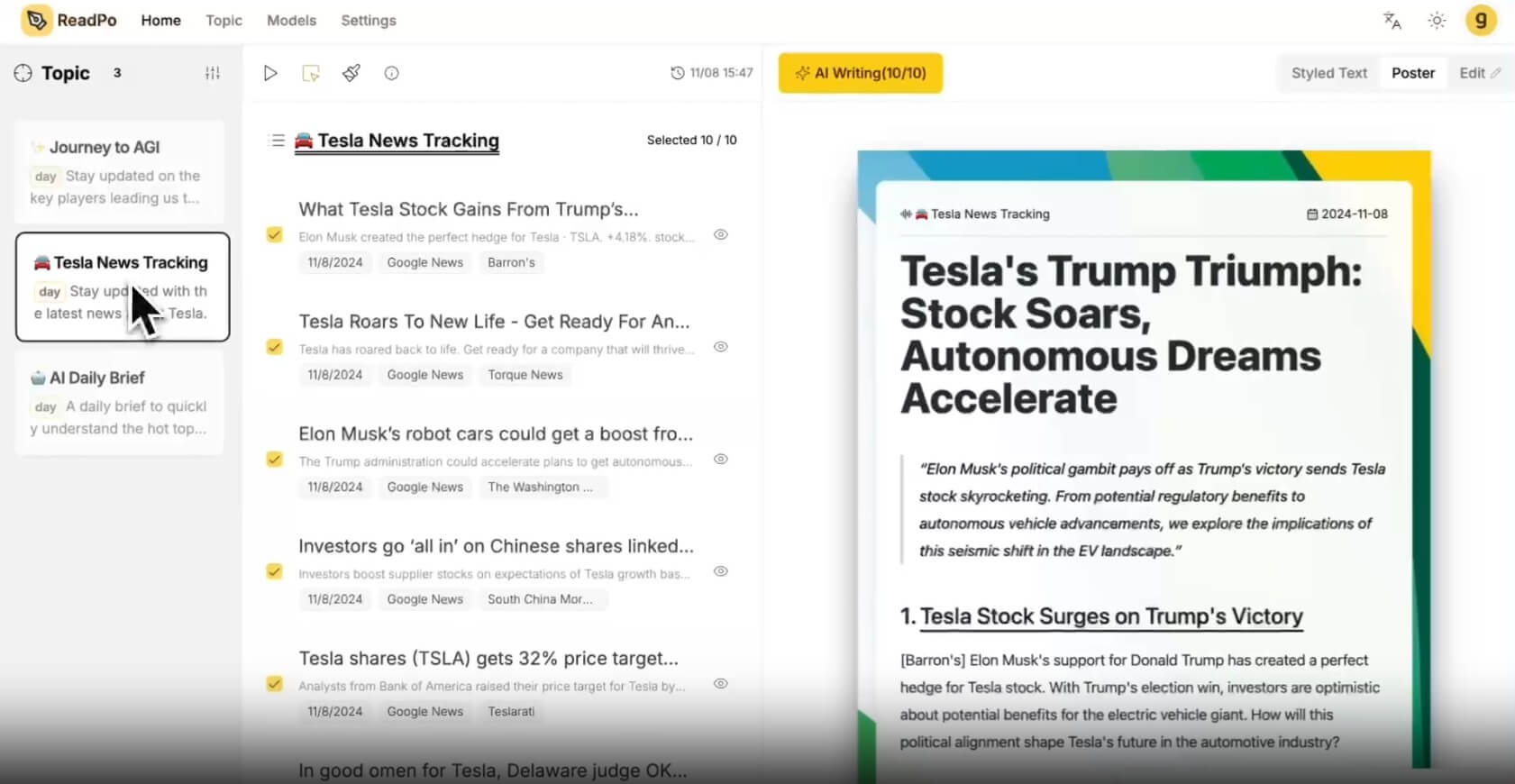
ReadPo’s writing quality will likely depend on the quality of the collected sources and the user’s editing standards. That is true for most research-assisted writing tools, but it matters more here because ReadPo’s promise is tied to synthesis.
The good part is that source-based writing gives users a stronger starting point than a generic AI draft. If the tool has better input, the article has a better chance of being specific. The risk is that the output can still sound too compressed or too summary-like if the user does not add judgment, examples, and editorial framing.
The custom prompt support is important here. It lets users shape tone, format, and article type instead of relying only on fixed writing modes. ReadPo’s public Early Bird announcement specifically notes custom prompt support alongside its built-in summary and writing AIs.
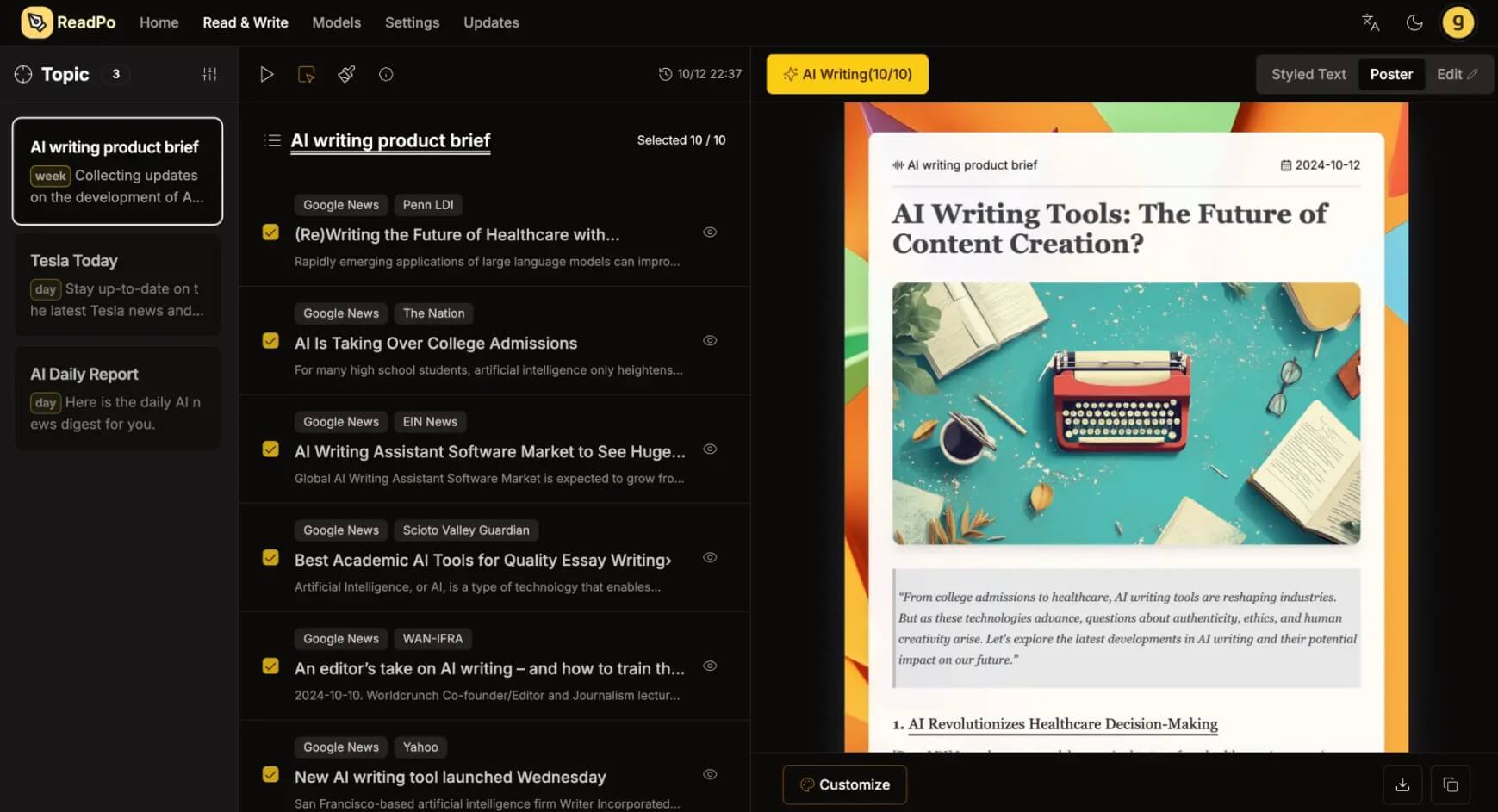
- ReadPo is a strong fit for newsletter operators who need to scan a topic, pull useful links, and turn them into a digest.
- It is also useful for bloggers who publish explainers based on current information, especially when the first challenge is sorting through many sources.
- Researchers and students may also find value in the reading layer, though they should treat ReadPo as an assistant, not a citation authority. The tool can help organize and summarize, but academic or high-stakes work still needs source checking.
- For marketers, ReadPo is useful for turning industry updates into thought leadership drafts, LinkedIn-style summaries, blog outlines, and quick visual posts.
- The poster tool makes the platform more appealing for content repurposing, especially when the same research needs to become both an article and a social graphic.
- Start with narrow topics: “AI tools” is too broad. “AI voice agents for customer support this week” is much better.
- Review the source set before writing: The output will only be as good as the material selected.
- Use ReadPo for first drafts and structured summaries: Then add your own point of view. The tool can help with speed, but the final content still needs editorial taste.
- For posters, keep the Markdown short: The poster workflow is better for compact ideas, not dense essays.
- ReadPo is not the best choice for pure long-form creative writing: It is more useful when the writing depends on gathered information.
- It also should not be treated as a fully automated publishing system: AI filtering and summarization can save time, but users still need to verify important claims, check source quality, and edit for voice.
- The visual poster tool is useful, but it is not a full design platform: It works best for simple information graphics, quote-style posts, and clean Markdown-based layouts.
- The biggest trade-off is focus: ReadPo is built around reading-to-writing workflows. That makes it valuable for content curation, but less flexible than a general AI workspace for coding, chat, file analysis, or broad creative generation.
ReadPo is best for knowledge creators who need to turn a steady stream of online information into useful written and visual content.
Its strongest value is the full path from collection to filtering to synthesis to output, not just AI drafting.
The main caveat is that it still needs a careful editor. Use it to speed up research and first drafts, but keep human judgment in charge of the final piece.
TAGS: Research Content Creation
Related Tools:

Offers multitrack video and audio editing

Automates content creation for social media

Professional video editor with advanced color grading

Automates literature review process
Simplifies data visualization and interaction

Provides advanced tools for professional-grade video editing