

Share this tool:
 |
Description:
RAFA AI is an investment AI platform built around specialized agents rather than one general financial chatbot. RAFA’s tools cover portfolio analysis, market research, risk monitoring, trading signals, and investment questions. RAFA PRO extends the same agent-based idea into wealth-management firms, where AI can handle parts of compliance, portfolio intelligence, research, and client operations.
That distinction matters. RAFA isn't just a place to ask an AI what it thinks about a stock. Its stronger use case is continuous financial analysis, where different agents monitor information and surface findings that would otherwise require moving between research sites, portfolio trackers, news feeds, and analytics tools.
RAFA structures much of the experience around AI agents with different financial jobs. On the investor side, these agents can help with portfolio management and data-driven trading analysis. Users can ask about individual securities, request trading strategies, or work with portfolio-level questions.
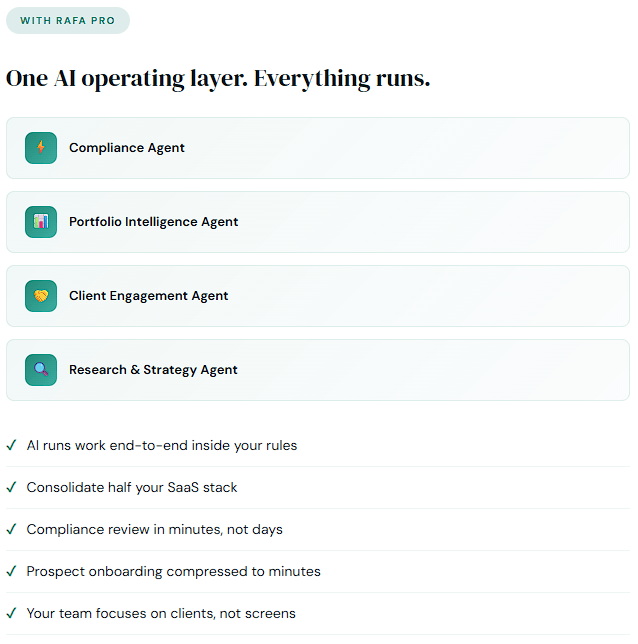
RAFA PRO takes the concept further for professional wealth-management workflows. Its current agent lineup includes a Compliance Agent, Portfolio Intelligence Agent, Client Engagement Agent, and Research & Strategy Agent. The aim is to automate multi-step work inside rules set by the firm rather than add another isolated assistant to the software stack.
This is a more useful way to think about RAFA than treating it as another AI search box. The platform is designed around assigning different financial tasks to specialized systems.
RAFA's portfolio dashboard combines standard investment tracking with AI-generated analysis.
Once a portfolio is created or an external investment account is linked, users can see holdings, portfolio value, profit and loss, and alerts. The platform also generates a portfolio report covering strengths, weaknesses, and possible areas for improvement.
More detailed metrics include Sharpe ratio, volatility, compound annual growth rate, income, and drawdown. A risk/reward view plots positions according to return and volatility, making it easier to identify assets that behave differently from the rest of the portfolio.
This makes RAFA more useful for investors who want context around their holdings, not just a dashboard showing whether today's numbers are green or red.
Another important part of RAFA is proactive monitoring.
The platform can flag portfolio events and potential risks rather than requiring the user to repeatedly check each holding. Its portfolio tools highlight relevant market or company events, while hedge alerts are designed to draw attention to risks that may warrant closer examination.
RAFA also offers features including AI Sentinel, Volatility Shield, Alpha Edge, Options Pulse, and Smart Folio. These cover areas such as portfolio monitoring, potential hedging opportunities, unusual options activity, market opportunities, and dynamic portfolio construction.
For active investors, this monitoring layer may be more valuable than asking occasional questions. It changes the workflow from manually searching for developments to reviewing issues that the system has already surfaced.
RAFA also functions as an idea-generation and research platform. Its stock dashboard combines market information with AI-generated investment ideas, portfolio alerts, market reports, and research tools.
Users can search stocks, ETFs, funds, and cryptocurrencies, while RAFA's ranked asset lists provide another way to discover securities for further research. The platform's own guidance makes an important point here: these rankings are intended as inputs for analysis rather than substitutes for the investor's own research and judgment.
That distinction matters because AI-generated signals can make complicated market information easier to scan, but they cannot remove market uncertainty.
RAFA becomes more personalized when investment accounts are connected. It supports linking brokerage accounts and cryptocurrency exchanges, while manual portfolios are available for assets that aren't connected directly.
Once holdings are available, the system can analyze the investor's portfolio rather than giving only generic market commentary. This enables portfolio-specific alerts, performance analysis, risk metrics, and questions about existing positions.
| User | Where RAFA Fits |
|---|---|
| Individual investors | Portfolio monitoring and AI-assisted research |
| Active traders | Market signals, technical analysis, options activity, and alerts |
| Portfolio-focused investors | Risk metrics, holdings analysis, and portfolio reports |
| Crypto investors | Monitoring connected crypto holdings alongside other assets |
| Wealth advisors | Research, portfolio intelligence, and client workflows |
| Advisory firms | Automating compliance and operational processes with specialized agents |
RAFA packs many financial tools into one environment, but that creates a learning curve. Investors who only want a basic portfolio tracker may not need agents, hedge alerts, options analysis, rankings, and advanced risk metrics.
There is also a more important limitation: AI analysis should not be treated as certainty. Signals, forecasts, portfolio observations, and trading ideas depend on data and analytical models that can be incomplete or wrong. RAFA itself states that its services are for educational, research, and informational purposes, and that it isn't a broker-dealer or investment adviser.
Professional users should also distinguish between RAFA's investor tools and RAFA PRO. The latter is positioned as a broader AI operating layer for wealth-management firms and involves workflow configuration, integrations, compliance rules, and deployment rather than a straightforward self-service investing app.
RAFA AI is strongest when used as an investment intelligence layer rather than a simple financial chatbot. Its combination of specialized agents, portfolio analytics, alerts, research, risk metrics, and connected-account analysis gives investors several ways to examine what is happening in their portfolios and markets.
RAFA PRO broadens that idea for wealth-management firms by applying agents to research, compliance, portfolio intelligence, and client operations.
The main caveat is the nature of the subject itself. AI can organize financial information, monitor signals, and speed up research, but it cannot remove investment risk or make its conclusions certain. RAFA makes the most sense for users who want AI to support their analysis while keeping the final investment decisions in human hands.
TAGS: Finance
Related Tools:
Streamlines workflow and project management

Facilitates task management and time tracking

Simplifies financial analysis

Automates invoice processing, organization, and financial insights

Provides real-time market insights

Assists in connecting with investors