

Share this tool:
 |
Description:
Finalle AI is a financial intelligence platform for tracking market news, AI-generated stock events, ticker briefs, and industry-level summaries. Its clearest value is speed: it helps users move from scattered market updates to structured context faster. The product is not a full investing terminal, and it should not be treated as a trade recommendation engine. It is best understood as a market-event and briefing layer that can support research, dashboards, watchlists, and investor workflows.
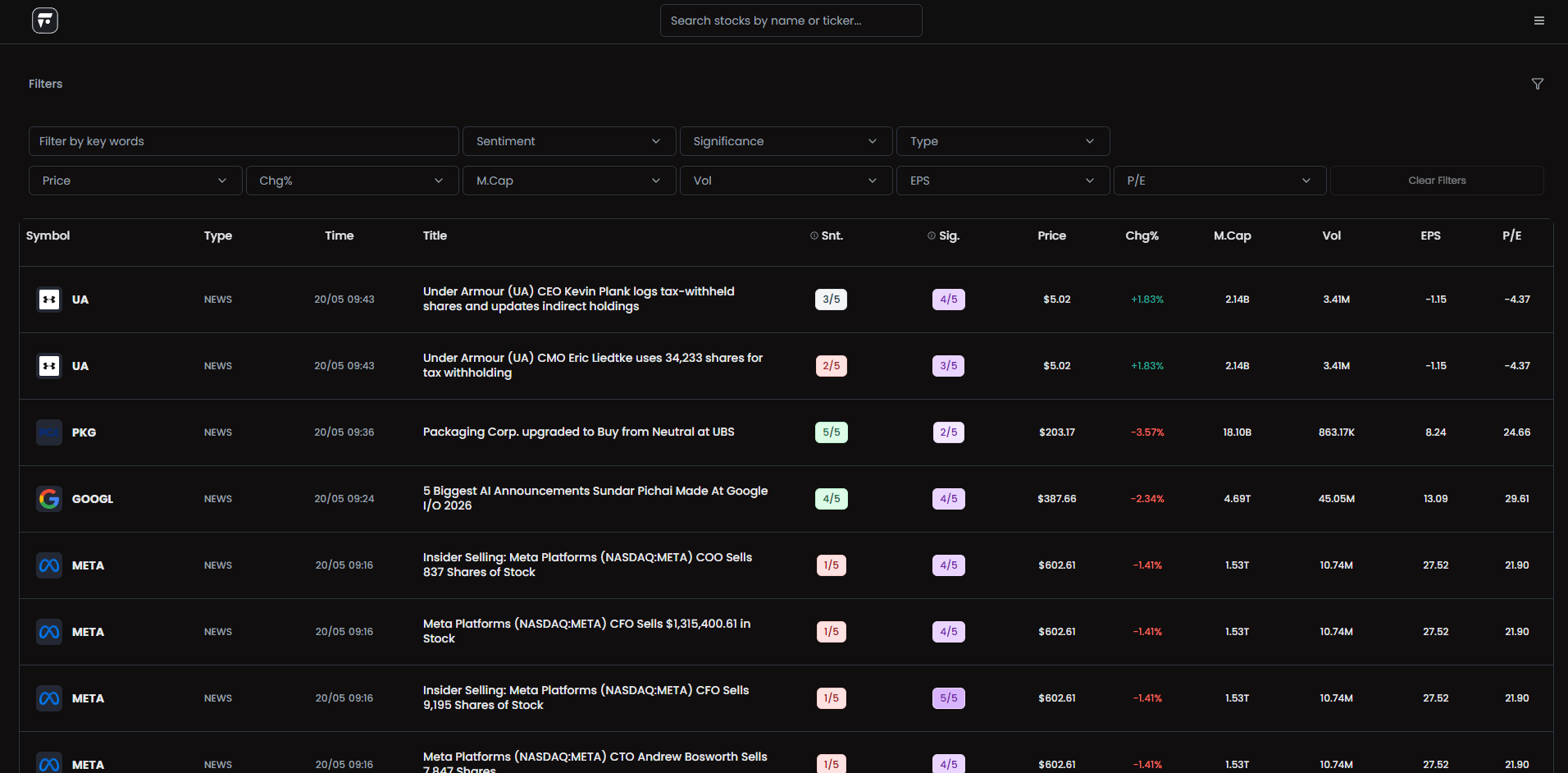
Finalle AI’s public API docs describe a REST API for querying the latest market events from US stock exchanges and receiving real-time portfolio and industry briefs. The API uses a standard base URL, authenticates with an X-API-Key header, and returns JSON responses with result, data, and request_id fields. That tells you a lot about the product: Finalle is not only a web interface for reading market news. It is also built to feed structured market intelligence into other tools.
The current documented product surface is organized around four main endpoints: News, Events, Symbols Brief, and Industry Brief. News is the rawer feed. Events is the more AI-processed layer. Symbols Brief turns selected tickers into short summaries. Industry Brief generates a summary for a supported sector. Together, those pieces make Finalle feel more like a financial signal infrastructure tool than a traditional news reader.
The main thing to know is that Finalle AI is strongest when the user already has a research process. It can help surface what changed, summarize recent events, and organize market information by ticker or sector. It does not remove the need to verify sources, understand valuation, compare fundamentals, or manage risk.
Finalle’s News endpoint retrieves a descending feed of financial news and can filter by up to 10 symbols, with fields such as symbol, timestamp, URL, title, text, author, and publisher image.
The Events endpoint turns market information into structured event objects with review text, sentiment, significance, category, sector, related sources, and event detection timing.
The Symbols Brief endpoint generates AI summaries for selected tickers, supporting up to 20 symbols and periods such as daily, 12-hour, and weekly.
The Industry Brief endpoint generates a summary for a supported industry such as technology, healthcare, energy, financial, utilities, real estate, or basic materials.
Finalle exposes its data through REST endpoints with JSON responses, request IDs, and common HTTP error handling.
Event responses can include related source objects, giving users a path back from the AI-generated event to the underlying articles or resources.
Finalle AI is most useful for reducing market noise. A regular investor can open a news feed and drown in headlines. A developer can connect to a financial news API and still need to classify, filter, summarize, and rank everything. Finalle tries to sit in the middle: pull in market information, associate it with symbols, summarize it into events or briefs, and expose it through an API-friendly format.
The Events endpoint is the most important part of that workflow. It returns AI-generated financial events along with related resources, sorted by timestamp. Each event can include an event review, sentiment score, significance score, main symbol, stock price at event detection time, event title, related sources, category, sector, and last update timestamp. That gives users more structure than a headline list.
That structure matters because financial news is rarely useful without context. A legal update, analyst note, product launch, earnings item, partnership, insider-trading disclosure, or dividend announcement can mean different things depending on the stock, sector, timing, and market mood. Finalle’s category and significance fields give users a first-pass way to sort what deserves attention.
Finalle AI is strongest for investors and builders who care about current market context but do not want to assemble the full pipeline themselves. The product is useful when you need to pull market news, summarize events, filter by symbol, compare recent activity across a watchlist, or create an automated brief inside another workflow.
For nontechnical users, the most valuable part is the brief format. A ticker summary is easier to digest than a long feed of article cards. If you follow several stocks, you can use briefs to decide where to spend attention first. This is not deep equity research, but it is a useful front door into research.
For developers, the API is the stronger reason to care. A structured JSON feed is easier to plug into dashboards, internal tools, alerts, Slack-style updates, notebooks, or AI agents. The request and response format is clear enough to build around, and the documented endpoints cover the most common market-intelligence needs: news, events, ticker briefs, and industry summaries.
For analysts, the useful part is event structure. The event record includes fields that are worth saving: event ID, symbol, timestamp, last update timestamp, event-time price, category, sector, sentiment, significance, review, and related sources. Those fields are helpful if you want to compare what happened, when the event appeared, and how the stock moved later.
The Events endpoint is the most review-worthy part of Finalle AI because it adds interpretation. Raw news is easier to provide. Event summaries require the system to decide what an article means, which symbol it belongs to, how important it is, and what category it fits into. Finalle’s docs list categories such as earnings, analyst review, product update, mergers and acquisitions, insider trading, partnerships, financials, trading, legal, exceptional incident, dividend, investor sentiment, personnel, and other.
That category list is practical. It maps well to the types of events investors already track. A dividend update and a legal issue should not sit in the same mental bucket. A product update and an analyst review also require different follow-up. Finalle’s categories help separate those cases early.
The sentiment and significance scores are useful, but they need restraint. A sentiment score can describe the tone or likely direction of the event, and a significance score can help sort urgency. Neither one tells you whether a stock is underpriced, whether the market has reacted enough, or whether the event changes the long-term thesis. This is where users need to stay disciplined. Finalle helps structure the signal. It does not finish the investment decision.
The related-sources field is important here. If an event summary looks important, the next step should be reading or at least checking the underlying sources. This matters more in finance than in many other AI categories because the cost of acting on a bad summary can be high.
Finalle works well when you want a quick read on a group of stocks. Use Symbols Brief for a compact summary, then open the underlying events or sources for anything that looks material.
The Events endpoint gives developers a clean way to populate dashboards with event titles, reviews, significance, sentiment, categories, sectors, and related sources.
A daily or 12-hour ticker brief can help users check what changed without scanning every article manually. This is especially useful for active watchlists where the question is “What do I need to know right now?”
Industry Brief is useful when you want a fast summary of what is happening across technology, healthcare, energy, financials, utilities, real estate, or another supported sector.
Finalle’s structured JSON format makes it a useful input for AI agents that need current market context before writing a memo, preparing an alert, or comparing recent catalysts.
Because events can include categories, sentiment, significance, timestamps, and related sources, they can support follow-up systems that flag legal events, earnings items, analyst reviews, or product updates for deeper review.
| Compared with | Where Finalle AI is stronger | Where it may be weaker |
|---|---|---|
| Standard news sites | More structured ticker and event summaries | Less suited to long editorial reading |
| Basic finance dashboards | Better AI-generated event context | May not replace charts, fundamentals, or portfolio tools |
| General AI chatbots | More direct access to market-event feeds through an API | Less flexible for broad reasoning outside finance |
| Full market-data platforms | Easier to use for news-to-brief workflows | Not a full replacement for deep financial datasets |
| Manual watchlist spreadsheets | Faster summaries and event sorting | Still needs human verification and context |
The best comparison is not “Finalle versus a Bloomberg-style terminal.” That would be the wrong bar. The better question is whether Finalle can reduce the time between market news and useful context. On that job, its documented endpoints make sense.
- Start with Symbols Brief before building anything more complex. It is the easiest way to see whether Finalle’s summaries match the kind of market context you care about. The endpoint supports multiple symbols and period options, which makes it a practical first test for watchlists.
- Use Events for higher-signal monitoring. Raw news is useful, but the Events endpoint adds category, sentiment, significance, sector, and related-source context. That is the better layer for alerts and dashboards.
- Set a significance threshold when you need less noise. Finalle’s Events endpoint includes a significancy filter from 1 to 10, which lets users return only events at or above a chosen threshold. That is useful for workflows where too many minor updates would dilute attention.
- Keep the original source in the workflow. If an event looks important, check the related sources before acting on it. AI summaries are helpful for triage, but they are not a substitute for reading key source material.
- Use Industry Brief for context before single-stock review. A company headline can look different when the whole sector is moving. Sector summaries help avoid reading every stock event in isolation.
- Store request IDs and timestamps in production workflows. Finalle’s responses include request_id, and event records include timestamps. Keeping those fields makes debugging, logging, and later review much easier.
The first limitation is category fit. Finalle AI is a market-intelligence and briefing tool, not a full investment research stack. It does not replace earnings models, financial statements, valuation work, risk controls, tax planning, or portfolio construction.
The second limitation is coverage scope. The official API docs describe querying market events from US stock exchanges. Users who need global equities, crypto, fixed income, private markets, or niche asset classes should verify coverage before building around it.
The third limitation is query scale. The News and Events endpoints document a maximum of 10 symbols per symbol-filtered query, while Symbols Brief supports up to 20 tickers. That is enough for focused watchlists, but not ideal if you want one simple call for hundreds of names.
The fourth limitation is interpretation risk. Sentiment and significance scoring are useful, but markets often move for reasons that a summary cannot fully capture. A negative legal event may already be priced in. A positive analyst note may be less important than guidance, margins, liquidity, or macro pressure. The score is a starting point, not a decision.
The fifth limitation is interface clarity from the outside. The API documentation is concrete, but the public web product is harder to evaluate from documentation alone. Based on public sources, the strongest verified details are the API and briefing endpoints. Users should test the live web experience before relying on it as their main market dashboard.
Finally, finance is a high-stakes category. Finalle can help organize information, but users still need a verification process. The safest workflow is: use Finalle to surface and summarize, check the source, compare with other data, then decide.
Finalle AI is best for investors, analysts, and developers who want faster market context from news, stock events, ticker briefs, and industry summaries. Its strongest layer is the structured Events feed, supported by real-time News, Symbols Brief, Industry Brief, and a clean REST API.
The main caveat is that Finalle should sit at the front of a research process, not at the end of one. It can help you see what changed faster, but it does not replace the work of verifying the source, understanding the business, and judging whether the event matters enough to act on.
TAGS: Finance
Related Tools:

Simplifies task management

Automates bookkeeping and financial processes,

Provides real-time insights for stock and crypto

Automates financial record-keeping and expense management

Optimizes small business operations

Enables teams to plan, track, and manage their work