

Share this tool:
 |
Description:
Copy.ai used to be easiest to describe as an AI writing assistant. That is no longer the most accurate way to think about it. The current product is positioned as a GTM AI platform for sales, marketing, and operations teams that want to automate repetitive work, unify data, and turn best practices into repeatable workflows. That shift matters, because it changes both who the tool is for and what kind of value you should expect from it.
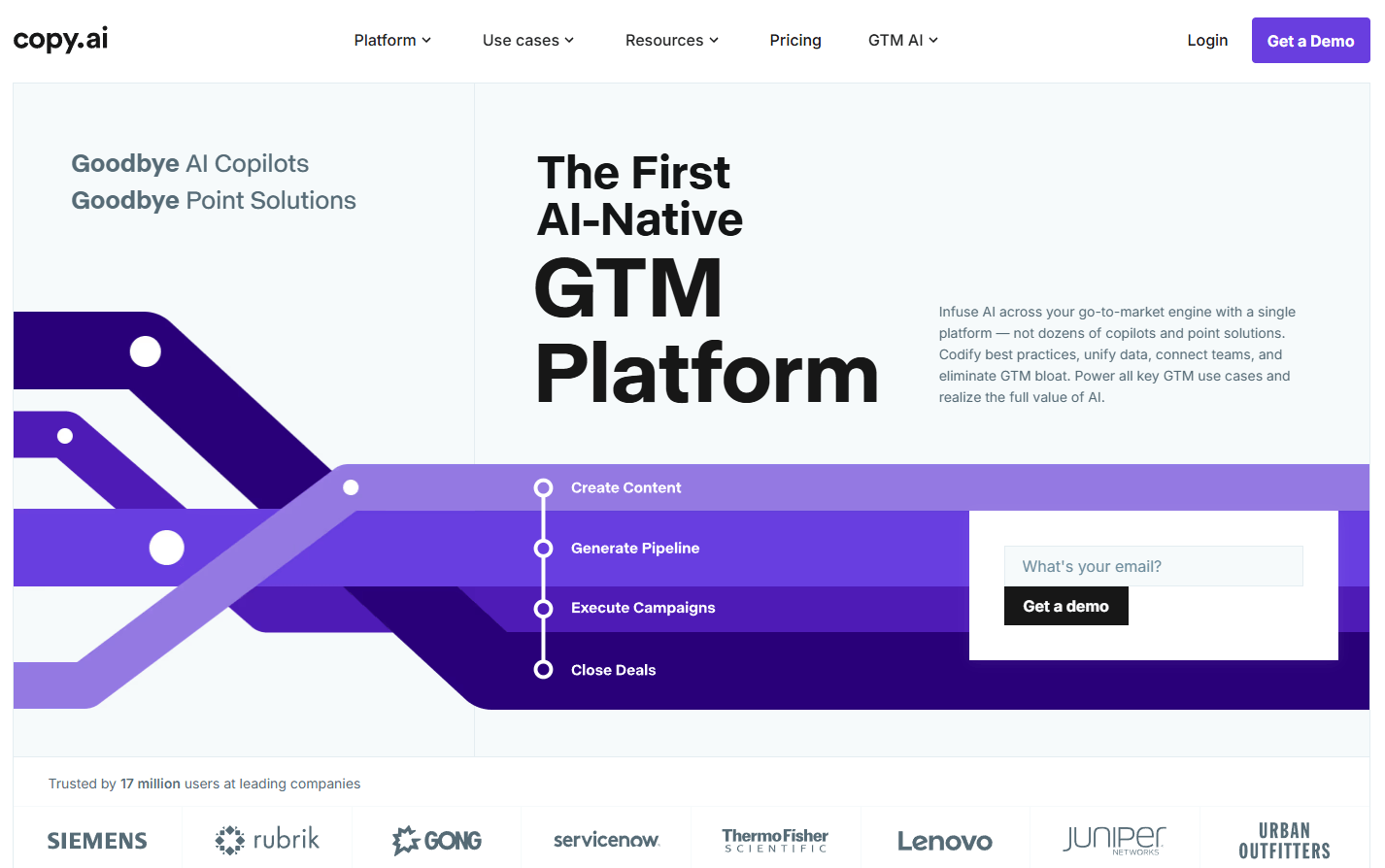
The easiest way to understand Copy.ai today is to break it into two layers.
The first layer is still the familiar one: chat, content generation, brand voice, and quick writing help. That part remains useful, and the company still offers chat, free tools, and writing-oriented surfaces. But that is no longer the center of gravity.
The second layer is the more important one: workflow automation for go-to-market teams. Copy.ai’s platform centers on Workflows, Actions, Agents, Tables, Infobase, Brand Voice, and Chat. The company frames this as a way to replace disconnected copilots and point solutions with one system that can codify processes, connect systems, and automate real GTM work across teams.
That means Copy.ai now sits in a different category from simple AI writers. It is closer to a sales-and-marketing automation layer with AI generation built in than to a blank-page writing app. If you mainly want occasional blog help, Copy.ai may feel heavier than you need. If you want prospect research, CRM enrichment, inbound lead routing, account-based marketing support, translation, and repeatable content operations in one place, the product makes much more sense. This is an inference from how the platform is currently structured and marketed.
Multi-step AI processes that combine research, generation, integrations, and business logic into repeatable GTM plays.
Modular building blocks that package AI capabilities and best practices so non-technical teams can use them without deep prompt engineering.
Constrained agents that make targeted micro-decisions inside workflows while operating within guardrails.
A centralized data layer for structured and unstructured GTM information that can trigger workflows and support personalization at scale.
Shared company knowledge and tone controls that help generated outputs stay accurate and on-brand across teams and audiences.
Copy.ai says self-serve chat gives access to OpenAI, Anthropic, and Gemini models, while the homepage also presents the broader platform as model-agnostic.
Copy.ai is strongest when the problem is not “write me one thing,” but “turn this recurring GTM job into a reliable system.” That could mean researching accounts, drafting tailored outreach, enriching inbound leads, building ABM assets, localizing content, or pulling together data from several sources and using it to generate personalized outputs at scale. The official use-case pages and platform overview consistently emphasize those workflow-heavy jobs.
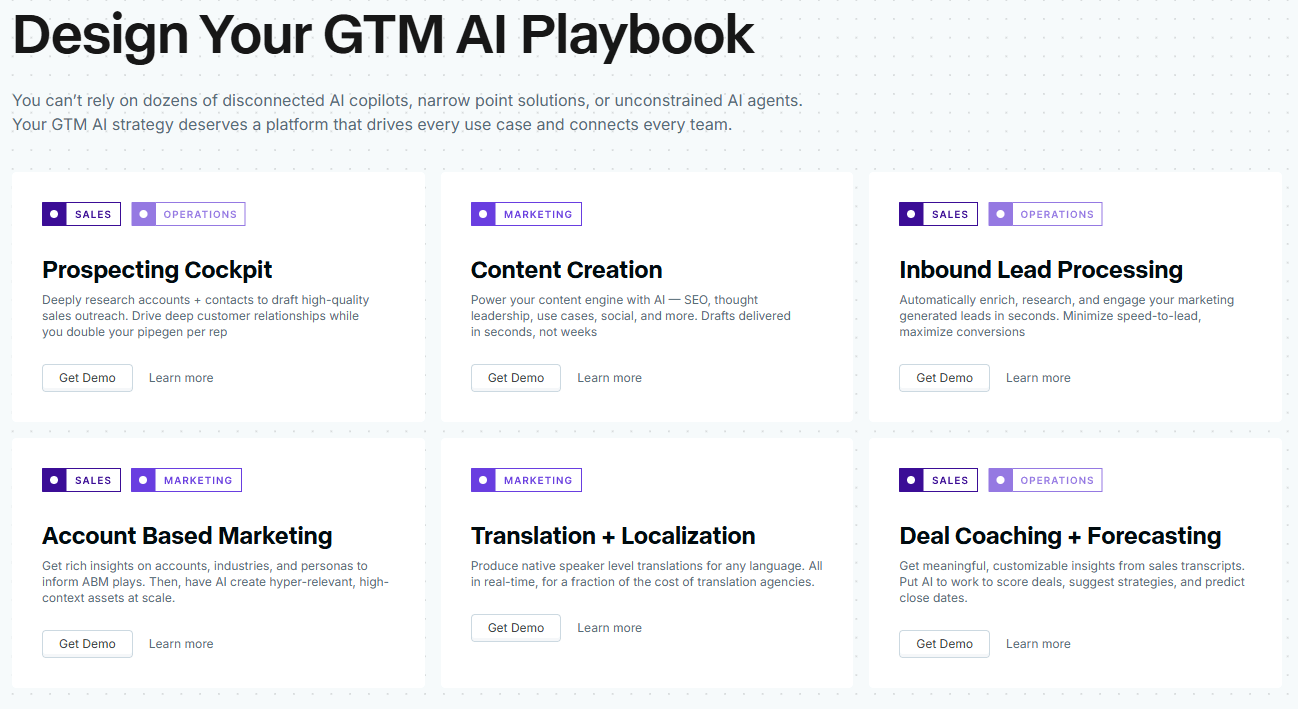
A good example is prospecting. Copy.ai’s platform highlights a Prospecting Cockpit that researches accounts and contacts, drafts sales outreach, and supports relationship-building at scale. Another example is inbound lead processing, where the platform is positioned to enrich, research, and engage leads quickly. Those are not just writing tasks. They are multi-step operational tasks.
That is the real theme of the product: operationalizing GTM work. If your team has repetitive, rules-based, high-context tasks that live between data, messaging, and systems, Copy.ai is much more interesting than it looks from its older brand reputation.
| Layer | What it does | Why it matters |
|---|---|---|
| Chat | One-off generation and quick tasks | Good for fast drafting, ideation, rewrites, and ad hoc help |
| Brand Voice | Encodes tone and style | Helps keep outputs usable across teams instead of sounding generic |
| Infobase | Central repository of company knowledge | Improves context quality and reduces hallucinated brand details |
| Tables | Queryable GTM data foundation | Makes workflows more operational and data-aware |
| Actions | Reusable AI building blocks | Lets non-technical teams assemble complex automations |
| Workflows | End-to-end process automation | This is the main reason to use Copy.ai seriously |
| Copy Agents | Guardrailed AI decision-making in workflows | Useful when a task needs some autonomy without going fully open-ended |
This layered structure is also why Copy.ai can feel either simple or advanced depending on how you use it. A solo marketer can stay mostly in chat. A RevOps or demand-gen team can treat it as an automation platform.
Copy.ai’s core usability advantage is that it tries to hide a lot of AI complexity behind business-facing components. “Actions” are meant to package prompting and model selection into reusable blocks, and workflows are described as no-code or low-code sequences that combine those blocks with data and integrations. In practice, that is a much more approachable setup for business teams than building everything from scratch in a generic automation tool.
The trade-off is that Copy.ai is not the lightest tool in its category anymore. If you only need quick copy generation, the platform’s larger GTM framing can feel like overkill. The learning curve rises once you move into workflows, tables, credits, and system-level use cases. The product becomes more powerful as your use case becomes more repeatable and cross-functional, but it also becomes less instantly casual. That is an inference based on the breadth of the platform and plan structure.
For teams that do have those repeatable use cases, the workflow design is where the product starts to justify itself. The platform is clearly built around standard GTM motions rather than around generic “ask anything” AI use.
On plain writing quality alone, Copy.ai is good but no longer uniquely differentiated. Plenty of tools can draft email, blogs, ads, and social posts. Copy.ai’s stronger advantage is context control: Brand Voice, Infobase, and the broader workflow architecture make it easier to produce writing that is connected to your business rather than floating free of it.
That matters more in business settings than raw eloquence. A slightly less flashy draft that actually reflects your brand, product details, ICP, and process can be more useful than a prettier generic draft.
Copy.ai also appears to lean hard into structured GTM outputs such as prospect research, account planning, lead routing, localization, and operational handoffs. That focus makes it more credible for revenue teams than broad AI writers that still live mostly in the content-marketing lane.
The current self-serve and enterprise structure is more substantial than many people expect.
| Plan | Best for | Public pricing |
|---|---|---|
| Chat | Small teams mainly using AI chat and projects | $29/month monthly or $24/month billed annually |
| Growth | Businesses moving into workflow usage | $1,000/month billed annually, includes 20K workflow credits/month |
| Expansion | Larger enterprises expanding AI automations | $2,000/month billed annually, includes 45K workflow credits/month |
| Scale | Organizations deploying generative AI more broadly | $3,000/month billed annually, includes 75K workflow credits/month |
| Enterprise | Custom deployments with implementation and security needs | Custom pricing |
The public pricing page also lists enterprise features such as guided jumpstart implementation, API access and bulk workflow runs, 20+ tech integrations, unlimited customizable workflows, designated support, and enterprise-grade security protocols.
This pricing tells you two things. First, Copy.ai still has an accessible entry point for chat use. Second, the serious product is not priced like a casual AI writer. Once you move into workflow automation, this becomes a budgeted business platform, not a hobby subscription.
Copy.ai is a strong fit for B2B sales teams that want prospecting and outbound support tied to richer account context. It is also a good fit for marketing teams that need high-volume content, localization, ABM assets, and tighter brand consistency across channels. RevOps teams should pay special attention, because the platform’s strongest framing is around unifying data, reducing GTM bloat, and automating operational steps that usually live across multiple tools.
It is less compelling for people who just want a cheap AI writer, a research chatbot, or a general-purpose assistant for life and work. Copy.ai can do some of that, but the product is clearly optimized for revenue-facing business workflows.
- Start with one repeatable process, not ten. Copy.ai is easiest to justify when you automate one painful workflow end to end, such as inbound lead processing, territory assignment, or account research. The platform’s own recent materials lean toward exactly those concrete GTM flows.
- Build Infobase and Brand Voice earlier than you think. Those two layers are what help the system move from generic output to business-usable output.
- Use chat for fast drafting, but do not judge the whole product by chat alone. The deeper value is in workflows, tables, and integrations, not just in whether one paragraph sounds nice.
- Check the workflow-credit economics before scaling. The pricing model makes workflow usage a real planning variable, especially above the chat-only tier.
- The biggest trade-off is category confusion. Copy.ai still carries the legacy reputation of an AI writing tool, but the current platform is much broader. That can create mismatched expectations. Someone coming in for blog help may find it oversized, while a GTM team may overlook it because they assume it is “just copywriting AI.” This is an inference based on the gap between the brand’s older market perception and the current platform messaging.
- There is also a complexity trade-off. The more you move into workflows, agents, data foundations, and integrations, the more implementation thinking is required. Copy.ai tries to reduce that with packaged actions and guided onboarding, but it is still a business system, not just a writing app.
- Finally, pricing climbs fast once you want meaningful automation. The self-serve chat tier is approachable, but the platform’s serious workflow value lives in plans that are aimed at teams with budget and operational intent.
Copy.ai is no longer most interesting as an AI copywriter. Its strongest identity now is as a GTM AI platform for sales, marketing, and operations teams that want to turn repetitive revenue work into repeatable systems.
It is best for organizations with real workflows to automate, real brand context to preserve, and real systems to connect.
The main caveat is that it becomes most valuable only when you use it as a platform, not just as a chatbot.
TAGS: Copywriting Content Creation
Related Tools:

Enhances writing process

Generates various type of content
Pproduce engaging videos using customizable templates

Finds keywords and create SEO-optimized content

Simplifies the creation of professional-quality video

Offers screen recording and video editing features